Wednesday, October 18, 2006

BoJ v. DIC: Who's Got the Hot Hand?

Mizuho Securities reported in their latest 4th quarter strategy summary that Japanese public entities (The BoJ, the DIC, and the BPSC) held roughly YEN 7 trillion (nearly USD$65 billion) of listed stock.

Interestingly, the DIC (Deposit Insurance Corp) held on a cost basis YEN1,795 Billions primarily "acquired" from the less-than-illustrious though once-mightly NCB & LTCB, the former who was one of the largest writers of Put Options on the Nikkei 225 at the Pinnacle of the Bubble. Likewise, the BOJ bought YEN 1,974 billions of stock at cost from it's accumulated interventions and market pecadilloes. The DIC, as of Sept book closing was showing a market value of YEN 1,780 billions - for a loss of YEN 15 billions which is rather surprising given the breadth and depth of the bull market over the past four years. The BoJ, by contrast, shows a market value of their acquired holdings (basis the same Sept book closing) of YEN 3,565 billions - netting them a cool YEN 1,591 billions (USD$18 billion) of profit for the People of Japan, who with a >6% of GDP fiscal are in need of additional revenues, whatever their source.

All which leads one to ask the burning question: what is their secret? Who is their hot-hand? To be fair, the BoJ acquired most of their stock at the pitiful depths of bear despair in 2002 whereas the DIC acquired theirs in the mini, but narrow bull of FY 2000. Moreover, it is likely that both LTCB and NCB - both lacking long historical Keiretsu's - ending up with little less than poodle-shit in their portfolio, something the DIC must eat as lender (and apparently buyer) of last resort. Yet it is worth fathoming just HOW BAD their stock selection must have been to effectively make no mark-to-market money whatsoever during the past 4-year bull market which has been of a breadth and scale not seen since the 1980's - more than two and a half decades now-passed.

Charlie's War & Yen Market Shenanigans

I just finished reading "Charlie Wilson's War" about the enigmatic Texas Congressman's championing and funding of the Afghan Mujahaddin's fight vs. The Soviets in Afghanistan during the 1980s. Some even go so far as to extend to Congressman Wilson the honor and credit of single-handedly being responsible for the destruction of the Soviet Empire. Eye-popping stuff, indeed. But much of the sordid details are not entirely unexpected for the slightly cynical. Grand conspiracy? No. But nonetheless, what one learns is that whatever was rumoured to have happened, or whatever deeds the CIA was alledged to have been undertaken, or whatever horse-trading one might insinuate to have been responsible for the legislation, money and events that followed was not only true, but more colourful and entertaining than anything a conspiracy theororist might have imagined in their wildest fanatsies.

Which brings me to the subject of the Japanese Yen and deflation. Here your faithful seer and prognosticator, "Cassandra", has been brutalized by the neo-mercantilist apologists for Japanese & Chinese fiscal, monetary and international economic policies that have - at leastly partly - perpetuated and exacerbated global imbalances. First hog-tied by a mysterious, arrogant and dismissive Asian economist (perhaps one who himself works for the Chinese government or such) followed by a pummelling from an official at a Japanese lobbying organizations active in advocating Japanese Policy to foreign governments, all for having the audacity to suggest that Japanese deflation has been whipped and is (and has been for a little while) a problem no longer, and that we find ourselves in our current predicament of "sticky", non-correcting exchange-rates, not as the result of happenstance, serendipity or for that matter, benign neglect, but as a result of conscious policy action in both China and Japan.

Seething dismissive derision was the resulting response. "Deflation is evil and causes AIDs, not to mention Nuclear Proliferation!", he chimed. "No one can live with it!". "Everyone will suffocate". And therefore, "No economist can understand what your suggesting!". His partner took over: "Conspiracy theorist!" "Prove it", he taunted, as he went on to explain that rather than being a conspiracy of the type our Cassandra suggested, it was actually the result of a different domestic policy conspiracy of the type he favored, one in whihc the Japanese Yen was simply innocent road-kill on highway of pacifying the farmers. All I suggested was that there were plenty of good reasons to believe that many prices in Japan should have fallen, and for that matter, still be falling. And that combatting this fall with ZIRP-tastic monetary policy was not only difficult, and unwise, but terribly uncivic-minded as far as the international monetary system goes. About as useful as putting out a candle with a high-pressure fire hose.

All which brings me back to the CIA. And Oliver North (remember him?), Charlie Wilson and Gust Avrakotos, the hero (of sorts) of the aforementioned Afghan story. You see, they did do all these things. Despite Jimmy Carter and the new moral foreign policy. The CIA did (and does) have fat balding paedophile-looking guys thinking about devious ways to blow-up our enemies, running proxy wars and destabilizing regimes just as the KGB was behind the Bulgarian assasination of their lliterary dissident in London with the funnny poison-tipped umbrella. And there were ideological wackos in the Pentagon thinking of ways to subvert Congress' will to NOT fund the Contra, by, yes, of all crazy schemes, supplying arms to anti-American Iranian mullahs (to fight Saddam who we were also supplying) in exchange for the Iranians giving money to the Contras. Silly as it sounds, people thought it was, at the time, sound and so it happened. Calmly and calculatingly, and stupidly.

In modernity, where "war" between advanced industrialized countries, and increasingly all nations, is often fought economically, financially, and in the realm of trade, it should come as little surprise that successful nations are doing everything possible to gain parochial advantage for their people and their corporations, through every means possible, including intervention in, and the resulting manipulation of, international money markets. And Japan is the King in this respect. After all, "PKO" (Price-Keeping Operations) only has meaning in Japan - something which saw government authorities indirectly and directly hoover-up many trillions of YEN of stock from all comers. Think Eisuke "Mr Yen" Sakikibara, who massacred dollar shorts and engineered an appreciation from the excruciating depreciation torture engineered by Secretary Rubin. So today, think of the double-talk of Tanigaki, lambasting the BoJ on every occasion for even hinting rates might rise. Or BoJ officials, even today, frantically denying stories they might be even gathering data on the potential size of the carry trade. "No! No! Absolutely Not!!!" "We have no idea, no such intention, and we do not care....."

Yeah, Right!

Friday, October 06, 2006

Change of Heart: Bring It On, Dude

I've changed my mind. In an epiphany (of sorts) overnight, I have dramatically shifted my mindset from one of "outrage" and "blame" regarding neo-mercantilists' self-serving treatment of the international monetary system to a "take charge"attitude of "Bring it on Dude - The More The Better". Let the Japanese and Chinese play their petty mercantilist games, but we too can play and win. They may have won this battle whereby they escaped with a sizable amount of America's manufacturing base, but looking forward with some skill, scheming, and Muhammad Ali rope-a-dope tactics, American can yet win the war.

Here is my plan: America should subsidize and encourage Disney, Dreamworks, etc. to dump as much Bambi, SpongeBob and "Friends" as well as Video games (e.g. Grand Theft Auto) upon China & Japan. Encourage their piracy for THEIR domestic markets - since the more distribution the better. The lamer, more hynotic and saccharine the plot, the more we should encourage its consumption. Next, we should subsidize and encourage the export of our world-class Processed Food. Oreos. potato chips, Nacho-flavored Bacon Bagels, Chocolate Chicken Nuggets, TV Dinners, BigGulp Sodas, Campbell Soup, Philly Cheese Steak Pizzas, and loads and loads of ice-cream. With fertility rates already low in Japan & China, and their darling little spolied children already over-indulged getting fat and lazy, hanging about in Yoyogi Park dressing like Elvis and slacking with computers & pop culture, we are already half there. Then we need to send them skateboards and snowboards. And perhaps AC/DC or The Scoropions, Kurt Cobain or something else rad to accompany it. Gen-X-J & Gen-X-C!! Brilliant, huh? Oh a couple of more things. We need to train lawyers for them. Lots and lots of lawyers. If we can get their lawyer-to-population ratio up to where we are in the USA, we can really throw a proverbial spanner in their works. And we should try to teach them the benefits of LObbying within government giving them the whole spiel on aggregation of interests and how it breeds efficiency. Maybe they'll bite. Finally, we must encourage the promulgation of CNBC China, and stealthily encourage E-Trade & all manner of on-line brokers to expand & grow in Asia. We could even send Maria Bartiromo over there and make trading "free". The combination of hypnotic pseudo-financial news and essentially "free" on-line gambling coupled together would be absolutely toxic and would grind work and efficiency to a slow halt since we know that both cultures are already inveterate gamblers. Together, these things, in the absence of government policy, will drive convergence on the Asian side.

But that's only half my plan, not to mention half the battle. Causing convergence on the eastern edge of the Pacific will be tricky, and for this we must use reverse psychology and counter-intuitive methods. The USA must encourage the Asians to continue to accumulate dollar reserves and make our dollar even stronger. We will at once both raise rates, and taxes upon the rich to ease our fiscal deficit. This will cause the dollar to soar and will be like putting one's balls into a vise and squeezing. The dead will awake from the excruciating cries of pain, but this time something different will emerge. Not the historical moaning and whinging about cheating and unfair competition, but a John Wayne-like gritty determination to figure out ways to compete and win. Whereas in the past companies simply up and left, moving to China, this time they'll stay and fight. Like in Iwo Jima. Or the beaches of Normandy. This time, like the Japanese and the Germans, capital will take a haircut on returns and invest in training, new and more efficient plant & equipment, while management takes across-the-board paycuts, especially at the executive levels. Labour too will work longer, harder, more efficiently discarding all remnant lines work demarcation that are vestiges of the UAW and labour struggles of the past. And most importantly, management, labour and capital will work together to figure a way to best their neo-mercantilist competition. The Federal government will also pitch-in. They'll unburden companies of their current and legacy pension and healthcare obligations, finally placing US companies on equal competitive footing with their European and Japanese counterparts, and taking a huge burden off of the day-to-day worries of labour, finally letting everyone focus on how to improve and get better, cut the fat, make production processes leaner and more intelligent, with less waste. They can also perfect the Japanese art of "our rice is different" and "your meat smells funny", or the Chinese skill in protecting "key" or nascent industries from competition, by resurrecting any number of non-tariff barriers, security checks and port-controls for Asian cargos to make sure there are no Zerba Mussels or Japanese Beetles aboard. Americans have historically been up to meeting a challenge. But the narcotic effect of affluence, unrequited indebtedness (and, yes, Taco Bell) have numbed our ability to respond to a such an important challenge. In fact they've even numbed our ability to know we're being called out!.

America can regain her competitive feistiness, but it will take pain. Not pain for the sake of masochistic pleasure, but pain for the sake of regaining our senses. How can one know pleasure if one doesn't feel pain? How can we overcome our parochial selfishness if we are not forced by circumstance to work together?? Ok besides meditation, is there a route? And in an increasingly hedonisitc world, this lack of ability to sense and react accordingly will be our undoing unless she can regain a sense team spirit, rejuvenate her ability to manufacture, innovate, and compete effectively, and collectively rise to the occasion.

Wednesday, October 04, 2006

Pirating, Buccaneering & Steeling

The news that Tom Hudson's Pirate Capital, and his aptly-named "Jolly Rogering Fund" were taking some heat last week was no surprise (to me). Hudson's operation runs what is professed to be an "activist" fund. This effectively entails buying a wodge of an albeit "cheap" or otherwise unloved stock, ramping the price as much as one can once one has bought the line. Then publicly professing one's [affection, admiration, recognition of value] for the [company, business, sector] while simultaneously (and again publicly) expressing one's disaffection with [management, CEO, share price performance, business strategy]. For those with lots of their own money, secure credit lines, a keen eye for value, and a reasonably deep reservoir of patience, this can be rewarding as Nelson Peltz recently demonstrated with Heinz. But the equation is entirely different IF one is an agent, employs fickle forms of leverage, is subject to frequent SEC reporting, and is at the whims of market liquidity and redemption cycles that differ from one's possible duration. This caveat is NOT for the manager for he is popping the Veuve Cliquot and flying private so long as investor just show up in his fund. He it must be said has the trader's option. For his capital "partner" on the other hand, it is an entirely different equation.

In the extreme, an activist's attention results in a quick sale of the company at a premium allowing one to exit the entire position, in cash, at a nice profit as was the case for Pirate & ski resort operator, Intrawest. However, this is the exception rather than the rule. More frequently, one buys a position, ramps it a bit, grabs a positive mark-to-market, leverages that to raise more assets and if he is smart and lucky, accrue and collect fees from an irreversible quarterly high-water mark. That is sweet, at least for a swashbuckling investment manager. What follows is: (a) he's "spent his ammo" or "shot his load" so to speak (b) passed the filing threshold (c) used his PR splash to exhort to the world his intentions (d) is now left with an unconscionably large and unmarketable position in a stock of dubious longer-term merits.

Often, the targets are flawed, which is why they are "cheap". They are in declining segments, facing stiff low-cost competition, or perhaps have not invested as they might have. Stale longs and short-sellers notice that the stock has gone up. It's elevated price now often deters value investors, as well as potential trade or private equity buyers. Basically, one has put lipstick on a pig, but it remains a pig by any other name. The financial privateer must now:(a) pray for a stock-specific or market tailwind to keep prices elevated, (b) collude with other pirates, (c) buy more of the same stock - prefarably at the end of the week, month and quarter to avoid losses and redemption cascade that will inevitably follow if he fails in "a", "b" &/or "c".

Now if our Corsair is fortunate, he will score a few extra-base hits, or home runs AND the market breeze will carry and reward one's accumulated positions. The virtuous circle of returns->new investors->new capital->buying more of the same->returns->new capital and so-on continues so the manager, now Master-of-The-Universe can speak authoritatively at conferences about the tremendous market opportunities there is, the virtually unlimited capacity of his vision (and his Fund), the unbounded opportunities that will open up in China as well as the social good he is doing for the world not to mention the untouchables in Calcutta. After all, Hedge Funds CARE, you know.

But as anyone who has been around can tell you, "shit happens". LTCM, 1987, Gulf Wars, fraud, panics, scares, regulatory changes, recessions, depressions, devaluations, hemorrhoids, your entire research staff walking out, you name it. Then like a frigate under attack, one is subject to the unvirtuous circle. Because something happened, one's positions come under pressure causing poor performance. Investors redeem causing one to necessarily sell positions, causing their prices to fall, causing one to lose more money, causing more redemptions. Somewhere in between all this, depending on the shit that has happened, the market, too, begins to gun for the positions of the once Master-of-the-Universe. The positions then return to the realm of "cheap getting cheaper" and once again might enter the sights of the private equity or deep value guys who invariably have more capital, more "principal" and less "agency", more patience, and less hubris.

Publicity-shy Warren Lichtenstein (and friends) were the group that seized the day in Japan. Though Yoshiaki Murakami's MAC may have made more headlines as a former MOF-man gone renegade, it was Steel that actually made the buckets of money - at least on a mark-to-market basis, and collected the fees in cold hard cash. There are three types of activist in Japan. First there is the "cooperative" ones that take a big line in a cheap company and truly desire to hold it for investment purposes. Silchester, Wilbur Ross's Taiyo Fund fall into this category. They let everyone one the object of their eye is "cheap", but they don't shake down management, though they do buy more at higher prices when "opportune". The second type is SFP or Symphony Financial Partners. They buy really shitty businesses and crappy companies at ostensibly knock-down prices. The companies may have some redeeming quality such as a crown jewel of undervaluied real estate, or sub-book valuation, or excess cash they could return to shareholders if management were so inclined. There performance is entirely self-generated and this is effectively a market impact trade or ponzi for the really cynical. They cannot exit without destroying 50% of the market value, which is often the same amount of market appreciation they created when they bought their shares at higher and higher prices. If held, this trade is effectively a race to the death of when the company will burn, or mis-use, or write-down the value of their cash, investments or assets.

Steel Partners is the third type, that combines the first two. They adopted a portfolio approach and bought stakes in all the net-cash companies that were low hanging fruit. They bought more shares at higher and higher prices to generate mark-to-market profits that created the aforementioned "virtuous circle". Then they made public bids for a few companies to demonstrate that they were serious. Of course they had no intention of consummating the deal, and almost certainly had no interest in running a Japanese company. The bids accomplished a few things. They forced some change that might be construed as "good" from a passive shareholders point of view, but ultimately bad for an investor in Steel who was now an oversized holder of an unmarketable position in a once-cheap, but now pedestrianly valued security. Sure Steel has a large mark-to-market gain (which Steel collected incentive fees upon already). Sure the dividend is high, but with six-months trade of an average day's volume, one would have to take a massive haircut to liquidate. Moreover, at present valuations, many of the companies hold little appeal to private equity or trade buyers.

So what does the future hold for activism in Japan? Eventually, there will be more successful hostile deals, like the Hankyu-Hanshin merger. But they will be made by private equity firms or trade buyers who desire to actually strip out the cash and assets, run, merge and/or subsequently flip the company back out to the unsuspecting public market with negative book value. They will encounter resistence along the way from all the constituents, including the authorities who desire to keep the "wah" of the house in tact. But before then, perhaps during a capital dislocation event that is as yet to emerge, it is my forecast that Steel Partners and the other parasitic activist flippers who don;t really want to get their hands dirty, will be the victim of the most unbecoming unvirtuous circle, like the one we see unfolding today at Pirate's not-so-jolly Fund.

Monday, October 02, 2006

Denial is a Team Sport


Here we see a sign outside the Finance Ministry in Tokyo. It alerts everyone to the August Ministry's location and it roughly translates into English something much like: "Do not show us the truth inside these wall because we do not wish to see it; do not speak the truth inside these walls, for we do not wish to hear it; and do not wait for truth to come from our lips, for we have no intention whatsoever of uttering it - not at least to smelly Americans or pig-dog Chinese". That is a paraphrase of course.

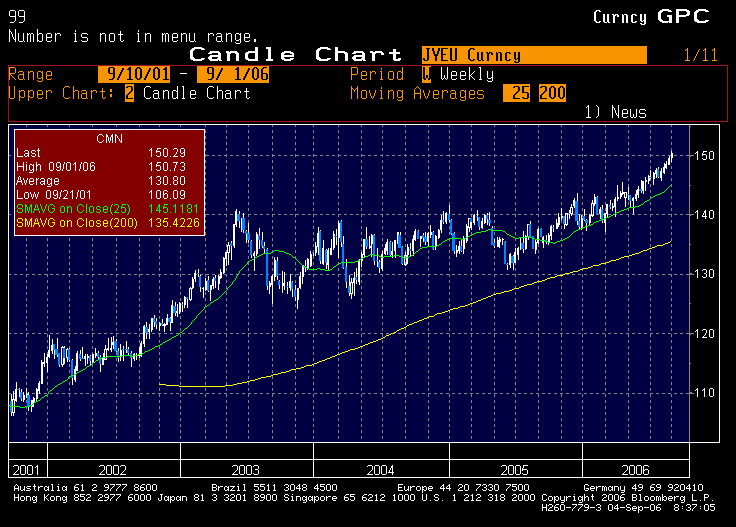
Such a sign is not surprising for with the the Euro again reaching new highs versus the Japanese Yen (see adjacent graph), even as the Eurozone slides in to deficit v. Japan & China both and the Japanese continue to rack up prodiguous surpluses against everyone except OPEC, we see Japanese consumer prices & property prices rising smartly, unemployment falling, and, most recently, releasing a most optmistic and promising Tankan survey, it is worth contemplating how deeply cynical such parochial selfishness and team denial actually are within Japanese policy.

Japan-o-philes and Nippon's other apologists will point to now-laughable threats of continued deflation (certainly if viewed relatively for Japan shares the same global economic risk as other OECD nations), or the need to keep rates low just in case deflation rears its ugly head again. But by now, these are so obviously just tired, lame, recycled excuses for TeamJapan to avoid doing its part in making any concessions in the desperately-needed global move towards rectifying global imbalances.

In the meantime, they seem intent (and rather pleased with themselves, I must say) to beggar jobs from Europe at an increasing pace, and the United States at a decreasing pace, and do their utmost to insure that the Chinese do NOT get the upper hand by somehow outlasting Japanese efforts to prevent the YEN from abandoning it's tether to the USD before the RMB. And so they will continue with ZIRP, a bloated fiscal policy with 6 or 7% of GDP deficits, and insure YEN is the finance currency of choice for everything from USD denominated bonds, any higher-yielding soverign & junk, a new kitchen or beach-home for the Hedgies of Greenwich, as well as a new flash fab in Milipitas, CA.

Friday, September 29, 2006

Groundhog Day

Each morning I rise and shine thinking, hoping, and wishing that the world be better place than the one I left behind the night before. Gosh knows I try to be a better in what ways I can. But why oh why do nation states in general (and to get to the point for this is an economics-related blog of sorts) and the various finance ministries & central banks in particular have such difficulty making it "a better place" and doing the right things for world as a whole?

I am not here to bash "free trade", the benefits of trade, or the imperative of each minister or chief banker to regard the interests of the polity from whence he came above the interests of the world in general. But each day, we seem to diverge further from, rather than converge towards, any medium-term sustainable global equilibrium. And each morning as I scan the headlines and review the figures in detail, I am both both saddened and worried anew. Yes cliched as it is, like Bill Murray in "Groundhog Day".

Just once might I get up and hear: "The head of the BoJ admitted that Japanese interest rates are too low (and have been for too long) and thus effective immediately will be normalizing rates. "He said further that such normalisation will occur "at once", and there will be quote "No pussy-footing around". When questioned about the impact of the move upon the stability of financial markets, he said: "Speculators who have borrowed YEN at near zero to finance investment activities in other parts of the world when economic activity and inflation are so obviously very buoyant must be smoking crack or be severely mentally challenged if they didn't factor in the risk of eventual normalisation of YEN rates into their speculative equations. From Japan's point of view, they deserve whatever financial fate befalls them, not to mention that the Darwinian shakeout will make the world financial markets more efficient in the future.

Or how about: "PBoC Chief Zhou today announced the full scale float of the RMB, effective immediately. In teh same breath, he warned speculators that Chinese Banks have lots of bad debt, Chinese rates while low, are not expected to rise anytime soon, and that inflation is actually much higher than officially admitted, but that the float of the RMB will help the market enforce some much needed discipline..."

And then of course, we would all like to hear: "US lawmakers, feeling the deficit is really rather too large, said today they believe the USA needs to raise Federal revenues, and thus taxes, at least until revenue and expenditure correlate more closely. Speaking for the unanimous bi-partisan coalition, Sen Chaffee said they'll be effecting it by raising marginal inome tax rates by 10% on the dollar in the highest brackets as well as implementing a windfall resource tax, and a hefty nationwide Carbon Tax to both raise revenue and promote efficiency).

One day of course, I would be profoundly gladdened to hear "The entire Bush administration has resigned effective immediately". "New elections will be called for next week..."

Or, in keeping with the main topic of this board, Japanese equities, I would see a better world if: "Masayoshi Son, alledged charismatic and enigmatic founder of the Softbank internet empire was led away by officials from the Tokyo Prosecutors office Financial Crimes Squad as they investigate wrong-doings within the Softbank group of companies. Reporters were told Mr Son admitted to the various counts of fraud and was deeply deeply apologetic to those who as a result of his notoriety and schemes came to believe that wealth could be created in ways other than through the alignment of great prescience and good hard honest work, and of course time...".

I can dream, can't I?

Wednesday, September 27, 2006

Abe & Omi

I know this is irrelevant in comparison to the weighty subjects often tackled here but has anyone noticed how cute the names of new Japanese Primo and MoFo Chief (Abe & Omi) sound when ennunciated together?

In both German & Dutch the sweet nicknames for Grandama & Grandpa are "Oma" & "Opa". Along the south Indian coast, the same is Ajja & Ajji. Father & Mother in Hebrew are of "Abba" & "Ema". "Abe" and "Omi" just has such a cute and ring to it, that one might mistake them for a an absent-minded elderly couple puttering about their business meaning no one any harm. And heavens knows that that such an image might be important in the battle to defend what are indefensible interest rate and weak yen policies. one could imagine that every little bit will help...

Tuesday, September 26, 2006

Amaranth: Was It The Market?

That Amaranth had a losing position is [now] a USD $6billion undeniable fact. But the nagging question that I have about this trade-gone-bad is: (a) did the position itself sink Amaranth", (b) did the market sink Amaranth or (c) did some more nefarious interplay of causes sink Amaranth?

The common perception is that it was (a) "the position", which means the size of its bet, and the severe wrongness of the bet was responsible. This ascribes the disaster essentially to bad luck and poor risk-management and oversight. An elephant skating on thin ice, so to speak, that broke. To the young (after all, he IS rather green) Mr Hunter's defense, he didn't expect such a large move in such a compressed period. And he had been blessed with remarkable luck and prescience before so he (and his boss) might be foregiven for a lapse whereby they extrapolated Mr Hunter's (and by extension Amaranth's) luck into skill.

But I have been around the block a few times, and things are rarely what they seem. I am not ruling it out, but "the market" is rarely as big an anonymous as lore and certainly financial hacks purport. "The market" is, after all, the sum of participants, and though the mythology of capitalism would be furthered by widepsread belief that prices are set in pure competition by thousands of small anonymous ineffectual hedgers and speculators, reality very often differs. For the inconvenient truth (to borrow Mr Gore's pleasant turn of phrase) IS that some players are huge and alone can set or at least [temporarily] have great impact upon the marginal price. And all-too-often, large investors DO collude thus acting in concert. Yes it's prohibited, but when has that ever stopped anyone from trying to squeeze a profit? And it is none-too-easy for authorities to prove it in fact. And there are other feedback mechanisms such CTA trend-following strategies that have the same de facto collusive effect, even if the particpants never speak.

Where I am going with this? Metalgesellschaft's oil plunge, Sumitomo-Hamanaka's "little" copper problem, as well as Codelco's Juan-Pablo Davila's copper cock-up were all examples where feedback mechanisms whether overtly revealed, parsed from price-action, or driven by plausible rumour, innuendo, or margin calls, are rather different from the over-sized wrong-footed bet where the market random goes against. In all these, and potentially Amaranth's case, the market is hunting. They smell blood, and may not know why or what is precisely causing the move but as it moves, "they" (the market-as-hunter-killer) increase positions and press, thereby shaking the proverbial tree to see what falls. In Amaranth's case, there was information available to the market as it was common knowledge to the Energy cognoscenti that they'd bought MotherRock's book. And LTCM's [rightly} resident paranoic Lawrence Hillenbrand will tell you that unles you're Exxon that is the beginning of the end...

To my suspicious mind, this is getting warmer to the truth. And it somewhat shifts the "blame" from "stupidly unlucky" to "unluckily stupid", since getting caught out as such reveals hubris, overconfidence, and a feeling that one is smarter than "the market". All cardinal market sins and Bad! Bad! Bad!

But there is third possibility that is understandably NOT discussed in the mainstream media, but surprisingly is not discussed in the trade press either. And this is the possibility that their clumsy and quasi-public long Natty position was the subject of predatory trading by those with material non-public information about the Fund and it's positions. You see, Securities firms and Mega-Banks are required to have what are called Chinese walls, ostensibly to reflect the scale and impermeability of the Great Wall of China. But this is a rather poor analogy. "Shoji Partition" might be better. Or perhaps, "A Blood-brain barrier", or even "Placenta-like Separations". These are more accurate because information can and does flow to "those who require it" in the firm, i.e. risk-management personnel, Executive Committee members, CEO, CEO staff. Irrespective of what these firms might advertise, whe information flows, nothing is secure - certainly not as secure as one with an oversized-Natty position and already high-leverage would require to feel safe and secure (at least where I sit).

Roger Lowenstein's account, When Genius Failed reconstructed the scenario pretty well. Essentially, if you're very leveraged, once someone sees your positions, you're a target. Hillenbrand was seemingly the only one who really understood this risk. He made sure they used multiple Prime Brokers, swapped positions between leverage providers to insure no one saw the full extent of their leverage or their positions. If one cannot be certain as to whether one has an offsetting position at another shop, the risk-reward equation for "gunning" is greatly reduced. After LTCM started to take a hit, and needed either new capital or bigger lines, anyone who might supply the credit that was needed also needed to see "the position". All the Positions. He fought it, but there was recourse, and that was the precise point at which Hillenbrand knew they were dead.

LTCM accused many of the people of trading against them once they saw their positions, Goldman Sachs being singled out, in particular. But AIG, Citigroup, Berkshire, all had seen the enitre book. But everyone had lines with LTCM, so even for those who didn't see the whole book, and even they didn't know whether there was a hedge on the other side, they knew what THEIR risk was, or rather what as a lender to LTCM, they would soon be owning as principal in the event LTCM missed their call, or violated the fine print. As a creditor, a firm knew precisely what to sell and its childish to think they didn't take measures to protect themselves directly by "hedging" their risk (i.e. selling some or all of the position out directly in anticipation) or that opportunists managing the various trading desks didn't understand "the wink & the nod" that this client was now "shark bait", or that the sales manager on the bond desk couldn't resist helping another large client who would still be a client AFTER the mess was mopped up, make a little money.

But there was another incident a couple of years ago called "Eifuku" (amusingly pronounced "I F*ck You"), in which a Japanese hedge fund priming with Goldman Sachs took on entirely too-much leverage, and ploughed it into rather stupid concentrated positions. And in the span of a few short days, "the market" moved against them, and lo and behold, Goldman "owned" the position. The proprietor screamed "foul play", and sent a letter to his investors that all his positions mysteriously moved against him at the same time, causing margin call after consecutive margin call until POP!! Rumours circulated later that they had been "gunned" by Goldman. And Admittedly, this is suspect since it would make very bad business sense to risk a franchise for a little trading profit. But the world is small. And there ARE other plausible, though unproven, possibilities. For example, the head of a large London hedge fund might have worked at Goldman, and still had private friends there, and might have even been a big client of theirs. Perhaps Mr "Eifuku" had an oversized ego and inflated opinion of himself, was a Cowboy, and a potential liability to the white-shoes. Coveted position information thus passed could have seen such a client and fund trade against the position. Given the leverage, it would only take a couple days to torpedo it. Goldman would then "own the inventory" and would presumably sell the offsetting position to the client hedge fund locking in a lovely profit, and solving the problem of a loose cannon. Not to mention that the now-enriched client, with boosted returns, would gather more assets, thus completing a virtuous circle. "Boat drinks!!" Of course all the foregoing is pure and unsubstantiated conjecture, and by way of disclosure, is meant to entertain a plausible alternative explanation for very real events.

Which brings us to what really happened to Amaranth. We know they had a big energy position that was compromised from the get-go because others bid for it, so they knew marfin calls were being made. We know that they had reasonably high leverage across the fund (and I don't care what anyone says or what comparisons they make to LTCM, it WAS high). We know Citadel is very active in the energy markets and has boatloads of capital, and probably "saw" the MotherRock position. Having missed it, and seen the market tail south, did THEY "gun" it? Did their Prime Brokers "see" the position and decide it was scarily big and thus sell some Natty to hedge their credit risk, thus creating larger margin calls? Did the IB prop desks (through their Prime's) "get wind" of the position, see the margin calls, and give it a friendly "push"? Did the CTA Trend followers acclerate the trend through their "informationless" feedback loop? Maybe all? Maybe none. But be assured that there is an objective reality out there and the NYMEX Natty "time and sales" audit trail that flows back to the ultimate traders will reveal a story. How nefarious that story ultimately is will have to wait for a determined investigative pit-bull. I wonder to what extent "plausible deniability" is being manufactured as you read this?

Monday, September 25, 2006

Never Feel Sorry For A Man With His Own Plane

One of the top headlines in Bloomberg news this morning was the revelation in an Austrian Magazine that an Austrian speculator had been forced to sell amongst other things a van Gogh in order to repay the Austrian Bank whose money he was reputed to have lost in the markets. The article closed by saying that the centerpiece was, (of all places), now adorning the walls of Steve Wynn's Las Vegas palace, and that it's former owner was too distraught to cast eyes upon it ever again.

In addition to the irony that the famous canvas finds itself yet again, in a gambling establishment, it must be pointed out that that it is but another in a long list of speculators and famous works sold under duress. Alan Bond, Ryoei Saito who's story is detailed by Cassandra here, along with many others whose involuntary art dispositions and subsequent legal humiliation were far worse than what's at stake here.

Perhaps the point of the Bloomberg article was to mock the feelings the van Gogh's former owner, though with Mr Bloomberg himself being a collector, such an accusation might be out of line. Or perhaps the implied sympathies were genuine. After all, the wealthy do have feelings too. But the implicit plea for sorrow made me think of that film with Anthony Hopkins, Alec Baldwin, (and Bart The Bear, for whihc he won a special Academy Award) called "The Edge", in which Hopkins plays a fabulously wealthy older man with a stunning young wife who as it happens is having an affair with his confidante, the young Mr Baldwin. They are all away in somewhere in Alaska for Hopkins character's birthday celebration where they (sans wife) take a little sea plane voyage to do some fly fishing or such.

Baldwin's character, emboldened 'cause he's sleeping with his rich old Friend's beautiful young wife starts taunting Hopkins asking how difficult and challenging it must be "to be rich". "You never who your friends are", "You never know if someone is sincere or just wants something for from you....". "Yeah it must be rough...". Hopkins is silent. Expressionless. He hears what Baldwin is saying, clearly contemplating it carefully as they cross beautiful virgin Alaska wilderness. Then, in with the utmost of non-chalance, Hopkins responds: "Yes, well you should NEVER feel sorry for a man who owns his own Jet Plane...". Which seems rather fitting in the circumstances in case one was in danger of shedding too many sympathetic tears.

Thursday, September 21, 2006

Get Rich Funds vs. Stay Rich Funds

Are you a "Get Rich Fund" or a "Stay Rich Fund"?!??, I recall him asking. "You're a "Stay Rich Fund", which is all very nice and I am sure you're a nice girl, but, I only invest in "Get Rich Funds. Perhaps, you should talk to Izzy...since he's sweet on "Stay Rich Funds...." . Yup, that was a "potential investor meeting" following the LTCM debacle in late 1998. It followed a meeting in which the short, cigar-chomping Jewish allocator screamed "Dammit, Leverage is POISON!!". That of course followed the guy who said: "...only 20% pa and Sharpe of 2x?!?? You'll be lucky to raise a two dimes...I saw three guys this morning doing 35% with Sharpe's of 12..."

Such were the dark days in 1998 following LTCM's mere hiccup in comparison to the heaving technicolour yawn of the Amaranth Fund's demise. What will be the fallout for the street, hedge funds and hedgefund investors?

At $9bn, everyone who could, seemingly did have a piece of Nick Mouanis' Amaranth. Every Fund of Fund, family office, and large pension fund will have got stung. Many, will make public pronouncements, because they have to, though others -particularly in Switzerland - will be either more discreet or too embarassed to admit association. And surely the Japanese were there. Maybe that's why Mouanis let it happen: in response to the pathetically selfish neo-mercantilism of Japanese monetary policy? OK, probably not. And surely some of the Petro-dollars got "recycled" from Russian & Middle-Eastern owners to CTA's and the investment banks shorting Natty (who must have been the big winners), in their pursuit of putting the wounded holder of "The Ill-Fated Long Position", out of their margin-call misery.

LTCM was a capital dislocation event. It widened spreads of all variety across all credit-sensitive markets. And they stayed divergent or distended for a reasonably long period because LTCM was pari-passu with every prop-desk and Wall Street firm inventory position (and they had eaten their fill and weren't taking any more). The heightened perceived risk caused capital to pull in its horns, making it difficult for anyone to raise equity let alone think about dramatically increasing leveraged exposure to risk. Eventually it dissipated as the Fed ill-fatedly open the spigots in fear for the Y2K bug-a-boo. And the pain of investor losses faded.

But make no mistakes: the demise of Amaranth IS a capital dislocation event. Fortunately for the markets, their leveraged exposure was concentrated in Energy, and zero-sum. And though its zero sum, this is a dramatic destruction of equity, is not entirely offset since the short-Natty "winners" are not necessarily levered Spec Funds, per se. But more imtportantly, like in 1998 there will be ripples, and these ripples will cause risk-reduction, meaning position reduction in anticipation of year-end redemptions. Risk-spreads will widen, even though this was not a credit event. Christmas in Greenwich will not be as gluttonous as it might otherwise have been.

For the real economy, global imbalances (and the median US stock), Amaranth and its fallout is probably good news (for the moment). That there was excess speculation by all manner of Macro, Strategi, and Trend-Following investor in energy (and other commodities) as well as their stocks is obvious. Kicking the shit out of Natty validates the reality that there is plenty of supply (for the moment). Copper & Nickel are probably next. Maybe the whole real-asset complex. The net result will improve sentiment across the board by taking the heat off rising goods & service prices, the Fed, and especially the US's massive trade and current a/c deficits. PCE will take that much longer to roll over, and Nouriel Roubini's bold recession call, may prove to a quarter or two too-premature.

In the meantime, for hedge fund principals, and marketers alike, it is worth rehearsing your investor explanation for why you are no longer (and never really have been) a go-go "Get Rich Fund", but in fact are (and always have been) a conservative "Stay Rich Fund", irrespective of your momentum-humping pursuits, and envelope-pushing leverage. Just hope and pray that they do not demand to "look under the hood"...

[Bad] Hedge Fund Poetry Corner

So, Farewell
Then Amaranth
Fund L.P.

The Myth
of Your Floral
Permanence -
Now Shattered.

Seekers of
"the Secrets
Between Price
& Value", You
Might've Been.

But, Torpedoed
by "Natty"
while
Shooting The Moon!"
Will Be
Your Epithet

Some Will Call
You "Vermin",
While
"Fraud" May Roll
From The Lips
of Others.

But Markets
Will Remember You
Simply As:
September's
"Cannon Fodder".

(with apologies to EJ Thribb)

Monday, September 18, 2006

That Joint IMF Statement (in full).

All work and no play makes Hank, Sadakazu & Zhou dull boys. All work and no play makes Hank, Sadakazu & Zhou dull boys. All work and no play makes Hank, Sadakazu & Zhou dull boys. All work and no play makes Hank, Sadakazu & Zhou dull boys. All work and no play makes Hank, Sadakazu & Zhou dull boys. All work and no play makes Hank, Sadakazu & Zhou dull boys. All work and no play makes Hank, Sadakazu & Zhou dull boys. All work and no play makes Hank, Sadakazu & Zhou dull boys. All work and no play makes Hank, Sadakazu & Zhou dull boys. All work and no play makes Hank, Sadakazu & Zhou dull boys. All work and no play makes Hank, Sadakazu & Zhou dull boys.

All
work
and
no
play
makes
Hank
Sadakazu
& Zhou
dull
boys.


.syob llud uohz & uzakadaS, knaH yalp on dna krow llA .syob llud uohz & uzakadaS, knaH yalp on dna krow llA .syob llud uohz & uzakadaS, knaH yalp on dna krow llA .syob llud uohz & uzakadaS, knaH yalp on dna krow llA .syob llud uohz & uzakadaS, knaH yalp on dna krow llA .syob llud uohz & uzakadaS, knaH yalp on dna krow llA .syob llud uohz & uzakadaS, knaH yalp on dna krow llA .syob llud uohz & uzakadaS, knaH yalp on dna krow llA .syob llud uohz & uzakadaS, knaH yalp on dna krow llA .syob llud uohz & uzakadaS, knaH yalp on dna krow llA .syob llud uohz & uzakadaS, knaH yalp on dna krow llA .syob llud uohz & uzakadaS, knaH yalp on dna krow llA .syob llud uohz & uzakadaS, knaH yalp on dna krow llA .syob llud uohz & uzakadaS, knaH yalp on dna krow llA .syob llud uohz & uzakadaS, knaH yalp on dna krow llA

A L L W O R K A N D N O P L A Y M A K E S H A N K , S A D A K A Z U A N D Z H O U D U L L B O Y S . A L L W O R K A N D N O P L A Y M A K E S H A N K , S A D A K A Z U A N D Z H O U D U L L B O Y S. A L L W O R K A N D N O P L A Y M A K E S H A N K , S A D A K A Z U A N D Z H O U D U L L B O Y S. A L L W O R K A N D N O P L A Y M A K E S H A N K , S A D A K A Z U A N D Z H O U D U L L B O Y S

All work and no play makes Hank, Sadakazu & Zhou dull boys.

Errrr. That's it, now if you would please be on your way and go sell the Yen again!

Friday, September 15, 2006

GeithnerSpeaks: On Balance He's Balanced

That Geithner speech in full:

"Markets are not perfect & fail. People too are fallible. Flights-to-quality are scary. The big are getting bigger - huge in fact. Leverage & agency probs may amplify bad market outcomes to the detriment of the system. But balance should be sought and cost/benefit weighed wisely before trying to "save" the system. The large equity of Levered Specs can help transfer risk away from core to periphery. Free-riding on systemic health may be an issue. Central Banker's can regulate & spank. Cascades can happen. CBs can catch them, saving the day, but that may create moral hazard. Errr that's all"


There is a lot of hand-wringing about hedge funds, leverage, and speculation. Probably too much. Geithner said in essence that leverage & modern markets should be monitored as accidents can happen, but on balance its more-than-alright, and quite manageable, though we shouldn't be complacent. I wonder if much of the concern is not at the obscenely outsized spoils that result from their bets, rather then the speculations themselves.

Let it be said that I morally disapprove of highly leveraged betting as a force of habit like I disapprove of smoking. But I doubt the necessity and the wisdom of drawing too-strict a line (for ice-cream, too, is dangerous) to restrict its undertaking, except where damage to the public can be established. And while there are potentially systemic stability issues, there is a great deal of rather sophisticated private equity (bank & nroker equity capital) and their strong self-interest (and domestic and international regulatory regimes) to temper the stupidity and greed all along the way, that insulates "the public", between speculators private losses and such systemic disaster requiring public intervention.

If private nitwits - whether individually or however organized - desire to make big leverged gambles (with their equity), where the collateralised financing arises from others (be they banks, or brokers who as it happens also have plenty of equity), and where margining is in most casea is daily and sacrosanct (particularly where granted leverage is knife-edge), and where said providers of leverage are themselves self-interested, the problem is more likely to be an issue of hoe large will the "self-inflicted wounds" be rather than consituting a serious and unmanageable systemic problem for it is likely that "solutions" don't create issues as meaningful as the problem.

Recall there was no public money lost or directly risked in the LTCM aftermath. The equity holders of the fund lost everything, and where the collateral, ex-post, was insufficient, their leverage providers got stung too. Full-stop. And this was as it should have been, and numerous lessons being learned by all concerned: e.g. How much leverage is too much; Take great care leveraging illiquid OTC positions; Never never never under any circumstances let anyone see your positions; Be careful of pari-passu risk; Be firm in demanding to know a leveraged speculator's entire exposure if granting them "extreme" leverage"; Be sure to warn investors 10-ways to Tuesday they can lose EVERYTHING and things can and indeed might go horribly horribly wrong.

There IS an agent-principal dilemma (as Geithner highlighted numerous times), generally speaking in the financial & investment management industries. But its endemic with few exceptions - from Fidelity Mgmt (yes Vanguard too!) to hedge funds, insurance co's, and prop traders at banks. Buffet to his credit, despite Berkshire's AAA rating, refuses to allow Berkshire & GenRe to participate in the low-margin swaps biz, in order to avoid Herstatt-like cross-default issues. This epitomizes the distinction between "the get-rich & richer specs" and the "Stay Rich" investors. This is the real issue at stake, and it cannot be legislated or directivized out of existince - not in a hugely complex world where regulatory arbitrage is rife.

Higher capital adequacy standards, demands for more regulatory transparency, higher tax rates on leverage-enhanced trading & investment profits, tigher controls on widow, orphan, & general public participation in leveraged funds all can contribute to a greater systemic margin of safety and contribute to official policy that makes a positive policy statement about the utility to society of excessive "greed". But as one goes further down to the path of prohibitions, and overly-wieldy regulation, it's a slippery slope where if one ventures, one must begin to examine the public utility of lotteries, casinos, bungee-jumping, sports cars, trans-fat snacks, sugared-drinks, unprotected sex, or for that matter any form of risk-taking behaviour.

Wednesday, September 13, 2006

The TSE says: Me Too !!

That stock & commodity exchanges have proved fabulous post-floatation investments is undeniable (excepting the NYSE where "members" & Goldman judiciously sucked out the juice a-priori). But NASDAQ, CME, CBOT, ISE, Deutsche Borse, LSE all have spun profits for the prescient and the lucky. In typical Japanese style, somewhat after the apparent peak of boom in values, the venerable Tokyo Stock Exchange is readying its own transformation into a publicly-traded entity slated for 2009, a date that reflects delays resulting from recent trading mishaps for which management has been excoriated.

But I must admit to being less than enthusiastic about the wisdom of the central exchange marketplace within a capitalist, market-driven economy as a for-profit endeavor. As I look at these words, they appear oxymoronic and even silly on the page, but my concerns are real for a number of practical reasons. For the exchange while it has many constituents - the companies who list there, the brokers that facilitate trade there, the institutional investors who transact there, the public who trades there, and public who uses the values derived therefrom for micro-level allocative decisions throught the economy - has IMHO a single pivotal role: to most efficiently assist in the allocation of resources.

My first objection begins with the question: What is the role of "the exchange" in a capitalist system? Is the objective to maximise profits for the "owners" per se or is it to grease the proverbial wheels of the economy by facilitating maximally efficient price discovery, thus allocation of scarce resources that in the case of a stock market, brings together those seeking capital with those supplying it? In my opinion, it is clearly the latter.

Proponents of publicly-listed, joint-stock company exchanges will self-servingly argue that not-for-profits underinvested, and have insufficient resources to "compete". But exchanges are natural monopolies, or could be or in my opinion should be granted such status, provided the benefits accrue to all constituents. Investing in technology takes capital, but it is not deterministic that because an exchange has excess capital or free cash-flow, it will invest, nor is it the case that because it doesn't have a war-chest, it won't. The NYSE has always had lots of money, and has recently raised turnover fees - not because of a paucity of investment, but for the sake of offering the shareholders an adequate return on the high prices they paid for their shares during the transfer of ownership from men's club to profit-seeking enterprise.

Second in the laundry list are the natural conflicts of interest. Now, we all know that exchanges were, previously, "members clubs", and were run as such so the bar is not set very high in regards to a for-profit company doing more than remunerating Dick Grasso and enriching Spear Leeds. Since they were run in the interests of the members, they maintained high guild-like barriers to entry preserving oligopoly-like profits for the members. In the NYSE's case, specialists were outrageously granted exclusive license (for which they didn't even competitively bid for) to steal money (which they did) from those transacting. In NASDAQs & LSE's case, they fought tooth and nail to preserve a system that prevented their customers from getting the best price in order to preserve their members' profits. In both cases all the other constituents lost.

Tokyo, on the other hand historically maintained a much fairer and more neutral market-structure system. While it is indeed run as members club, there is more impartiality and fairness in the structure. Even in the by-gone days of floor trading, the TSE eschewed specialists for a "Satori" whose job - like that a public servant - was to manage the order-flow and independantly match buyers and sellers, not to scalp them when it suited (like Spear Leeds). The same held true for the "maerklers" in Germany, whose role was the same. In both cases there was no principal vs. agent conflict, no privileged information, and club membership benefits were limited to the oligopoly rents it provided members to their granting a point of access to trade. Technology soon supplanted the floor, and now everything is fairly and impartially handled by computers, as they are in Continental Europe. Only the Anglo-Saxons stand out resisting the virtues of technology in order to preserve the benefits for the boys club.

The third issue is "costs". But this is not so simple as the difference fees it costs to transact. NASDAQ may historically have been cheap to transact upon from a commission point of view, but if the implicit cost of spread and impact was taken into account, it might look very expensive. France might have been cheap to transact from a commission point of view, and very transparent, but the monoply extracted high costs for settlement. The NYSE may appear cheap to trade and efficient to settle, but the cost in terms of what the specialists manage to extract from their privileged monoplies is high indeed. So what do we know? The fact is that the infrastructure costs money to develop and maintain. Surveillance and administration costs money. And constituents are will pay, one way or the other. We also know that concentration of liquidity is "good" and "fragmentation", while increasing competition, (a good sobering wake-up call for NYSE), also increases trading costs and decreases allocative efficiency. This should not be seen as an indictment of not-for-profit exchanges, but rather an strong reprimand for "crony capitalism" as evidenced by the NYSE. The bottom line here is that what is good for the shareholders (higer costs & fees) is patently bad for all the other constituents as the higher fees deter turnover, liquidty, and thus decrese the efficiency with which resources are allocated. Can one imagine a bigger conflict of interest??!?

The Tokyo Stock Exchange is not immune from such accusations, but they are different. The Tokyo Stock Exchange (complicit with Japanese Finannce Ministry Officials) has historically given petty advanatge to Japapnese Brokers. Historically they did not permit the "baikai" or the order book to electronically leave Japan, and limited the dissemintation of this information to special Japanese-owned machines, or from the floor. They were also very slow to permit electronic connectivity from abroad - again to rpeserve the oligopoly rents for members, particularly Japanese ones. But ever inventive, people found a way. Proprietary traders at a member brokerage in NY were reputed to have trained a video camera on the baikai machine to watch which they could access. Morgan Stanley, in the early days of connectivity allowed their customers to send through the orders electronically to their desk, where a Japan-domiciled clerk had the job quite literally of "pressing the button" to on-send the orders to the floor, thus meeting the letter of the law.

Further conflicts arise in for-profit organization. The TSE historically served to protect small investors by vetting the companies that listed there, as did the NYSE. Fly-by-nights were prohibited by minimum requirements for audit compliance, sales, earnings, operating history length, etc. This prevented the speculative issues from listing, thus protecting the public from scams, and their own greed. Today in the US (like in the 1920's) we are seeing listing of shells with no businesses who hope to acquire business or companies in the future. Or on smaller exchanges, MOTHERS, JASDAQ, etc. there are companies with little operating history, and very small floats, that are easily manipulated by speculators, hedge funds, and institutional investors such as Fidelity & Jardine. There is no good reason in a world awash with capital and savings why these securities should be be granted equal shelf-space and and best should carry serious warnings regarding lack of operating history, excess valuations, high volatility and the lack of liquid markets, particularly during times of stress.

Finally, there is what one might call freebie revenue. Financial data has become enormously valauble to participants wishing to review history in order to make better investment decisions. This includes current & historical time quote & sales data, volumes, short-interest, failed trades, specialists trades (for which by the way, there is NO transparency at all), etc. The exchange extracts huge tribute for these records, in many cases making availability prohibitively expensive for all but the most well-heeled participants. In a sense it's both exclusionary and anti-democratic. But the true conflict arises insofar as the high prices they demand for real-time access and data deters turnover, and thus liquidity, and so injures the interests of all other constituents, thus creating an inherent tension between the exchange "owners" and all of the other constituents.

It's ironic that a listed corporate for-profit exchange at the center of financial capitalist financial markets creates such inherent conflicts of interest, leading yo what is probably a sub-optimal allocation of economy-wide resources. The answer to the question of the best structure, as the NYSE has clearly shown, is not the Gentlemen's Member Club. And for-profit creates inherent conflicts. Even a "mutual association" is a poor choice given the diffuse and varying interests of constituents. I would offer that that only a true not-for-profit public service organization would maximize utility for all constituent while at the same contributing economy-wide benefits.

Monday, September 04, 2006

Euro Makes New High v. Yen - And So...

Bloomberg news reported today Aug 28th 2006 that the Euro posted an all-time high vs. the Japanese Yen, ostensibly because investors believe that European rates will be heading higher, faster, than Yen rates. In a related news item, Brad Setser over at RGE Global punctured the myth floating around US policy circles (particularly conservative ones) that Europeans are not pulling their weight and need to expand their domestic demand as well as their imports. The two points are undoubtedly related, and highlight the dilemma or perhaps crisis effecting the international monetary system, and sheds light on the direction where potential finger pointing might be in order.


Setser highlighted that Euro-area demand (and imports) have been rising smartly. But sadly, from a US perspective that is, Europe's goods imports have primarily increased with Asian exporters, hence their new vigour and demand take-up has done more to increase Asian surpluses than they have done to make a dent in US deficits. Such is the luck 'o the draw in a free-market. This is partly the result of the goods and services the US has to offer, in addition to the impact of a Japanese Yen that’s de facto shadowing the RMB, an RMB that’s more explicitly pegged to the dollar, and a dollar that’s been depreciating against the Euro, and it's entire trade-weighted basket, creating a daisy chain resulting in Euro appreciation vis-à-vis the RMB and Yen, for no good reason(s), and undoubtedly some rather bad ones, since the Euro area is in rough balance, while the neo-mercantilists of the Pacific ride roughshod over the spirit of the international monetary system.

The new high of the Euro vs. Yen (as pictured above is significant, if for no other reason than it is wrong. It is wrong in regards to the spirit of the international monetary system, for it neutralizes the market mechanism of "relative price" for which the system depends to nudge the balance of payment accounts in a direction more convergent with long-term sustainability. And with nothing to police the system, the lack of market signal and pressure allows cynical free-riding, or worse, potentially lethal parasites. This in no way pejoratively judges the necessity or determination of China and its people, still a poor country, to develop rapidly. However, undermining the systemic mechanism of adjustment carries with it great cost and moral hazard - something that seems to be viewed somewhat cynically in Beijing, if actions imbue more meaning than words (which I believe they do). At the very least, everyone must recognize that continuation of the status quo, without meaningful appreciation of the RMB vs. USD and Euro runs the very real risk of seeing the world retreat down the rat-hole(s) of beggar-thy-neighborism, protectionism, or, in the extreme US repudiation or default. In the intereim, it opens the system up to the possibility of real speculative attack that would find the authorities defending the wrong side of the trench in the war. The resulting costs and economic dislocations from such systemic turmoil are immense, and one need only look at Argentina for a view of what unresolved bad policy can produce in teh realm of mayhem & chaos.

But this post was NOT primarily about China, but about the focus of Cassandra’s Love-Hate relationship: Japan. For Japan, the above picture is the Euro/Yen, and there can be no excuse. The Japanese are first-world, and one of the richest nations on earth. Their focus upon, and domination of, world markets in may key areas is without comparison, providing rents which sustain a rich quality of life and advantageous position. And this is a position that has been made possible by a world monetary order dependant upon cooperation and respect for the rules of the game. Yet the domination of markets more than sufficient to sustain them appears not to be enough to satisfy them. And so they illicitly beggar jobs from the USA and Europe by currency exchange rate manipulation using direct intervention and unparalleled reserve accumulation of dollars. Even against China, they refuse to allow the hollowing on anything but THEIR terms, hollowing that the USA and Europe have been granting de facto to the developing world for two and a half decades. This is as it must be. IF Japan insists on using whatever means necessary to trash its currency in order to gain pecuniary economic and parochial advantage for its corporations and its citizens, the Japan must be prepared to pay the ultimate price: systemic breakdown, eventual collapse or severe devaluation of the central currency (the USD); potential seizure of Japanese assets abroad. None of these things should be viewed joyfully, or wished for. But, if one is playing a game with rules, and one persistently breaks the rules, one should be prepared for the consequences, whatever they may be. For the level-headed eastern-establishment trilateral-types in the US may, in the future, be unable to prevent the more aggressive emotions erupting from the rust-belt of formerly triumphal America, intent on finding a whipping-boy and flogging him.

Tuesday, August 22, 2006

Flash! Crossholdings Unwound

In a research report dated 21st of August, 2006, K. Nishiyama of Nomura Securities says: The final figure makes it clear to us companies have finished unwinding their cross-shareholdings. The final figure is the approximately 11% of oustanding market cap (excluding listed subsidiaries/affiliates and the holdings of life & non-life insurance companies) that has held steady at this level (again) as it has for the past calendar years. This is from a peak in 1990 of 50% of outstanding market capitalization (including insurance co's holdings) and 33% which is the amount sympahtetic to the current constant 11%. It took more than a decade and a half, but it's finally done!

So can investors rest easier now? Or even better, can they look forward to the time when managers try to please them, above their affections to other constituents (i.e. management themselves!), as well as non-executive employees, suppliers, customers, and government ministry officialdom? That is an interesting question, for one must remember that there is much overlap here. For while the companies may have shed their holdings, one would be premature to say these holdings have found themselves homes in the hands of stable (or for that matter unstable market-oriented investors. This is because "Government" has not finished intermediating the "great unwinding". Through the DIC (Deposit Insurance Corporation, the BoJ and its affiliates, and Daiko Henjo pension giveback share acquisitions programs, the Government (and thus the people) own quadruple-digit billions of yen worth of shares.

Why should we care about this technical distinction? Investors should care for several reasons. First, these shares are in purgatory. An institutional half-way house, so to speak. Some must be unwound within the next several years. Second, the State of Japan was nearly downgraded by Moody's not long ago, and they've continued to run > 6% per annum fiscal deficits. So although they may not want to sell the proverbial family silver, their accumulated Debt-to-GDP ratio may cause them to sell against their wishes. And remember: these are no small lines of stock, but a vast amount of shares in virtually every enterprise in Japan. Mind you, this is not a prognostication that Japanese shares will be going lower any time soon (though I do not preclude this from happening), but rather to take such "All Clear!!" proclaimations with a touch of skepticism.

Monday, August 21, 2006

The Enigma of Martin Armstrong

Some memories fade, but are not forgotten. The same holds true for certain personalities, particularly the bizarrre and eccentric. One such notorious individual is Martin Armstrong a.k.a. Princeton Economics a.k.a. self-professed expert in the history of money and things gold, and of course, true to my theme of things Japanese. He was accused of Ponzi fraud and the purveyor of the notoriously unvaluable "Cresvale Bonds" that besotted Japanese corporate investors and populated their portfolios, much to their eventual chagrin. Coincidentally, in a bout of synchronicity, I was wondering only a few weeks ago what's become of him and was preparing a post, so it is timely indeed that after languishing for six and a half years in a Manhattan jail cell, he finally pleaded guilty to charges fo Fraud on Thursday, August 17th 2006.

In a nutshell, Martin Armstrong was a confidence trickster, if not a fraudster for which he was accused. Martin Armstrong was also a bad trader. A very very bad and inept trader. And Martin Armstrong committed fraud to cover up his bad trades. And then he committed more trades to cover up his fraud. Most in Nikkei and Gold. Despite the laughable ineptitude with which he implemented his "strategies", by most accounts he was smooth, suave and authoritative, in a way that encouraged people to entrust to him their money. Which he duly lost. Many many hundred of millions of US doillars. Perhaps billions. The official court dockets (available on-line) from his 1999 indictment in the Manhattan district of US Federal Court read like a Shakespearean comedy. The more he traded, the more he lost. So much and so bad were his trades that his colleagues, and brokers mercilessly joked about it behind his back. He was so consistently wrong-footed in his bets that he would have done far better flipping a coin to decide whether or not to be long or short. Or use the infamous "8-Ball" method. Or consult Nancy Reagan's financial astrologer, or ask the advice of Paul Wolfowitz. Anything but use his own judgement.

Though his company, Princeton Economics, had head offices in the US, he traded from Tokyo in an office overlooking the gardens of the Imperial Palace. For Japan has a special place in his scheme. You see, the Japanese too, in undertaking their own form of speculation known as Zaitech, had lost billions in late 80's and early 90's on dubiously-thought-out wrong-footed speculation and investment. Like Martin Armstrong, and other agent-trader victims shell-shocked by large lossess, they were too ashamed and emabrassed to tell their shareholders that they had punted wrongly, or in UK football vernacular, scored an "own-goal". Not willing to "come clean, they found themselves with a serious problem and yearned for a clever and tidy solution that would absolve them of the thing they feared most, which was NOT the losing of the money itself, but accepting responsibility, a dilemma not unlike that faced by I. Lewis "Scooter" Libby.

Enter Martin Armstrong and the almost forgotten Cresvale Securities. He too had a problem since his golden-tongued investment plans, proved rather less robust than hoped [and promised] and resulted in large trading losses for his clients. It seems that he was able to continue his scheme and make payments to the clients who redeemed by using the proceeds from new investors. This, however was proving more difficult as losses mounted, and so he need new clients. Big clients. Well-heeled clients who wouldn't be asking for their money back any time soon. Like money from a dead persons trust. A better yet, a dead-pet trust. Or even better: a Japanese corporate client that themselves had a dirty big secret to hide.

And so they found each other: the companies, like an inveterate gambler, desperate for an investment saviour who would, over time, regain their previous losses, rescuing them from humiliation and shame they most dreaded (not to mention a demotion to the Corporate Travel Office, or Janitorial Services Dept.) and Armstrong, now with a fresh load of clients, and more importantly, their cash. In between them stood Cresvale Japan, the securities firm who brought them together, gave legitamacy to both their pursuits, and took nice fees out of the middle in the process, and in so doing torpedoed themselves out of existence.

The scheme worked something like this: Japanese Corporate 'Y' perhaps lost $100,000,000 speculating through a subsidiary, selling Nikkei Put Options or buying boatloads of overvalued shares after consulting with Madame Inoue's Buddhist toad. They were able to hide this for a while by playing "pass the parcel". perhaps between offshore subsidiaries with different year-ends. Thus their consolidated accounts still showed these losses as assets at their full value on their balance sheets. So Armstrong/Cresvale prposed they swap $50,000,000 of new money for a "repair bond" with a maturity value equal to the full $150,000,000 ($100mm of losses + $50mm of new money) and then let Magic Martin do his thing. If things went right, they would make their money back and everyone wins. If something goes wrong, well they can blame the investment losses on Armstrong, call it fraud, and take write-offs, without having to take responsibility in the first instance. (note: this is sketch of the essence, not the actual details).

This is all interesting, but what really fascinated about this story is that in the mid-90s, certain un-named American value investors had eyed a number of Japanese companies that they believed "cheap" because they seemed to have large amounts of cash & marketable securities on their balance sheets, relative to their now-diminished market capitalizations. In some cases it was in excess of their entire market capitalization. Many reasons were put forth explaining the phenomena such as: "empire building"; "saving for a rainy day"; "deflation"; "management conservativeness"; "investor pessimism"; "adverse taxes upon large distributions"; "legal inability to conduct share buy-backs" etc. All seemed somewhat plausible. Conspicuous by its absence, except as speculated by the most hardened, battle weary cynical gaijin observers was: "because it doesn't exist".

But clearly some people HAD to know about their losses. For other foreign banks were in the repair bond business. And many of the companies themselves were household names. Maybe their businesses were not as fraudulent as Armstrong's, but nonetheless their audited accounts and actions were meant to deceive shareholders by masking losses and allowing them be amortized over many years.

Annd since we are writing it, we all now know that things didn't go according to planned. When the Armstrong fraud broke, many of the guilty Japanese Corporates had to come clean. Sort of. They said they were victims of fraud (and some truly were unsuspecting purchasers of Cresvale Bonds), but the "repair Bond" concept and angle was often lost on most observers. Yakult Honsha (TSE#2267) was said to have $1bn of losses, as well as engineering firm Chudenko (#1941); specialty chemcial maker Gun-Ei Co. (#4229) pharma co's. Kissei (#4547), and Towa Pharm (#4553), machine-tool giant Amada Corp (#6113), pneumatic specialist SMC (#6273), eletronic parts mfgr Alps Electric (#6770) advertising agency Asatsu (#9747), office furniture maker Itoki Crebio (#7972) and more than 50 other firms were deemed to be "stung". Yakult's losses were so big that they couldn't blame Armstrong, but many other co.s did, and were "absolved" of culpability for their original sins.

The epilogue was that Armstrong, accused of Fraud, sat in jail for contempt of court, not brought forth to trial for failure to turnover evidence and in particular, tell authorities the whereabouts of $15mm of gold and silver coins and bronze statues he'd squirreled away. It was the longest such languishment for contempt in United States history. All the while, he's claimed that he was innocent of the fraud. I make no judgement here, but it seems likely from the court documents and testimony that he did commit fraud in the form of the ponzi that used new proceeds to pay old losses. His brokers, Republic Bank, (now the behemoth HSBC) coughed up nearly USD$600mm for their part of not alerting autorities to the potential wrong-doing, whichh court documents alledge, they were well aware. But most of the losses were not "embezzlement" or "theft", per se, as the newspapers and Japanese Corporates would have readers believe, but out-and-out ineptitude and shitty trading, for which is no crime, excepting one's sensibilities of the good, the bad, the random and the ugly.

His guilty plea may reflect that Armostrong the man met Armstrong the fraudster. Or it may reflect Armstrong's understanding that having spent six years in jail, an admission of guilt might allow him to squeeze a few years of freedom in his (no pun intended) "Golden Years".

For investors, the only the protection they can afford themselves is doing appropriate due diligence and being highly skeptical of anything that purports to be "too good to be true", or turn base metals or paper into errrrr gold.

Thursday, July 27, 2006

PM Tanigaki? Rat's Chance in Hell

Back from holiday and rested, I see in a headline that all is now clear: Chief MoFo Tanigaki's pseudo-vicious fight with the BoJ was a prelude to his now not-so-secret desire to succeed PM Junichiro ("Elvis") Koizumi as Japan's next PM, Bloomberg reported. His platform? Consumption tax increases coupled with lukewarm anti-nationalist foreign policy. It is the true Keidanren platform making him far and away the favorite of Corporatist and Mercantilist interests in Japan who would like to see a weaker yen and a "kindler, gentler Japan" to the billions of emerging Asian consumers. The only problem is that these are inherently unpopular policies with "the people". No matter that the Emperor's own reservations have been leaked to the press about PMs making official visits to the Shrine where amongst others, the spirits of Class-A war criminals are errr remembered and revered. No matter than neo-mercantilism is set to torpedo the post-WWII monetary system. Tanigaki is well behind Abe in polls, who leads with between 40% & 50% of voter sentiments. But at least we can now understand why Keidanren's Man With a Plan has been such a persistent and vocal critic of ending BoJs Free Money policy.

Thursday, July 06, 2006

Testosterone & Markets

How does one disentangle youthful exhuberance from recklessness or separate age's wisdom from over-conservatism? These are particularly interesting questions from the point of view of investment and speculation, and I believe, become particularly germane following a period where volatility and diminuation have been absent from price action for a longer-than-normal duration.

I have no categorical answers, but I have some anecdotes to share beginning high atop the petit Luberon in Vaucluse some years ago. After a lovely picnic amidst the herbs & cicadas, our group descended towards Oppede down a path that turned into a large and steep field of loose scree. My friend and I had done this walk dozens of times, though we were with a group of young people who were on the mountain for the first time. Descending thorugh a field scree, with the right pitch can be as exhilarating as skiing, pulled by gravity, softened by deep but hard loose stones. We picked up the pace, and within the limits of safety, began surfing through the stones. The others made their way, too, surfing at their own pace, or excusing themselves from what must be sais, was a risky undertaking to begin with. A few moments later, one of the younger and most exhuberant members of the group, brimming with testosterone and enthusiam, came bounding past us, taking dangerously giant steps. Mid-stride, I look over at my experienced friend and we shook our heads in disbelief and exchanged looks that said "That lad is insane and it will end in tears". But a few minutes later, we saw him splayed across the rocks, with bright-red blood oozing from a large and nasty gash atop his head. Bad luck? Possibly. Overconfidence & testosterone? Probably.

I drive a motorcycle myself which might be considered a risky endeavor (at least by the actuaries). But I am neither reckless, nor unnecessarily aggressive. I take advantage of the benefits that the motorcycle offers to bypass traffic jams, always looking for the unexpected: the car that is signalling left. but turns right; the motorist exiting from a blind drive, etc. This caution is driven by fear that comes with experience and wisdom. It results from a rapid mental cost vs. benefit analysis which says the advanatge of early arrival, or satisfication at having beaten the traffic is insufficient to the cost of death or incapacitation. It is that simple. Yet, every day, I am surrounded by other motorcyclists - mostly young men their late teens and twenties - who arrive on the "wrong side" of the cost vs. benefit calculation. They weave recklessly through cars and fellow motorcyclists, pass cars at high-speed around blind corners, tempt fate of on-coming traffic with cavalier non-chalance, and overtake around cars that have stopped to let someone pass. I realize that I could be accused of being overly conservative, of the kind that comes with age and family. But few of my aged peers die or or paralyzed needlessly or painfully. This fate is reserved for the reckless and young. Interestingly, they are not without skill as riders. Most are better than I, with many driving from young ages and participating in motocross. No. Their achilles heel lies in their inability to visualize potential risks; to imagine mechanical failure; to anticipate that others might be fallible. In short, they are onverconfident, probably driven by raging levels of testosterone.

Which brings me to markets, speculators, and hedge funds. For one cannot but see the parallels between youthful enthusiam and confidence - often a prerequisite for outsized returns (without respect to risk). But it is also a primary contributor to crash & burn syndrome. Age does (or at least should) breed a brand of conservatism that teaches one to respect markets, but to value the power of independent thought. To look forward, rather than backward. To approach risk laterally, and from many dimensions. To question the paradigm of "what is working", and look to those that are not for potential ideas. I am certain that there are smart and capable young investors, wise beyond their years, and every bit as capable as older peers. But they are rare. Youth, by definition, is prefaced by single-mindedness, that is a boon during a bull-market, but a potentially fatal flaw when risk rises, paradigms shift, and the ground upon which one stands rapidly turns to quicksand. Take a moment to reflect upon the benefits of age and wisdom.....

Tuesday, July 04, 2006

My Sadakazu Tanigaki Scrapbook

Japan's MoFo's were at it again today, issuing warnings that deflation might not have been whipped yet, and that the BoJ should refrain from raising rates from their current Zero level despite the lowest unemployment rate in the OECD, rising asset prices, a 7% of GDP fiscal gap, as well as robust capex and rising housing starts, and, yes, eight consecutive months of positive inflation numbers. All which reminds me of Monty Python's "Dead Parrot" sketch. Given Mr Tanigaki's variant perception, I thought it would be a good time to break out my Tanigaki Scrapbook.

Here is Mr Tanigaki one of his partners in crime, Mr Kuroda, looking very cheerful indeed at a recent ADB meeting. Notice the smiles and the confidence. It is interesting to note that in pitched battles between the Finance Ministry (or the Treasury, Exchequer etc.) and the Central Bank, in any country (except where the Chief Banker is a toad), the Finance Minister almost always resembles the cuddly toy, while the Central Banker is always cariacatured as Darth Vader. This is because the Finance minster typically tells "the people" that they can "have their cake and eat it too".

Here, we see Japan's Finance Minister Sadakazu Tanigaki, shaking hands with his Chinese counterpart Jin Renqing in the Chinese port city of Tianjin. Tanigaki was in China to attend a meeting of Asian and European financial leaders. Notice how tightly Mr Tanigaki is holding Renqing's hand. It was reported by those present that following the photo-opp, Tanigaki refused to let go, and security had to be called to pry their hands apart. Though it was hushed by reporters, he was reputed to have lost his typical decorum revealing the honne behind his tatamae by screaming: "We will follow the RMB where-ever it goes, we will NEVER revalue without you, whatever the cost, to the ends of the earth and the end of time.....we will not let it go...."
Apparently, my sources tell me, PBoC Chief Zhou Xiaochuan was observing Mr Tanigaki's rather uncharacteristic outburst, and was seen here grinning broadly at the mad-hatter-like behaviour of the Minister, reputed to have said: "Hasta la vista, baby!"


Here is Mr Tanigaki displaying faux-concern for the impoverishment of the "Mr & Mrs Sato" that might result if the Bank of Japan raises interest rates to where they should be given that Japan has the lowest unemployment rate in the OECD, is running a 7% of GDP fiscal gap, experiencing a boom in asset prices, with commercial rising rents, eight consecutive months of rising consumer prices, and robust housing starts. Observers are asking why, with all the problems in the world, and reform issues on his plate at home, Mr Tanigaki has made it a personal crusade to undermine the Weberian bureaucrats steering the BoJ. Answer: One might think it was to hide the immense incompetence within his own ministry and his inability and unwillingness to do anything about the huge and persistent fiscal gaps. But the real reason might be, that higher rates, though prudent and necessary, might ruin the MoF's grand Macchiavellian plan to trash the Yen to insure Japan's currency remains competitive with its Asian neighbors.

Ah yes, "Plan B". Mr Tanigaki is shown here with his vision of the future: A Yen that has been debased so thoroughly by persistent 7% of GDP fiscal gaps, and through years of ZIRP and quanititative easing, that the only thing the YEN will be good for is framing and hanging on one's sitting room wall. Observe the Elvis-like hair-do on the pictured figure on the note.


But Tanigaki is wily and always prepared. Here, he is seen executing "Plan C": Pray Pray Pray that the BoJ will continue to neglect it's fiduciary responsibilities. No matter that China remains vastly poor by comparison. No matter that the USA has [perhap unwittingly] donated many jobs and much wealth to the cause of Chinese development. No matter that Japan, though vastly rich is unwilling to give a competitive inch to China or its Asian neighbors, putting the vast burden of global adjustment squarely upon the Americans and the Europeans. No wonder the Chinese detest the Japanese. But can it last? He is praying it can and will.

Finally we see Mr Snow giving advice to Mr Tanigaki on post-governmental careers. Mr Snow tried the less oblique route to international financial reconciliation, but was undermined (like Mr O'Neill before him) by an American Congress pandering for votes and a political system dominated by special interest campaign contributions, an administration that spells Economics with a "K", and by the helpful assistance of "friends" such as Mr Tanigaki, Mr Renqing.