They call the JPX-Nikkei Index 400 smart beta. Ummmm, errrrr, yeah, sure, they can call it whatever they want, and perhaps, if they say it loud enough, and repeat it enough, some will adopt it as gospel. And God bless them - particularly the blithely gullible trustees. And my kids' trust fund blesses them - the latter benefitting large from (being as kind as kind can be) their rote sub-optimality.
The JPX-Nikkei Index 400's construction applies a straight-forward three-and-a-half stage process: screen, score, score again, select by rank. Initial screening (from the TSE's website) looks like this and weeds out what, to some, is the detritus;
① Screening by Eligibility Criteria
Issues are excluded from selection if they fall under any of the following criteria.
- Listed for under 3 years (excluding technical listings)
- Liabilities in excess of assets during any of the past 3 fiscal years
- Operating deficit in all of the past 3 fiscal years
- Overall deficit in all of the past 3 fiscal years
- Designation as Security to be Delisted, etc.
② Screening by Market Liquidity Indicator
The top 1000 issues will be selected from those eligible, excluding the above, in consideration of the following 2 items.
- Trading value during the most recent 3 years
- Market capitalization on the base date for selection
The first scoring covets OP, ROE and size, with bigger preferred to not-so-big. The TSE calls this quantitative (noting the lower case "q" and italics, which are mine). It is a bit like an American vehicle MOT: making sure it has four wheels (with tyres), the headlights that point straight, an engine that turns over when the fuel is ignited; the brakes stop the vehicle when in motion, and plumes of blue smoke are not being emitted from the exhaust. It is, yes, a car, in the least contentious sense.
The 1,000 issues selected in (1) will be scored according to the ranking of the following 3 items. (1st: 1000 points – 1000th: 1 point). Then, overall score is determined by aggregating those ranking scores with the following weights. (There are handling rules for the overall scoring with negative ROE and operating profit.)
- 3-year average ROE: 40%
- 3-year cumulative operating profit: 40%
- Market capitalization on the base date for selection: 20%
The second scoring is qualitative, based on the admirable, but by no means universal, attributes of transparency, accounting standards, and oversight. For those that cannot distinguish what the second scoring is based upon as written, it is "qualitative" with lower-case "q", italics and a tiny font size to highlight that this can only tweak the results by a maximum of 2%, a bit like smoking "lite cigarettes".
Following the scoring in (2), issues will be further scored based on the following 3 items. This score is complementarily added to the quantitative scores explained above (2)*.
- Appointment of Independent Outside Directors (at least 2)
- Adoption or Scheduled Adoption of IFRS (pure IFRS)
- Disclosure of English Earnings Information via TDnet (Company Announcements Distribution Service in English)
* The score is determined so that at most around 10 constituents are different from those chosen with only quantitative score above (2).
Then, it is a simple matter of letting the proverbial chips fall, or rather, rank wherever they may, combined with an "all-change" every now-and-again.
So despite my amusement at such an offering, and thankfulness for those allocating passively to it, I am neither derisive nor pejorative in its essential mechanics, and though some might, I do not call it "dumb". It just does what it does. On the other hand, one would be forgiven for thinking proponents a tad hyperbolic in terming it "Smart". It isn't. Beta? Yes. "Smart"? Errrr, no. For how can something of value, that is being exchanged amongst consenting adults many of whom are meant to be fiduciaries, be "smart" when it is completely, and totally untethered from any sense of value? It is likely worse than navigating by dead reckoning, and probably inferior to the piƱata method of security selection. Make no mistake, at times, it might be attractive. But, given that investors already covet consistent and high profitability in relation to their equity, with good governance, and that companies qualify only AFTER they have had it for a good spell, it is not unlikely to forecast that it might, more often than not, yield negative alpha. So what would YOU call "smart" beta, with negative alpha? I call it "winning the battle but losing the war".
For many, however, this IS, manna from heaven. For exchanges and index licensors it means incremental revenue where none existed before. For journos it means grist for the mill. For trustees, it is a simplistic (albeit highly sup-optimal) answer to a complex investment problem. For Japan Inc. it provides convoy cover for suspicious behavior change - yet-to-be-fully-embraced. For me, it will create a fantastic variety of relative investment opportunity whether from inflows, outflows, or re-balancing, that will keep giving and giving and giving. Hallelujah! Yes, it is manna from heaven for everyone except those investors whose money is passively and naively be thrown at something mis-labeled as "smart", though which is anything but. Blessed be index-makers...
Tuesday, June 24, 2014
Monday, June 16, 2014
Monday, May 26, 2014
Euro-Election Post-Mortem...
UKIP supporters, along with those of the European right are angry. And nostalgic. Nostalgic for ....ummm .....errrr..... Johnny Halliday? Johnny Rotten ? Sir Lawrence Olivier? Georges Pompidou? Chaban-Delmas? Harold Wilson? Ted Heath? Free parking? No traffic jams? A Ford Cortina or a Renault 4? Ten-pounds-a-week rent? Fifty-P a pint? Greasy chips fried in oil t'aint been changed for weeks? Baked Beans 'n'toast for breakfast? Twiggy? Cliff Richard? A white guy (not a Russian) winning at boxing or sprinting? One-piece swimming costumes? Free university? A job-fer-life? Iconic red pay-phones booths smelling of urine? Phones with an umbilical cord? Single-race marriages? The Cold War? Clean beaches? High-streets free from foreign food? Holidays in Blackpool? Turnips and root veg? Chicory drinks? Maybe. B ut I think that they are nostalgic for rising or stable real wages; a settled feeling that accompanies slower technological change; a stable job that pays a good stable real wage, with an indexed pension, and that is not undermined by someone more educated or qualified or enthusiastic, willing to work harder, for less especially if they are foreign; Oh and lower taxes. All of which are under siege. Regretfully, for sensible public policy, this has little to do with Europe, or immigrants, or the decline of religion and general moral standards. But that won't stop the angry cocks from crowing...like THIS.
Tuesday, May 20, 2014
More Jitney's Needed?
There is considerable debate in the state of New Jersey about whether Newark or Camden is the Garden State's armpit. True connoisseurs of sweat, however, would add another - the one that gave us The Diving Horse: Atlantic City. All three have long-passed their glory days. AC, remains a hollow shell of its mid-20th century optimistic seaside-self, despite many billions of collective investment by private casino operators and public authorities. Camden more closely resembles war-torn Mogadishu or the bombed-out Syrian frontline of Homs than it does prosperous archetypical suburbs like Darien, CT or Merion, PA. Newark, alone, may rise once again, like a Phoenix, recalling Philip Roth's adolescent days, if only a result of its proximity to New York. Yet, Atlantic City, for all its flaws, retains a pragmatic solution to public transport from which many public transport authorities can learn. It is called The Jitney, and is simply an uber-practical shrunken bus.
Nothing is more galling to a taxpayer than senseless avoidable waste. Cynical fraud can at least be seen in the context of benefits delivered. Some mean-spirited Libertarians see it everywhere. I am more generous, but nonetheless loathe stupidity, rigidity and tolerance for things abysmally-sub-optimal. Where I reside, in the leafy hilly part of Kent County, everyday I see huge, aged, empty buses plying their routes with growling Spitfire-sounding diesel's that would annoy Harley riders, struggling to climb steep grades as they make their way through the lanes and up hills of my area, belching smoke, wasting petrol, blocking or slowing traffic both on major arteries and B-roads, menacing cyclists with their overtaking. And outside of the rush hour/school runs, they are empty - or appear virtually so given the ratio of passengers to available seats. Ghost buses. And each and every time I see this, apart from my selfish desire for less polluted air, silence, and budgetary optimization, I feel as if a crime were being committed. And I wonder: where is the Jitney? One would have thought that, if one formed opinions on the basis of hyperbole, the private sector would have ingeniously invented and tailored market solutions that would quickly eliminate (or reduce) the horrifying waste described for all of these are private concessions (Arriva, MetroBus etc.) with, one would presume, the appropriate profit motives.
France is not without its macroeconomic and social problems. However, when it comes to public sector policy solutions and their execution, be they infrastructure, public works, or healthcare, one should take notice, not because I say so, but because they tend to pursue non-ideological pragmatic solutions to policy conundrums that would baffle ideologues from both the right and left. In contrast, to the smoke-belching rust-buckets on spartan routes subsidized by my UK County plying their neglected, pot-holed roads, my municipality in France, delivers multiple bus solutions that pragmatically balance efficiency, cost, with public needs in pursuit of the public interest. During busy hours, and in high-demand areas, the public authority deploys modern quiet, bendy-buses while on smaller routes, they dispatch drivers with modern Jitney equivalents that navigate country lanes without endangering on-coming traffic (and cyclists thankyouverymuch!!) and that can climb hills without draining the public fuel depot and purse. While the agency combines the resources of 13 towns surrounding our main city, the public authority also cooperates and coordinates with the regional transport authority to run convenient routes that cross jurisdictions without, as the case in my UK village, having to change buses just because of splintered geography and fractured concessions. That is even before mentioning cost which is low by any standards, but benefits everyone: passengers, business, non-passengers (less traffic and congestion on the road) and everyone else by lowering pollution.
Brits are a curious lot. Stoic. Patient. And, in the main, suspicious of collective activity as Orwell highlighted six decades prior, save for self-organizing their curiously peculiar pass-times such as birdwatching, needlepoint or plane-spotting societies. This suspicion of The Group Movement, he pointed out, insured that facism could never gain a foothold over these islands. For the mere sight of goose-steppers on the High Street with their earnestly-shined boots and silly rigid march would elicit derisive mocking laughter - a far greater deterrent than any form of counter-organization. The dark side of this combination of national traits is that the majority of people, and the public's interest suffer at the hands of more intensely-motivated and greedy parochial interests. Private monopolists abuse inelastic demand curves with an inert and collusive political class and the result: USD$40 a train ticket into London for the scant 24 mile return journey ($50 if you wish to park your car), roads that are hopelessly pot-holed and in dis-repair despite some of the highest road taxes and fuel-surcharges in Europe; bus-service so poor and mis-fitted for purpose it makes you cry. And the people stoically, patiently, say nothing, and do nothing, as the carpet-baggers using the svengali-like mantra of "free-market is best" empty the purses of the people extinguishing any hope of creating pragmatic efficient solutions to public policy issues. Like deploying efficient Jitney-like buses. Or maintaining authority and rectitude over monopolistic concessions sold or granted in the public's interest, rather than the Public Interest being treated like little fuck-boys of opportunists-run-amok. And still, the monopolists continue to push, and take, and gorge, not realizing the risk they run for themselves and their investors. Even the Brits have their breaking point and make no mistake, stoic as they are, even though it's been more than eight centuries, they WILL "go postal".
How they managed to run an empire is baffling. In all likelihood, it would have baffled Cyrus and Darius too. Now, the home territories are neglected. Now, there is too little enlightenment. Too little wisdom. Too little pragmatism. And not enough Jitneys...
Nothing is more galling to a taxpayer than senseless avoidable waste. Cynical fraud can at least be seen in the context of benefits delivered. Some mean-spirited Libertarians see it everywhere. I am more generous, but nonetheless loathe stupidity, rigidity and tolerance for things abysmally-sub-optimal. Where I reside, in the leafy hilly part of Kent County, everyday I see huge, aged, empty buses plying their routes with growling Spitfire-sounding diesel's that would annoy Harley riders, struggling to climb steep grades as they make their way through the lanes and up hills of my area, belching smoke, wasting petrol, blocking or slowing traffic both on major arteries and B-roads, menacing cyclists with their overtaking. And outside of the rush hour/school runs, they are empty - or appear virtually so given the ratio of passengers to available seats. Ghost buses. And each and every time I see this, apart from my selfish desire for less polluted air, silence, and budgetary optimization, I feel as if a crime were being committed. And I wonder: where is the Jitney? One would have thought that, if one formed opinions on the basis of hyperbole, the private sector would have ingeniously invented and tailored market solutions that would quickly eliminate (or reduce) the horrifying waste described for all of these are private concessions (Arriva, MetroBus etc.) with, one would presume, the appropriate profit motives.
France is not without its macroeconomic and social problems. However, when it comes to public sector policy solutions and their execution, be they infrastructure, public works, or healthcare, one should take notice, not because I say so, but because they tend to pursue non-ideological pragmatic solutions to policy conundrums that would baffle ideologues from both the right and left. In contrast, to the smoke-belching rust-buckets on spartan routes subsidized by my UK County plying their neglected, pot-holed roads, my municipality in France, delivers multiple bus solutions that pragmatically balance efficiency, cost, with public needs in pursuit of the public interest. During busy hours, and in high-demand areas, the public authority deploys modern quiet, bendy-buses while on smaller routes, they dispatch drivers with modern Jitney equivalents that navigate country lanes without endangering on-coming traffic (and cyclists thankyouverymuch!!) and that can climb hills without draining the public fuel depot and purse. While the agency combines the resources of 13 towns surrounding our main city, the public authority also cooperates and coordinates with the regional transport authority to run convenient routes that cross jurisdictions without, as the case in my UK village, having to change buses just because of splintered geography and fractured concessions. That is even before mentioning cost which is low by any standards, but benefits everyone: passengers, business, non-passengers (less traffic and congestion on the road) and everyone else by lowering pollution.
Brits are a curious lot. Stoic. Patient. And, in the main, suspicious of collective activity as Orwell highlighted six decades prior, save for self-organizing their curiously peculiar pass-times such as birdwatching, needlepoint or plane-spotting societies. This suspicion of The Group Movement, he pointed out, insured that facism could never gain a foothold over these islands. For the mere sight of goose-steppers on the High Street with their earnestly-shined boots and silly rigid march would elicit derisive mocking laughter - a far greater deterrent than any form of counter-organization. The dark side of this combination of national traits is that the majority of people, and the public's interest suffer at the hands of more intensely-motivated and greedy parochial interests. Private monopolists abuse inelastic demand curves with an inert and collusive political class and the result: USD$40 a train ticket into London for the scant 24 mile return journey ($50 if you wish to park your car), roads that are hopelessly pot-holed and in dis-repair despite some of the highest road taxes and fuel-surcharges in Europe; bus-service so poor and mis-fitted for purpose it makes you cry. And the people stoically, patiently, say nothing, and do nothing, as the carpet-baggers using the svengali-like mantra of "free-market is best" empty the purses of the people extinguishing any hope of creating pragmatic efficient solutions to public policy issues. Like deploying efficient Jitney-like buses. Or maintaining authority and rectitude over monopolistic concessions sold or granted in the public's interest, rather than the Public Interest being treated like little fuck-boys of opportunists-run-amok. And still, the monopolists continue to push, and take, and gorge, not realizing the risk they run for themselves and their investors. Even the Brits have their breaking point and make no mistake, stoic as they are, even though it's been more than eight centuries, they WILL "go postal".
How they managed to run an empire is baffling. In all likelihood, it would have baffled Cyrus and Darius too. Now, the home territories are neglected. Now, there is too little enlightenment. Too little wisdom. Too little pragmatism. And not enough Jitneys...
Monday, May 05, 2014
Edginess or Extrapolating The Unextrapolatable
Edginess. No, I am not referring to the one sought by my daughter by rolling her own and pushing boundaries (fortunately, for a parent, eschewing the tats, for now at least), but as in uneasiness, anxiety, disquietude, restiveness, worry, and an increasing sense of agitation of the type that George Soros wrote about in his journal as a feeling that gnaws at him from within his stomach.
I am becoming more aware of my growing agitation - and rather than let it gnaw away, I will try to dissect and articulate it in order to share with you for I've been sanguine about equity risk for what seems like a long time, certainly one of the longest periods I've held my pessimism in check. During this hiatus from my natural state, I've derided perma-bears through the recovery - through the Euro wobbles, US budget concerns, the ridiculous hyper-inflation/QE hysteria, and dismissed those both selling and wishing to buy tail risk insurance after the proverbial horse had bolted suggesting to those interested to heed Bob Litterman and SELL the insurance (SPX puts), rather than buy it. This is not because I am optimistic by nature, or otherwise bullishly inclined. Rather, it was because for much of the last five years - scarred investors were underweight despite, in plain english, things more or less continually improving on all fronts, albeit not fast enough for those in search of instant gratification. "Up" has been the path of least resistance. Housing/construction/ was diminished, and financials were so cratered, they are still, only now, getting back to something resembling normal index weights. Couple that with much of large-cap tech undemanding at close to single digit forward multiples and the risk, as PensionPulse's Leo Kolivakis presciently called, moved more clearly to the right. That was then. Over the past four year, investors have been squeezed in - and for the right reasons: absolute and relative valuations, cash-flows and earnings growth - all which have been more-than requited by their materialization, pwning the pessimists!!
Now, it no longer is obvious that investors are under-invested. Now it appears that they are, en masse reasonably allocated. In the process they've taken forward-looking returns from rather attractive levels with large implied equity-risk premia, down to levels which don't leave much margin for "shit happening". In the process, investors may very well have done too much of a good thing, inflating ratings (on a forward-looking basis) to pedestrian levels at best, or positively-unattractive ones - implying low to negative forward returns at worst. In itself, this situation doesn't mean imminent danger, and can continue - given positive sentiment, piss-poor alternatives, supportive monetary and fiscal policy, and the chance that underlying growth may continue unabated (and even accelerate) without undue inflationary pressures, keeping the ratings high as stock prices increase further. For the avoidance of doubt, this is not a bubble in the popular sense of the word. We have indisputably had phenomenal corporate earnings growth justifying and supporting the reversion back to the reasonable from ostensibly cheap crisis levels. In the process, investors have become comfortable increasing the rating of equities towards more historically-dubious levels, and in extrapolating forward, idiosyncratic boosters to earnings that I do not believe should be extrapolated.
Yes, I am gnawingly concerned about the blitheness with which many investors assume that major contributions to past earnings growth will replicate themselves going forward, an occurrence that often presages an intersection of bloated expectation with the spartan-ness of a wetter and colder reality.
Imagining a classical "T" account to conceptualize my edginess, I place these positive contributors to earnings growth since 2009 on the left-hand side of my construct:
* Sustained USD weakness. (USD weakness has flattered USD translated global sales and earnings)
* Constrained capex (Squeezing existing capital stock coincidental to prior capex depreciation rolling-off, dramatically boosts EPS; investors dazzled by and extrapolating EPS growth, but at CF level, multiples are getting heady. Eventually companies will have to re-invest which will hit both operating and bottom lines)
* ZIRPy interest rates. (Low rates have one-off refinancing benefits that benefit bottom line, and remain as long as ZIRP. Corp earnings now short put on rates for refi)
* Wafer-thin credit spreads. (Ditto above: one-off refinancing benefits to EPS but forward profile is left-skewed risk)
* Buybacks/share count squeeze. (Buybacks - whether from cash-flow or debt have materially goosed EPS over last five years. But, with capex needs increasing, and valuation ratings elevated Co's will find it increasingly difficult to justify maintaing/curtailing buybacks). Yet, only NOW in typical gamma negative behavior are co's leveraging up to buy back stock.)
* Wage restraint (Corporate pricing power coincident to falling real wages will not last forever. With economy hollowed, and jobs already offshored, one would not be remiss forecasting that we are at or near peak disparity. The wage squeeze has given Co's enormous operating leverage during the last five years of recovery. UK real wages ticked higher than inflation for first time in years, last print. In US, with @6.7% unemployment, the balance of power favoring Co's feels like it petering out. If so, this will hit operating and bottom-lines directly. With Piketty on top of best-seller list, one might also wonder whether this is another tell-tale of the end of the squeeze on labour. )
* Tax holidays/optimization. (Firms are increasingly keeping money offshore and borrowing onshore to buyback stock or pay divs rather than repatriate and pay tax); They consolidate overseas earnings gross of tax, but with increasing scrutiny of avoidance/minimization they will have to bite the bullet sooner or later; It looks like earnings have grown, but if you can't use them or return tim to shareholders without taking a hit, there appears to be an asymmetric outcome. At best, it is baked into the price; at worst investors have discounted potential liability over-stating realizable cash flows.
* Pension holidays. (Higher asset prices thanks to recovery have allowed firms to get actuarially onside and reduce DB plan contributions, in many cases reducing contributions that directly flatter both operating and bottom line earnings. Never mind that with asset prices high, the actuarial assumptions of most DB plans are unrealistically optimistic. With so many asset classes fully valued, and forward expected returns low - see GMO forecasts - such holidays will end. And in true to gamma-negative feedback loops, one need only imagine what might be required were asset prices to fall…).
And In fairness, one must take into account drivers on the other side of the "T" account that may continue to have legs such as:
* Pricing Power. (Increasing industry scale, concentration, oligpopoly have materially diminished competition, and created competitive moats that have buoyed both prices and margins across many industries. Toothless regulators, concentrated gain to collusion and diffuse pain make it unlikely that margin gains from such sources will reverse anytime soon. It remains more attractive to collude and bank immediate benefits with certainty than pay fines in the future, in which there is reasonable likelihood, it will go completely unpunished. )
* Productivity. (Benefits from IT and FA, after years of disappointment have finally gained traction. They can continue to surprise to the upside offsetting reversals in the above.)
* EM Growth. (Volume growth outside DMs has provided meaningful surprises, and may continue to pick-up slack resulting from other erstwhile disappointments).
Despite prolonged meditation, I make no claims that either side of the T-account is complete. But I suspect that if one took the combined income statement of the SPX, non-exptrapolatable growth boosts explain a large portion of the upside growth Co's have seen in both operating and top-line earnings. Analysts (both top down and bottom up) are well known for more or less extrapolating priors, but I surmise that at precisely the time these are getting harder to reproduce, or are on the cusp of reversing, the ratings are getting extended, and this is a recipe for concern - not because 17x or 18x earnings is an awful return in tame inflation environment - but because expectations are primed for more of the same dancing juice. This, and the gamma-negativity of some of the variables themselves has the potential to cause a more vicious negative feedback loop, inconsistent with a tame VIX, and extremely low historical vol., and for which markets are neither prepared nor positioned.
This is why I feel edginess, despite having been a committed "probability-adjusted optimist"… 'till now. With that said, I historically have been early….and what with parabolic-like pops as we saw in Feb/Mar, it is likely there'll be additional opps to temper exposure or put in place more attractive conditional hedges.
Thursday, April 24, 2014
Are There Really Good and Bad HFTs?
After writing a half dozen HFT posts all which remain unpublished in draft form, I will cut right to the proverbial chase in a last-ditch attempt to vomit my thoughts into the public domain: despite my predisposed feelings to the contrary, I reckon there is little practical difference between "good" and "bad" HFT and therefore market-structure should be leveled to reflect this.
Let me state at the outset: I am naturally sympathetic to bona-fide market-makers like Tom Petterfy & Timber Hill (one of the earliest and most thoughtful innovators using computerized technology for market-making purposes) chiefly because, in the main, they are attempting to a capture a portion of the bid/ask spread in exchange for risking capital by providing immediate liquidity. Likewise, I am naturally suspicious of predatory HFTers who have no natural raison d'ĆŖtre to transact and are, at best parasitic, and worst, criminal. These participants in the market ecosystem, like frigate birds, prey upon bastardized market structures, ultimately disadvantaging, on-average, bona-fide buyers and sellers evidenced by the extraordinary profits derived from the undertaking. In the increasingly vocal debate following Lewis' PR onslaught, and Schneiderman's attention, for the record, I think Dave Lauer (@dlauer) has it right, "@ModernMarkets" is no more informative than Radio Pyongyang, Craig Pirrong (@StreewiseProf) is thoughtful with a usefully wide-reaching analytical framework but off-the-mark in estimating the ratio of nefarious activity, while the NANEX/Themis (@nanexllc & @joesaluzzi) nexus has consistently been the most vociferously transparent shiners of light into the darkest most contentious corners of both structure and abusive practice - a position sadly not helped by their too-often overly-strident timbre and their adoption by the tin-foil hat brigade as anti-establishment marauders.
On the basis of the preceding, one would have thought I would support advantages to bona-fide HFT market-makers and desire to impose restrictions upon predatory HFT. Both views suffer slippery slope arguments, and they are, despite what I consider to be divergent virtues, in essence, more the same than different.
Dr. Pirrong makes an important contribution highlighting the drive that electronic market-makers pursue to combat adverse selection resulting from informed trading. Informed trading can range from immense orders, for quantities and a time-scale larger/longer than even the best capitalized bona-fide market-makers can supply, to private possession of material non-public information. Bona fide market-makers pursuing spread-capture strategies, typically have no view, and will always be on the wrong side of informed trading which is why Petterfy protests so loudly when there is obvious malignant activity before a high-profile takeover. The depth and breadth of private material non-public information being acted upon in the market, remains underestimated. Whatever MMs capital and time-frames, their spread-capture, must exceed the drag of this adverse selection (being on the wrong side of liquidity supply that never comes back). The more informed the trading, the greater the necessity to avoid adverse selection by widening spreads, diminishing quote size, narrowing stops, or outright limiting or eliminating exposure where one estimates the presence of informed trading. And make no mistake: this is highest in the equity shares of public companies. In its simplest distillation then, bona-fide market-makers seek to deploy their capital, to the greatest extent possible, only to random or noise-like activity to capture some of the spread.
Predatory HFT (of which there are many flavors and time frames), in its simplest distillation, seeks to avoid the deployment of capital in bona-fide market-making activities where they are exposed to adverse selection, focusing instead on strategies that commit as little capital as possible to pay lip-service to market-making for structural advantages (latency, rebate, order information) that allows either a risk-less arbitrage between venues, or high-probability predatory bets that for all intents appear indistinguishable from front-running. On average, this intermediation increases the cost of trading, though likely moves the price more rapidly in the direction where its going in the presence of informed trading. Some term this movement greater efficiency, but as highlighted in Stiglitz' argument against HFT, it taxes information, transferring wealth from those with information (however appropriated) to the (free-riding) frigates who are adept at spotting others heavy with information.
Bona-fide market-makers attempting to avoid adverse selection creates a slippery-slope. Where is the line and what is time frame? There appears no possible line of demarcation between limiting or avoiding adverse selection and using the same information for positive selection. Just a smooth continuum. Why, one might ask, be content just limiting negative exposure? Why not, where one suspects the presence of PIN, warehouse or positively discriminate one's markets to get on the right side of it? Few, if any, in my two and one-half decades of experience - not specialists, not jobbers, not market-makers, not brokers, have shown themselves able to avoid using the possession of an advantaged position for private profit. So despite my distinction centered on intention and virtue, I see no reason to confer advantage to someone rather likely to abuse them.
Predatory HFT are cynically trying to do the same thing using their conferred advantage within the markets as presently allowed and structured. There are many calls for all manner of outright restriction and regulation. The slippery slope centers on what, precisely, is "bad". Is it short-term speculation? If so, how short? Yes, certainly some things are illegal (quote stuffing, spoofing etc.) But the essence of the most egregiously blatant abuse (with respect to the market and welfare) is the abuse of a structurally-privileged position - be it proximity, latency, or order information. Some argue such abuse of privilege has existed for as long as markets have existed. And this is true, but so what. This is not setting the bar very high. We cannot, and with high likelihood, should not prevent speculation at almost any time frame given its slippery slope. But we have the means to be better, and fairer and we certainly shouldn't positively promote and effectively subsidize the activity whether by selective designation and privilege, promotion of fragmentation or similar.
There are undoubtedly people who understand the minutiae SIPs and regs better than I. Like Dave Lauer. Fundamentally, I am certain technology is good for markets. It is both democratizing and empowering. More importantly, I believe that bona-fide activity and integrity are good for markets; that if you enter the market to buy are sell a quantity, you should be willing to trade at the price and in that quantity, whatever the next quote-change or print. I am in favor of punting at whatever timeframe - whatever its utility. Without conferred structural advantage, guessing games can be minimized by execution games (as they have for time immemorial). I think fragmentation is bad for markets. It may be good for certain brokerage participants, sponsors and exchange shareholders, but I have yet to see a convincing argument how this fragmented structure can possibly deliver utility, fairer, more equitably, more efficiently, with more integrity than a single, well-run venue where everyone is equal before the rules, and the rules are laid down to best promote trade in as frictionless, cheap, and transparent mode as possible. Yes, perhaps back then, it was easy to do something better and fairer than the NYSE or NASDAQ market-making club, when neither exchange, nor their members, nor captured regulatory or oversight body had any concern for something one might term the Public's Interest.
There... its out. This was more for me, and now I feel better. It really should't be contentious. But sadly, most participants seem to put their private agenda's before the public interest. Nothing new about that, in America at least…..
Let me state at the outset: I am naturally sympathetic to bona-fide market-makers like Tom Petterfy & Timber Hill (one of the earliest and most thoughtful innovators using computerized technology for market-making purposes) chiefly because, in the main, they are attempting to a capture a portion of the bid/ask spread in exchange for risking capital by providing immediate liquidity. Likewise, I am naturally suspicious of predatory HFTers who have no natural raison d'ĆŖtre to transact and are, at best parasitic, and worst, criminal. These participants in the market ecosystem, like frigate birds, prey upon bastardized market structures, ultimately disadvantaging, on-average, bona-fide buyers and sellers evidenced by the extraordinary profits derived from the undertaking. In the increasingly vocal debate following Lewis' PR onslaught, and Schneiderman's attention, for the record, I think Dave Lauer (@dlauer) has it right, "@ModernMarkets" is no more informative than Radio Pyongyang, Craig Pirrong (@StreewiseProf) is thoughtful with a usefully wide-reaching analytical framework but off-the-mark in estimating the ratio of nefarious activity, while the NANEX/Themis (@nanexllc & @joesaluzzi) nexus has consistently been the most vociferously transparent shiners of light into the darkest most contentious corners of both structure and abusive practice - a position sadly not helped by their too-often overly-strident timbre and their adoption by the tin-foil hat brigade as anti-establishment marauders.
On the basis of the preceding, one would have thought I would support advantages to bona-fide HFT market-makers and desire to impose restrictions upon predatory HFT. Both views suffer slippery slope arguments, and they are, despite what I consider to be divergent virtues, in essence, more the same than different.
Dr. Pirrong makes an important contribution highlighting the drive that electronic market-makers pursue to combat adverse selection resulting from informed trading. Informed trading can range from immense orders, for quantities and a time-scale larger/longer than even the best capitalized bona-fide market-makers can supply, to private possession of material non-public information. Bona fide market-makers pursuing spread-capture strategies, typically have no view, and will always be on the wrong side of informed trading which is why Petterfy protests so loudly when there is obvious malignant activity before a high-profile takeover. The depth and breadth of private material non-public information being acted upon in the market, remains underestimated. Whatever MMs capital and time-frames, their spread-capture, must exceed the drag of this adverse selection (being on the wrong side of liquidity supply that never comes back). The more informed the trading, the greater the necessity to avoid adverse selection by widening spreads, diminishing quote size, narrowing stops, or outright limiting or eliminating exposure where one estimates the presence of informed trading. And make no mistake: this is highest in the equity shares of public companies. In its simplest distillation then, bona-fide market-makers seek to deploy their capital, to the greatest extent possible, only to random or noise-like activity to capture some of the spread.
Predatory HFT (of which there are many flavors and time frames), in its simplest distillation, seeks to avoid the deployment of capital in bona-fide market-making activities where they are exposed to adverse selection, focusing instead on strategies that commit as little capital as possible to pay lip-service to market-making for structural advantages (latency, rebate, order information) that allows either a risk-less arbitrage between venues, or high-probability predatory bets that for all intents appear indistinguishable from front-running. On average, this intermediation increases the cost of trading, though likely moves the price more rapidly in the direction where its going in the presence of informed trading. Some term this movement greater efficiency, but as highlighted in Stiglitz' argument against HFT, it taxes information, transferring wealth from those with information (however appropriated) to the (free-riding) frigates who are adept at spotting others heavy with information.
Bona-fide market-makers attempting to avoid adverse selection creates a slippery-slope. Where is the line and what is time frame? There appears no possible line of demarcation between limiting or avoiding adverse selection and using the same information for positive selection. Just a smooth continuum. Why, one might ask, be content just limiting negative exposure? Why not, where one suspects the presence of PIN, warehouse or positively discriminate one's markets to get on the right side of it? Few, if any, in my two and one-half decades of experience - not specialists, not jobbers, not market-makers, not brokers, have shown themselves able to avoid using the possession of an advantaged position for private profit. So despite my distinction centered on intention and virtue, I see no reason to confer advantage to someone rather likely to abuse them.
Predatory HFT are cynically trying to do the same thing using their conferred advantage within the markets as presently allowed and structured. There are many calls for all manner of outright restriction and regulation. The slippery slope centers on what, precisely, is "bad". Is it short-term speculation? If so, how short? Yes, certainly some things are illegal (quote stuffing, spoofing etc.) But the essence of the most egregiously blatant abuse (with respect to the market and welfare) is the abuse of a structurally-privileged position - be it proximity, latency, or order information. Some argue such abuse of privilege has existed for as long as markets have existed. And this is true, but so what. This is not setting the bar very high. We cannot, and with high likelihood, should not prevent speculation at almost any time frame given its slippery slope. But we have the means to be better, and fairer and we certainly shouldn't positively promote and effectively subsidize the activity whether by selective designation and privilege, promotion of fragmentation or similar.
There are undoubtedly people who understand the minutiae SIPs and regs better than I. Like Dave Lauer. Fundamentally, I am certain technology is good for markets. It is both democratizing and empowering. More importantly, I believe that bona-fide activity and integrity are good for markets; that if you enter the market to buy are sell a quantity, you should be willing to trade at the price and in that quantity, whatever the next quote-change or print. I am in favor of punting at whatever timeframe - whatever its utility. Without conferred structural advantage, guessing games can be minimized by execution games (as they have for time immemorial). I think fragmentation is bad for markets. It may be good for certain brokerage participants, sponsors and exchange shareholders, but I have yet to see a convincing argument how this fragmented structure can possibly deliver utility, fairer, more equitably, more efficiently, with more integrity than a single, well-run venue where everyone is equal before the rules, and the rules are laid down to best promote trade in as frictionless, cheap, and transparent mode as possible. Yes, perhaps back then, it was easy to do something better and fairer than the NYSE or NASDAQ market-making club, when neither exchange, nor their members, nor captured regulatory or oversight body had any concern for something one might term the Public's Interest.
There... its out. This was more for me, and now I feel better. It really should't be contentious. But sadly, most participants seem to put their private agenda's before the public interest. Nothing new about that, in America at least…..
Friday, March 21, 2014
A Bridge To Far (for Snookered HFs)
Germans may have been resoundingly defeated in two world wars, but they can claim some vicarious pleasure from Porsche's unilateral victory in their legal fight with Allied Hedge Funds over Porsche's perfect corner of VW shares, the irony of which I discussed on separate occasion here, and here. The decision is final, and while there are no formal surrender documents, the Germans must be feeling rather satisfied.
When the HFs sued Porsche, you have to wonder what the HFs were thinking. Presumably, one would have thought they assessed the probabilities of success - something they do for a living. And as any good decision-makers do, they must have taken the advice of expert legal counsel, taking into account that top lawyers, as Madoff and Lehman creditors can attest, in a complicated case, aren't cheap.
Yet, something is not right. Did they really think that a German commercial judge was going to give nefarious offshore hedge funds - primarily American-run and British-run - a couple of billion dollars from one of the poster-children of German industrial success? I'm no lawyer, but I know a thing or two about assessing probabilities, and this one always looked like long odds from every angle. Heavens knows what the aggregate legal bills of the case and two appeals came to, but likely sufficient to alleviate poverty in more than few under-developed countries for a reasonable period of time. One might wonder about how impartial an advising counsel can be as he mentally tabulates the hours involved in the case and its appeals.
This reminded me of Baron Thyssen-Bornemisza's bid, at the behest of his former-Miss-Spain (and fifth wife!!) "Tita", to dissolve The Baron's airtight Bermuda-domiciled family trusts that favored his children from previous marriages, at the expense of hers, resulting rather remarkably in what is now known as the most expensive court case in history. Now the skinny was this case never had a chance of success, trust law being inviolable. Yet Tita was sold the dream of success, and bought it whatever the cost. Armies of lawyers were dispatched to the case, and more than a few visiting lawyers rented some of the expensive houses on the island, flying to Bermuda so frequently, they were reputedly on a first-name basis with the cabin crew. The case had a predictable outcome, with everyone looking bad, but only the lawyers with anything tangible to show for their actions.
In the case of the plaintiff hedge funds suing Porsche, it is unlikely that the management companies paid the costs, more probably being expensed to the Funds' investors. If this were in fact the case, we have managers with mostly upside (potential performance fees receivable), egged on by litigators who cannot believe their luck at the cash-cow, working a case whose bill is footed, with only investors having the unfavorable pay-off pattern.
But monetary reasons are the less-than likely motive: after all, what are a few pennies to Croesus?? Rather, the relentless pursuit of legal action is likely a way for egoists to avoid culpability, to avoid admitting they were wrong, to preserve a proverbial "the clean sheet". Not that there is anything shameful in getting royally squeezed out of a position. Supreme beings just don't like to admit it too loudly in public…for then, investors may start to believe they are mere mortals, easily taken out by a couple of amateurs, and where will 2&20 be then?
When the HFs sued Porsche, you have to wonder what the HFs were thinking. Presumably, one would have thought they assessed the probabilities of success - something they do for a living. And as any good decision-makers do, they must have taken the advice of expert legal counsel, taking into account that top lawyers, as Madoff and Lehman creditors can attest, in a complicated case, aren't cheap.
Yet, something is not right. Did they really think that a German commercial judge was going to give nefarious offshore hedge funds - primarily American-run and British-run - a couple of billion dollars from one of the poster-children of German industrial success? I'm no lawyer, but I know a thing or two about assessing probabilities, and this one always looked like long odds from every angle. Heavens knows what the aggregate legal bills of the case and two appeals came to, but likely sufficient to alleviate poverty in more than few under-developed countries for a reasonable period of time. One might wonder about how impartial an advising counsel can be as he mentally tabulates the hours involved in the case and its appeals.
This reminded me of Baron Thyssen-Bornemisza's bid, at the behest of his former-Miss-Spain (and fifth wife!!) "Tita", to dissolve The Baron's airtight Bermuda-domiciled family trusts that favored his children from previous marriages, at the expense of hers, resulting rather remarkably in what is now known as the most expensive court case in history. Now the skinny was this case never had a chance of success, trust law being inviolable. Yet Tita was sold the dream of success, and bought it whatever the cost. Armies of lawyers were dispatched to the case, and more than a few visiting lawyers rented some of the expensive houses on the island, flying to Bermuda so frequently, they were reputedly on a first-name basis with the cabin crew. The case had a predictable outcome, with everyone looking bad, but only the lawyers with anything tangible to show for their actions.
In the case of the plaintiff hedge funds suing Porsche, it is unlikely that the management companies paid the costs, more probably being expensed to the Funds' investors. If this were in fact the case, we have managers with mostly upside (potential performance fees receivable), egged on by litigators who cannot believe their luck at the cash-cow, working a case whose bill is footed, with only investors having the unfavorable pay-off pattern.
But monetary reasons are the less-than likely motive: after all, what are a few pennies to Croesus?? Rather, the relentless pursuit of legal action is likely a way for egoists to avoid culpability, to avoid admitting they were wrong, to preserve a proverbial "the clean sheet". Not that there is anything shameful in getting royally squeezed out of a position. Supreme beings just don't like to admit it too loudly in public…for then, investors may start to believe they are mere mortals, easily taken out by a couple of amateurs, and where will 2&20 be then?
Tuesday, March 18, 2014
Hypocritic Oath
So David Einhorn is upset that someone was spoiling his game in MU before he'd fully loaded-up and had the chance to "leak" the information himself, or talk his book on the numerous bully-pulpits on offer. He is sufficiently upset to sue. Which he can do. Mostly because he is well-lawyered and can afford it.I cannot say I feel sorry for him because I reckon talking one's book in the trading game is different than a long-term investor expounding on the long-term growth prospects of the apple of their affection. For those who do not know the difference, the former all-too-often uses the timing, publicity of disclosure and subsequent price reaction to shift their position to those who cannot distinguish between a trade and an investment. So while those enamored with, say someone like Mr Einhorn and his investment prowess, are buying - they are being sold the stock precisely by those touting its virtues. That doesn't mean I approve of violations of confidentiality. I do not. It is illegal, and talking your book is legal, even if you're doing the opposite which is merely devious and of a dubious ethical standard. But if, in the process, such leaking shines light (errrr Greenlight?) upon the practice of pump and dump, however slick, and/or professionally packaged, then I am tempted to focus upon its silver lining.
NYT's Dealbook today took note of the aggressive legal action. It said:
Mr. Einhorn contended in the petition that “the only persons who lawfully possessed information regarding Greenlight’s position in Micron were persons with a contractual, fiduciary or other duty to maintain the confidentiality of Greenlight’s position: Greenlight’s employees, counsel, prime and executing brokers and other agents.”
The irony and hypocrisy of this wasn't lost on me, again not because I do not agree with it, but because Mr Einhorn only a short time ago was censured for illegally dumping his 14% Punch Taverns position on a hair-trigger the just moments after he discovered (possibly even while he was discovering) material non-public information about forthcoming corporate finance activity, in breach of UK FCA code, (and probably every relevant line in CFA's code of conduct).
My point is clear: You cannot eat your cake, and then have it too (which, BTW I am told is the correct version of this proverb, not "Have your cake and eat it too"). If Mr Einhorn wants to play in, and profit from, the grey areas, be they regulatory or ethical, then he really shouldn't be hounding bloggers (or joining the plaintiffs suing Porsche over their snookering of VW shorts). To his credit, Mr Einhorn has an innocent-looking, impish grin that undoubtedly makes his grandmother very happy. But there is nothing nice or decent in his hypocritical actions.
Monday, March 17, 2014
Un-Diddled Markets
List of Markets Not Tampered With By Bankers, Traders, Dominant Corporates & Hedge Funds.
Girl Scout Cookies
Fresh Fish (thanks Joe W.)
Cut Flowers
Rice Noodles
HIBOR
Gold Fix
Foreign Exchange
Oil
Natural Gas
Payment Protection Insurance
Art
HY/IG Derivative Markets
Aluminium
Equity Markets
New Issues
LIBOR
EURIBOR
Collateralized Debt Obligations
Wholesale Electricity
Cheese
FTSE Derivative Expirations
Split Capital Trusts
Lead
Copper
Girl Scout Cookies
Cut Flowers
Rice Noodles
Friday, March 14, 2014
I Was Sooooooo Wrong
It takes some honesty and fortitude to confront one's mistakes. Everyone makes them, though not everyone admits to them, perma-bears (like ZH & MISH) being, being amongst the worst offenders. Many Hedgies, most likely for reasons of ego and hubris, also have great difficulty accepting culpability for their errors, evidenced by their letters, blaming everything and everyone but themselves and wayward theses. Hugh Hendry, at least, maintains the intellectual flexibility to thoughtfully, and articulately throw in the towel, whereas the most effective do not invest themselves so fully into their investment theses that they cannot cut-and-run without inflicting egotistical self-harm. Because I operate in the land of the diversified portfolio, excising errant positions has never been traumatic, nor do I self-flagellate with cutters-regret. So long as my distribution is skewed-right, and the tail not overly kurtotic, I am sanguine.
Macro is different. The calls are fewer. Gestation time to trade maturity is longer. False breakouts and devasting swoons create further potholes. One can be very right and still get completely hosed in one's expression (and timing) of the trade (just look at Corzine if you have any doubts!!). Needless to say, one should ideally approach one's positions with the same sense of detached objectivity described above. Many, however, find this challenging whether it is due to personal political bias that clouds reasoning, or the resulting delusion caused by the 24-7 talking of one's book, whatever the evolution in ummm … errrr… let's called 'objective reality'.
Rest assured, I make no claim to be better. My worst prediction - the one that haunts most, confronting me each and every day - was not a trade per-se (though there are no shortage of bad ones). Rather, it was a political-economic scenario that not only hasn't panned out, but evolved (and, continues to do so) in completely the opposite direction. This was my forecast for what I call "Peak Inequality", along with all the deterministic knock-on effects such a scenario would have upon everything from luxury goods, and trophy real estate and high-end everything-else. For a short time in 2008, I smugly felt vindicated witnessing halts in construction of premier projects, bankruptcy of uber-luxury developments and the failure of high-end props to catch a bid. As things stabilized and bounced, and embedded counter-cyclical stabilizers blew gargantuan holes in Govt fiscal income statements throughout the world, I believed that 1) markets would [wrongly in hindsight] press for austerity 2) consumption was too fragile to raise taxes generally or cut govt spending; 3)the highest inequality and lowest marginal top-decile rates in generations would be the obvious target; 4)this would occur across the DMs, and draw the line-in-the-sand for inequality; 5)For IF the authorities were to bail out and make beneficiaries of asset-owners (levered ones in particular) in a pull-out-all-the-stops attempt to reflate, I reasoned the moons would be aligned for the State to recapture a meaningful amount of this (via tax) as a quid-pro-quo for not letting the soon-to-be angry hordes do "a Romanov"; 6) This would go some way towards capping and sustainably financing a yawning fiscal gap while maintaining general consumption and employment with a more constructive balance than otherwise might occur were reflation to float top-decile boats with scant participation by the median.
It would be understatement to say I was wrong, so far was I off the proverbial mark. On the surface, Like ZHers and MISH, I committed the cardinal sin of letting my political ideals get in the way of assessing the true probabilities. I had thought that under the circumstance, political expediency and policy pragmatism would extract 'sacrifice' from, or or co-opt, the top decile beneficiaries, given the backlash against the financial sector and the levered, that would in other times prove tortuous or impossible. Saving the system, at public risk and expense, with all its attendant property rights, is, after all, useful to the beach-masters, and the old adage of 50% of a goldmine being preferable to 100% of nothing must (so I thought) ring truer during such moments.
I'd thought it would be obvious to largest asset owners, and the top-decile earners, that they had escaped by the skin of the proverbial teeth, and expected they would have been grateful (excepting Hank Greenburg), and that these people would have not reneged on their promises to the Supreme Being made as the plane was falling from the sky. Instead, they offered-up "austerity" rather than contributing, as the Koreans did in 1998, a bit of the family sailver. Mark Blyth @Brown said: "Democracy is 'asset protection for the rich'….Don't skimp on the payments!". But the incessant rise in inequality is, a sure sign, they've been skimping on the payments. This has had profound implications: delaying and muting recovery, swelling deficits unnecessarily, undermining fiscal confidence, and exacerbating political divisions and preventing pragmatic action where and when required.
While some has resulted from unabashed or calculated "smas-n-grab", globalization has laid the substrate for great windfalls for some while undermining real median incomes. This is not meant pejoratively, or suggest anything should be done to throttle the trend or pace of globalization, but rather as a statement of fact. But the strength of the current should be noted by those who argue against the ill effects of inequality on the basis of libertarian personal fortitude. Formerly domestic pursuits (entertainment) now have global audiences. Software, healthcare, and yes, asset management) often have fixed development costs and mind-boggling scalar effects producing unimaginable wealth while median wages are throttled by competitive global labour markets and technology that increasingly allows outsourcing to ever-lower cost venues. These dynamics have incredible inertia, and are lifting vast numbers out of poverty elsewhere, and are difficult to decry. But somewhere, in this process, democratic insurance payments have been missed, and responsibilities by the beneficiaries, ignored, resulting in a listing economic boat, a mis-firing distributionalengine, a drought of sorts, an entirely unnecessary and man-made creation as a result of the rules of the game as drafted.
If one use the Lord of the Manor, as an analogy, he would have had the property rights over his domain, but in exchange, would assumed responsibilities and obligations both up and down the food chain. He would support (albeit with a lower-case 's') those below during bad times, and would have fiscal obligations to the that above (not meaning god for the avoidance of doubt), and if required, raise men for armed conflict. Failing on either account might very well threaten the property rights granted, or worse, his life. They were not inalienable, despite his position. Today, the same metaphorical "Lord", has all the rights, and they are inalienable, but none of the responsibilities outside a modicum of fiscal contribution to the State which can, with effective counsel, be minimized to great extent. His properties are, excepting rights of Eminent Domain, fully enclosed in the medieval sense. The Modern State, over time, has assumed many of the responsibilities, with the provision of a social safety net, and a tax rate that can be raise or lowered according to the requirements of public finance. That is, until recently, it seems, with the War on the State, a war on what remains a social work-in-progress that is "government", one which at its extreme in the USA is seemingly stuck in a Mondale-esque deer-in-the-headlights inability to adjust (or even reform) the rates (and structure) of tax to meet the obligations and responsibilities of the State to her people. The Grover Norquists, if nothing else, have succeeded in framing the popular political-economic debate such that it is believed [in that parallel universe that exists in parts of the nation] that austerity is divinely good, that hyperinflation is around the corner, that the state should barely exist, and shouldn't have a strong sense of the public interest. And we can witness the result: no new taxes, less progressively on existing taxes, starved public investment, unnecessarily higher unemployment and lower wages, hardship, and an incessant rise in inequality that most economists believe is inimical to growth and a well-balanced economy. Few desire sharing their income - whether rich or poor. And few would choose to shoulder responsibilities, if they could be avoided. But we, and the economy upon which we depend, and/or thrive, all share fates and fortunes that are inexorably tied, that if not demand, then certainly benefit from civic responsibilities (mostly economic in modernity) that are not transmutably-minimalist, but should remain flexible so as to respond more pragmatically.
Yea, I got it wrong, which I wish wasn't the case. But I do not regret my lost investment opportunities. Rather I fret about the future threat property rights, of lawlessness, of the lost economic potential, of the diminished social mobility, and of the resulting coarseness and divisiveness that stems from all these negative pressures.
Macro is different. The calls are fewer. Gestation time to trade maturity is longer. False breakouts and devasting swoons create further potholes. One can be very right and still get completely hosed in one's expression (and timing) of the trade (just look at Corzine if you have any doubts!!). Needless to say, one should ideally approach one's positions with the same sense of detached objectivity described above. Many, however, find this challenging whether it is due to personal political bias that clouds reasoning, or the resulting delusion caused by the 24-7 talking of one's book, whatever the evolution in ummm … errrr… let's called 'objective reality'.
Rest assured, I make no claim to be better. My worst prediction - the one that haunts most, confronting me each and every day - was not a trade per-se (though there are no shortage of bad ones). Rather, it was a political-economic scenario that not only hasn't panned out, but evolved (and, continues to do so) in completely the opposite direction. This was my forecast for what I call "Peak Inequality", along with all the deterministic knock-on effects such a scenario would have upon everything from luxury goods, and trophy real estate and high-end everything-else. For a short time in 2008, I smugly felt vindicated witnessing halts in construction of premier projects, bankruptcy of uber-luxury developments and the failure of high-end props to catch a bid. As things stabilized and bounced, and embedded counter-cyclical stabilizers blew gargantuan holes in Govt fiscal income statements throughout the world, I believed that 1) markets would [wrongly in hindsight] press for austerity 2) consumption was too fragile to raise taxes generally or cut govt spending; 3)the highest inequality and lowest marginal top-decile rates in generations would be the obvious target; 4)this would occur across the DMs, and draw the line-in-the-sand for inequality; 5)For IF the authorities were to bail out and make beneficiaries of asset-owners (levered ones in particular) in a pull-out-all-the-stops attempt to reflate, I reasoned the moons would be aligned for the State to recapture a meaningful amount of this (via tax) as a quid-pro-quo for not letting the soon-to-be angry hordes do "a Romanov"; 6) This would go some way towards capping and sustainably financing a yawning fiscal gap while maintaining general consumption and employment with a more constructive balance than otherwise might occur were reflation to float top-decile boats with scant participation by the median.
It would be understatement to say I was wrong, so far was I off the proverbial mark. On the surface, Like ZHers and MISH, I committed the cardinal sin of letting my political ideals get in the way of assessing the true probabilities. I had thought that under the circumstance, political expediency and policy pragmatism would extract 'sacrifice' from, or or co-opt, the top decile beneficiaries, given the backlash against the financial sector and the levered, that would in other times prove tortuous or impossible. Saving the system, at public risk and expense, with all its attendant property rights, is, after all, useful to the beach-masters, and the old adage of 50% of a goldmine being preferable to 100% of nothing must (so I thought) ring truer during such moments.
I'd thought it would be obvious to largest asset owners, and the top-decile earners, that they had escaped by the skin of the proverbial teeth, and expected they would have been grateful (excepting Hank Greenburg), and that these people would have not reneged on their promises to the Supreme Being made as the plane was falling from the sky. Instead, they offered-up "austerity" rather than contributing, as the Koreans did in 1998, a bit of the family sailver. Mark Blyth @Brown said: "Democracy is 'asset protection for the rich'….Don't skimp on the payments!". But the incessant rise in inequality is, a sure sign, they've been skimping on the payments. This has had profound implications: delaying and muting recovery, swelling deficits unnecessarily, undermining fiscal confidence, and exacerbating political divisions and preventing pragmatic action where and when required.
While some has resulted from unabashed or calculated "smas-n-grab", globalization has laid the substrate for great windfalls for some while undermining real median incomes. This is not meant pejoratively, or suggest anything should be done to throttle the trend or pace of globalization, but rather as a statement of fact. But the strength of the current should be noted by those who argue against the ill effects of inequality on the basis of libertarian personal fortitude. Formerly domestic pursuits (entertainment) now have global audiences. Software, healthcare, and yes, asset management) often have fixed development costs and mind-boggling scalar effects producing unimaginable wealth while median wages are throttled by competitive global labour markets and technology that increasingly allows outsourcing to ever-lower cost venues. These dynamics have incredible inertia, and are lifting vast numbers out of poverty elsewhere, and are difficult to decry. But somewhere, in this process, democratic insurance payments have been missed, and responsibilities by the beneficiaries, ignored, resulting in a listing economic boat, a mis-firing distributionalengine, a drought of sorts, an entirely unnecessary and man-made creation as a result of the rules of the game as drafted.
If one use the Lord of the Manor, as an analogy, he would have had the property rights over his domain, but in exchange, would assumed responsibilities and obligations both up and down the food chain. He would support (albeit with a lower-case 's') those below during bad times, and would have fiscal obligations to the that above (not meaning god for the avoidance of doubt), and if required, raise men for armed conflict. Failing on either account might very well threaten the property rights granted, or worse, his life. They were not inalienable, despite his position. Today, the same metaphorical "Lord", has all the rights, and they are inalienable, but none of the responsibilities outside a modicum of fiscal contribution to the State which can, with effective counsel, be minimized to great extent. His properties are, excepting rights of Eminent Domain, fully enclosed in the medieval sense. The Modern State, over time, has assumed many of the responsibilities, with the provision of a social safety net, and a tax rate that can be raise or lowered according to the requirements of public finance. That is, until recently, it seems, with the War on the State, a war on what remains a social work-in-progress that is "government", one which at its extreme in the USA is seemingly stuck in a Mondale-esque deer-in-the-headlights inability to adjust (or even reform) the rates (and structure) of tax to meet the obligations and responsibilities of the State to her people. The Grover Norquists, if nothing else, have succeeded in framing the popular political-economic debate such that it is believed [in that parallel universe that exists in parts of the nation] that austerity is divinely good, that hyperinflation is around the corner, that the state should barely exist, and shouldn't have a strong sense of the public interest. And we can witness the result: no new taxes, less progressively on existing taxes, starved public investment, unnecessarily higher unemployment and lower wages, hardship, and an incessant rise in inequality that most economists believe is inimical to growth and a well-balanced economy. Few desire sharing their income - whether rich or poor. And few would choose to shoulder responsibilities, if they could be avoided. But we, and the economy upon which we depend, and/or thrive, all share fates and fortunes that are inexorably tied, that if not demand, then certainly benefit from civic responsibilities (mostly economic in modernity) that are not transmutably-minimalist, but should remain flexible so as to respond more pragmatically.
Yea, I got it wrong, which I wish wasn't the case. But I do not regret my lost investment opportunities. Rather I fret about the future threat property rights, of lawlessness, of the lost economic potential, of the diminished social mobility, and of the resulting coarseness and divisiveness that stems from all these negative pressures.
Tuesday, February 25, 2014
A Message To Shorts ?!?!?
Collective punishment has been employed extensively throughout history, long preceding the Geneva Convention and its modern consideration as a war crime. Occupying or invading powers used such forms of retaliation primarily against the wider group to discourage attacks on their own - particularly by resistance or guerrilla forces - to great demonstrative effect. Far from punishing perpetrators, it's primary goal is for show - to make others contemplating similar actions aware of the potential, dramatic consequences.
When a penny stock doubles or triples, it is tempting to imagine nefarious operators pumping and dumping, in process, lightening the investment accounts of unsuspecting victims. And one would, most often, not be mistaken in such an assertion. Moving the prices of such (often fictitious, or nearly fictitious shells) is, after all, both easy and cheap. And in the off-chance the company itself proves uncooperative, well, one might surmise bad things might follow to key people. As one crawls up the cap scree, however, it gets more expensive for operators to move the price. Not only is there is a greater diversity of shareholders, who, in response to to a pump, might themselves very well dump before the operators themselves, but companies themselves might use the pop to issue stock, or make takeover plays with newly inflated scrip. Of further interest to the curious, in the grey areas, exist some bold traders who, with capital and a long leash, have learned the dark art of reflexively employing similar techniques (both long and short) to push entities into, and out of indices, dragging the not inconsiderable community of indexers (and their investors) haplessly along with them. Such operations are not without considerable risk, but thoughtfully researched and executed, more than compensate the brave with commensurate rewards. Get it right, and you can shift your considerable position to index funds who are reasonably obliged to purchase the stock, or buy back your short from their sale of shares in the eliminated company who market cap no longer qualifies them for inclusion (as the very result of the perps considerable short sales).
Sometimes operators - either alone in collusive groups - do manage to operate upon much larger companies. Sometimes this is because the operator themselves is a leviathan, and is willing to take their collective investment to well into the high teens precent of shares out. Sometimes, because the proverbial moons align, where price momentum, a narrow float, and other useful considerations allow something that, to traders or tape-readers, comes close to a classic "corner", of the likes perpetrated by The Hunt Brothers in silver, or Volkswagen shares by their friendly cousins at Porsche AG. The former was well-chronicled in Timothy Green's book "Beyond Greed", whilst the latter remains the subject of lawsuits by embittered hedge fund managers, suckered and snookered at their own game - lawsuits as hypocritical as David Einhorn's attempted pursuit of the "Micron Leaker", given that Mr Einhorn himself saw nothing amiss with dumping his entire 14% Punch stake the moment he discovered materially non-public info regarding the companies likely share sale.
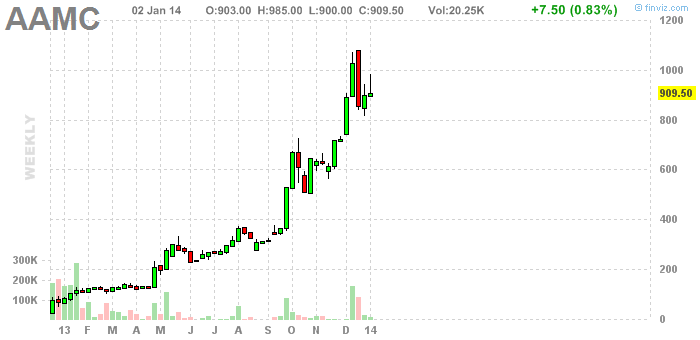
One might ask whether these two subjects - the notion of "Collective Punishment" and "The Corner" - intersect at a now $2bn dollar market cap Japanese electronics manufacturer called "Micronics" (Code# 6871). One could talk about absolute and relative valuation, growth prospects, market share, competitive analysis etc., all of which are at odds with a 60-fold increase in its share price since the start of 2013. As the chart up and left reveals, this is NOT a typo. SIXTY FOLD. And as with the focus of previous post about Altisource (AAMC), Micronics is not a penny-stock - depressed as its 2013 market cap was. They have no cure for cancer; they do not possess 3-D printing patents; they have nothing directly to do with the internet be it - gaming, e-payments, nor are they involved in biotech or nuclear cleanups or the newly-awarded Olympic games.
But whatever such incidentals as thematics fundamentals or valuation may reveal, they are more than likely wholly irrelevant to what very-well might be the world's single greatest non-micro-cap ramp-of-a-move. Yes, Mirconics is witnessing a recovery in their business and associated profit - an event that could (being generous) support a YEN2000 share price assuming one attaches a >20+ multiple to peak earnings, as it saw it do during the last recovery and accumulation in 2006. THAT move would have been nearly a 10-bagger from the depths it plunged - impressive by any means.
Apologists for such a move might suggest it is merely old-school retail speculation - the kind that vaulted Godo Shusei (2533), Nippon Carbon (5302), Matsuzakaya (8235) and Shinegawa Refractories (5351) to previously unimagined heights in back in1991, though these were likely the result of index art manipulation games employed on the least liquid names in order to game the absurdity of the Nikkei 255's price-weighting calculation method.
No. Something else is at work here. It is no ordinary speculative move or typical squeeze. It is a corner by ballsy operators. If the measure of success is the heights achieved by the share price, then they have been successful. They were in fact successful by any yardstick at the end of the calendar year 2013, an endpoint that raises suspicions as to whether the ultimate purchaser(s), whether individually or in concert, (who BTW have not filed requisite change of ownership details with the MoF), collected performance fees with respect to their achievements. And though shorts were granted a brief respite, the doubling again from YEN 5,000 to YEN 10,000 this month is curious. What is the endgame? Perhaps it is to squeeze the shorts completely in order to defray the eventual costs of exiting, which will come inevitably, and will be painful for longs on board for the ride. This is possible, but it ignores the breathtaking increase of risk. Perhaps, this unthinkable move is intended as a demonstrative form of collective punishment to shorts, who in the ordinary course of business, make operations more expensive, and less profitable, for speculative groups operating pump and dumps, and attempted corners on the long side. Killing innocents for the actions of the few has long proved to be an effective deterrent for future insurrections. Killing the shorts in a demonstrative show of force in Micronics, just might have the same effect upon pesky traders with a penchant for shorting the absurd.
Finally, one might wonder, for the sake of market integrity, just where is the MoF and exchange surveillance stand - whatever their residual loathing of (mostly foreign) short sellers might be….
When a penny stock doubles or triples, it is tempting to imagine nefarious operators pumping and dumping, in process, lightening the investment accounts of unsuspecting victims. And one would, most often, not be mistaken in such an assertion. Moving the prices of such (often fictitious, or nearly fictitious shells) is, after all, both easy and cheap. And in the off-chance the company itself proves uncooperative, well, one might surmise bad things might follow to key people. As one crawls up the cap scree, however, it gets more expensive for operators to move the price. Not only is there is a greater diversity of shareholders, who, in response to to a pump, might themselves very well dump before the operators themselves, but companies themselves might use the pop to issue stock, or make takeover plays with newly inflated scrip. Of further interest to the curious, in the grey areas, exist some bold traders who, with capital and a long leash, have learned the dark art of reflexively employing similar techniques (both long and short) to push entities into, and out of indices, dragging the not inconsiderable community of indexers (and their investors) haplessly along with them. Such operations are not without considerable risk, but thoughtfully researched and executed, more than compensate the brave with commensurate rewards. Get it right, and you can shift your considerable position to index funds who are reasonably obliged to purchase the stock, or buy back your short from their sale of shares in the eliminated company who market cap no longer qualifies them for inclusion (as the very result of the perps considerable short sales).
Sometimes operators - either alone in collusive groups - do manage to operate upon much larger companies. Sometimes this is because the operator themselves is a leviathan, and is willing to take their collective investment to well into the high teens precent of shares out. Sometimes, because the proverbial moons align, where price momentum, a narrow float, and other useful considerations allow something that, to traders or tape-readers, comes close to a classic "corner", of the likes perpetrated by The Hunt Brothers in silver, or Volkswagen shares by their friendly cousins at Porsche AG. The former was well-chronicled in Timothy Green's book "Beyond Greed", whilst the latter remains the subject of lawsuits by embittered hedge fund managers, suckered and snookered at their own game - lawsuits as hypocritical as David Einhorn's attempted pursuit of the "Micron Leaker", given that Mr Einhorn himself saw nothing amiss with dumping his entire 14% Punch stake the moment he discovered materially non-public info regarding the companies likely share sale.
One might ask whether these two subjects - the notion of "Collective Punishment" and "The Corner" - intersect at a now $2bn dollar market cap Japanese electronics manufacturer called "Micronics" (Code# 6871). One could talk about absolute and relative valuation, growth prospects, market share, competitive analysis etc., all of which are at odds with a 60-fold increase in its share price since the start of 2013. As the chart up and left reveals, this is NOT a typo. SIXTY FOLD. And as with the focus of previous post about Altisource (AAMC), Micronics is not a penny-stock - depressed as its 2013 market cap was. They have no cure for cancer; they do not possess 3-D printing patents; they have nothing directly to do with the internet be it - gaming, e-payments, nor are they involved in biotech or nuclear cleanups or the newly-awarded Olympic games.
But whatever such incidentals as thematics fundamentals or valuation may reveal, they are more than likely wholly irrelevant to what very-well might be the world's single greatest non-micro-cap ramp-of-a-move. Yes, Mirconics is witnessing a recovery in their business and associated profit - an event that could (being generous) support a YEN2000 share price assuming one attaches a >20+ multiple to peak earnings, as it saw it do during the last recovery and accumulation in 2006. THAT move would have been nearly a 10-bagger from the depths it plunged - impressive by any means.
Apologists for such a move might suggest it is merely old-school retail speculation - the kind that vaulted Godo Shusei (2533), Nippon Carbon (5302), Matsuzakaya (8235) and Shinegawa Refractories (5351) to previously unimagined heights in back in1991, though these were likely the result of index art manipulation games employed on the least liquid names in order to game the absurdity of the Nikkei 255's price-weighting calculation method.
No. Something else is at work here. It is no ordinary speculative move or typical squeeze. It is a corner by ballsy operators. If the measure of success is the heights achieved by the share price, then they have been successful. They were in fact successful by any yardstick at the end of the calendar year 2013, an endpoint that raises suspicions as to whether the ultimate purchaser(s), whether individually or in concert, (who BTW have not filed requisite change of ownership details with the MoF), collected performance fees with respect to their achievements. And though shorts were granted a brief respite, the doubling again from YEN 5,000 to YEN 10,000 this month is curious. What is the endgame? Perhaps it is to squeeze the shorts completely in order to defray the eventual costs of exiting, which will come inevitably, and will be painful for longs on board for the ride. This is possible, but it ignores the breathtaking increase of risk. Perhaps, this unthinkable move is intended as a demonstrative form of collective punishment to shorts, who in the ordinary course of business, make operations more expensive, and less profitable, for speculative groups operating pump and dumps, and attempted corners on the long side. Killing innocents for the actions of the few has long proved to be an effective deterrent for future insurrections. Killing the shorts in a demonstrative show of force in Micronics, just might have the same effect upon pesky traders with a penchant for shorting the absurd.
Finally, one might wonder, for the sake of market integrity, just where is the MoF and exchange surveillance stand - whatever their residual loathing of (mostly foreign) short sellers might be….
Wednesday, February 19, 2014
Something for Nothing ??
For a skeptic, I am generous in granting "the possible" underlying an investment thesis in pursuit of something like a boundary to its worth, however incredulous it, or its assumptions, may be. One can subsequently quibble over the details be it the forecasts, rates of discount, exogenous risk factors and so forth. As a skeptic, I am often at odds with the optimist, or a central case that involves the alignment of astral bodies, but it is rare that I just don't get the thesis, however flawed it's assumptions may be or prove to be, or however misplaced my Scottish sense-of-doubt.
AAMC is one of those rare instances where I continue to rub my eyes in disbelief at the market value attributed to income streams yet to materialize, however magical the annointed touch (and ownership) of Mr Erbey, or lucrative fruits of contractual obligations that will eventually flow to this obscure, though highly-prized vehicle, whose market cap peaked at more than $2,500,000,000, and currently resides still-north of the two-large-unit mark. My feelings oscillate between derision, awe, and wonderment. The awe derives from the reality that its value, as attributed by "the market", has increased twenty-fold in not much longer than it takes to bake a cake, emphasizing that it this not a twenty-fold increase in a penny stock. It is $2.2 billion of market cap approx 30% of which Mr Erbey, if he so chooses, can monetize into real currency to buy real things like a Yellowstone Club chalet, Gulf. IV or London Chelsky-Prospekt town home. And, for all we know, through structured transactions he may have already constructively done so. The wonderment derives from my ignorance into what future course of events will provide this fee-splitting recipient entity with the demonstrably large cash flows required to justify its ambitious market value (a wonderment which is less a skeptic's DOUBT as to their eventual arrival than a cry for some numerical quantification and justification). Network effects, scalability, rapid adoption and a global market are concepts I find easy to understand, and visualize in a spreadsheet with figures that rapidly add zeros to the end of increasingly-large numbers over time, and while I freely admit that I am not well-wired to invest effectively in this way on the long-side, such tangible forecasts of growth scare the bejesus of out of me on the short-side. This wonderment then leads to a plea: will someone please share their spreadsheet of the same for AAMC - the one that spawns additional zeros in future years like cancerous cell division - to satisfy my curiousity.
Apparently, some have such a spreadsheet or merely great confidence (or both) - in the thesis that will provide the cash-flow and the certitude of their arrival, evidenced by the large positions this unusual entity occupies in their portfolios. Long Pond Capital LP, Luxor Capital, Sab Capital Group, Tiger-Eye Capital, White-Elm Capital have (and it is not understatement) massive positions in this (with massive defined as a huge slug of said Hedge Fund investor's capital by any sensible risk-manager's measure). This is rounded out by FMR, Cap Research and Neuberger all with sizable positions, though not in relation to their behemoth size. Now, you would not be wrong if you detected a tad of derision (complementing the awe and wonderment), for all the arboreal southern-Connecticut-sounding buyers (except Long-Pond) appear to have hitched their investors' monetary wagons in Q3, no doubt the primary accelerating force in taking the shares from $250 at the end of Q2 to $500 at end of Q3. Together, (with the big-3), they represent approximately 50% of shares-out (80% with Erbey's apparent 30%), causing marginal purchases to have an amplified impact on the market price, and anyone who's been short, rather blue-in-the-ass. Though there is no evidence of collusion or a cartel, (however tempting this would be amongst friends) collectively, purchasers have, in Q3 and Q4 created "a lot of something-out-of-nothing".
Some will argue that mark-to-market is of less importance. They will discount ebbs and flows in market value fully understanding that they are, rather often, ephemeral. That may be true for a principal investor with said shares in their portfolio, but it is not most NOT for a hedge fund manager purchasing, holding, and/or purchasing more of said shares, . The Hedge Fund Manager, it should be highlighted, for the avoidance of doubt, realizes their profitable interest at the end of the performance period, (rather often Dec 31st.) crystallizing their profit share - independent of whether market-to-market profits are ultimately realized. They do, for the sake of fairness, concede to the investor a "high-water mark", before which they will not extract further performance, but this is a small bone of uncertainty with little tangible value, juxtaposed against the certainty of receiving what are to most observers, unimaginably-large sums of money. What remains for the investor, again for the avoidance of doubt, is still something ephemeral - minus 20% of the "profit" after costs. So looms that little chestnut known as "principal-agency conflicts".
Some (me included) will wonder why AAMC increased 40-fold from its opening print. Have it's prospects dramatically improved or was its initial post-spin-off price meaningfully undervalued (or perhaps both)? From cursory inspection, there appears to be no shortage of Machiavellian shell games within the Ocwen ecosystem that involve carving-up income streams and optimizing ownership amongst vehicles and and their domiciles. The benefits to non-executive shareholders may be uncertain, but the potential advantages for optimally-structured executive owners to advantage from aggressive structuring shouldn't be lost. Housing recovery convictions have also firmed. Some prescient investors flagged AAMC early, touting it's target value incredulously at multiples above the post spinoff price - upwards of $250 to $300 a share - which it quickly achieved via a dramatic triple in Q2 of '13. Allowing for a large error term in their forecasts, one might grant $500/shr (a $1bn market cap equivalent) - the heights it climbed by the end of Sept 2013, and which was the basis of quarterly filings of the last known positions. Yet with further little change in the housing market, or the firm's idiosyncratic prospects during Q4, AAMC's shares went positively priapic straight into the end of the year performance hedge fund finish line, taking the shares to more than $1000, and the market value of AAMC well north of $2bn. This may be coincidence, happenstance, or serendipity. Only the DTC may know.
Of course, it is possible that, $2bn is the correct value for AAMC, and that Mr Erbey gifted a massive increase market value to potential purchasers when AAMC was spun out. This may even be likely, for the tax consequences of transferring interests to more advantageous structures at low value are far more advantageous than doing the same the same at high value. If so, nice work if you can get it. However, I cannot purge from my skeptical mind that there is something more to the story than a bull-case for growing earnings in an Ocwen affiliate; more than short squeezes and hard-to-borrow securities. I remain curious, and think investors in funds with large positions would be prudent, themselves to understand what motivated their agents to accumulate large concentrated positions in an illiquid stock, and/or perhaps more importantly, to hold and even increase said positions to what to the uninformed is the point where hope might legitimately begin to exceed potential. And, if you find out and wish to share it, I will happily share it here.
AAMC is one of those rare instances where I continue to rub my eyes in disbelief at the market value attributed to income streams yet to materialize, however magical the annointed touch (and ownership) of Mr Erbey, or lucrative fruits of contractual obligations that will eventually flow to this obscure, though highly-prized vehicle, whose market cap peaked at more than $2,500,000,000, and currently resides still-north of the two-large-unit mark. My feelings oscillate between derision, awe, and wonderment. The awe derives from the reality that its value, as attributed by "the market", has increased twenty-fold in not much longer than it takes to bake a cake, emphasizing that it this not a twenty-fold increase in a penny stock. It is $2.2 billion of market cap approx 30% of which Mr Erbey, if he so chooses, can monetize into real currency to buy real things like a Yellowstone Club chalet, Gulf. IV or London Chelsky-Prospekt town home. And, for all we know, through structured transactions he may have already constructively done so. The wonderment derives from my ignorance into what future course of events will provide this fee-splitting recipient entity with the demonstrably large cash flows required to justify its ambitious market value (a wonderment which is less a skeptic's DOUBT as to their eventual arrival than a cry for some numerical quantification and justification). Network effects, scalability, rapid adoption and a global market are concepts I find easy to understand, and visualize in a spreadsheet with figures that rapidly add zeros to the end of increasingly-large numbers over time, and while I freely admit that I am not well-wired to invest effectively in this way on the long-side, such tangible forecasts of growth scare the bejesus of out of me on the short-side. This wonderment then leads to a plea: will someone please share their spreadsheet of the same for AAMC - the one that spawns additional zeros in future years like cancerous cell division - to satisfy my curiousity.
Apparently, some have such a spreadsheet or merely great confidence (or both) - in the thesis that will provide the cash-flow and the certitude of their arrival, evidenced by the large positions this unusual entity occupies in their portfolios. Long Pond Capital LP, Luxor Capital, Sab Capital Group, Tiger-Eye Capital, White-Elm Capital have (and it is not understatement) massive positions in this (with massive defined as a huge slug of said Hedge Fund investor's capital by any sensible risk-manager's measure). This is rounded out by FMR, Cap Research and Neuberger all with sizable positions, though not in relation to their behemoth size. Now, you would not be wrong if you detected a tad of derision (complementing the awe and wonderment), for all the arboreal southern-Connecticut-sounding buyers (except Long-Pond) appear to have hitched their investors' monetary wagons in Q3, no doubt the primary accelerating force in taking the shares from $250 at the end of Q2 to $500 at end of Q3. Together, (with the big-3), they represent approximately 50% of shares-out (80% with Erbey's apparent 30%), causing marginal purchases to have an amplified impact on the market price, and anyone who's been short, rather blue-in-the-ass. Though there is no evidence of collusion or a cartel, (however tempting this would be amongst friends) collectively, purchasers have, in Q3 and Q4 created "a lot of something-out-of-nothing".
Some will argue that mark-to-market is of less importance. They will discount ebbs and flows in market value fully understanding that they are, rather often, ephemeral. That may be true for a principal investor with said shares in their portfolio, but it is not most NOT for a hedge fund manager purchasing, holding, and/or purchasing more of said shares, . The Hedge Fund Manager, it should be highlighted, for the avoidance of doubt, realizes their profitable interest at the end of the performance period, (rather often Dec 31st.) crystallizing their profit share - independent of whether market-to-market profits are ultimately realized. They do, for the sake of fairness, concede to the investor a "high-water mark", before which they will not extract further performance, but this is a small bone of uncertainty with little tangible value, juxtaposed against the certainty of receiving what are to most observers, unimaginably-large sums of money. What remains for the investor, again for the avoidance of doubt, is still something ephemeral - minus 20% of the "profit" after costs. So looms that little chestnut known as "principal-agency conflicts".
Some (me included) will wonder why AAMC increased 40-fold from its opening print. Have it's prospects dramatically improved or was its initial post-spin-off price meaningfully undervalued (or perhaps both)? From cursory inspection, there appears to be no shortage of Machiavellian shell games within the Ocwen ecosystem that involve carving-up income streams and optimizing ownership amongst vehicles and and their domiciles. The benefits to non-executive shareholders may be uncertain, but the potential advantages for optimally-structured executive owners to advantage from aggressive structuring shouldn't be lost. Housing recovery convictions have also firmed. Some prescient investors flagged AAMC early, touting it's target value incredulously at multiples above the post spinoff price - upwards of $250 to $300 a share - which it quickly achieved via a dramatic triple in Q2 of '13. Allowing for a large error term in their forecasts, one might grant $500/shr (a $1bn market cap equivalent) - the heights it climbed by the end of Sept 2013, and which was the basis of quarterly filings of the last known positions. Yet with further little change in the housing market, or the firm's idiosyncratic prospects during Q4, AAMC's shares went positively priapic straight into the end of the year performance hedge fund finish line, taking the shares to more than $1000, and the market value of AAMC well north of $2bn. This may be coincidence, happenstance, or serendipity. Only the DTC may know.
Of course, it is possible that, $2bn is the correct value for AAMC, and that Mr Erbey gifted a massive increase market value to potential purchasers when AAMC was spun out. This may even be likely, for the tax consequences of transferring interests to more advantageous structures at low value are far more advantageous than doing the same the same at high value. If so, nice work if you can get it. However, I cannot purge from my skeptical mind that there is something more to the story than a bull-case for growing earnings in an Ocwen affiliate; more than short squeezes and hard-to-borrow securities. I remain curious, and think investors in funds with large positions would be prudent, themselves to understand what motivated their agents to accumulate large concentrated positions in an illiquid stock, and/or perhaps more importantly, to hold and even increase said positions to what to the uninformed is the point where hope might legitimately begin to exceed potential. And, if you find out and wish to share it, I will happily share it here.
Monday, February 03, 2014
An About-Face Regarding ZH Conspiracy Theories
ZeroHedgeEnigma House1 Underabigrockov Square
Sofia
Bulgaria
RE: An Apology
Dear ZeroHedge,I am sorry. Evidently, I was wrong about conspiracy, more specifically, the US Government's pursuit of what must be one of, if not THE world's biggest: the hoovering-up (no pun intended) storage and analysis of the entire world's digital and voice information. In the past, I derided your cherished belief in a US Government Puppeteer-like Plunge-Protection Team on the Ockham-inspired grounds that it would be virtually impossible to undertake what was alleged without at least some whistle-blowers, co-conspirators and/or enablers coming forward with evidence to expose such actions. I was quick to point out the glaring inconsistency to your argument that mocked what you saw as the US Government's apparent ineptitude in Agriculture, Healthcare, Securities Market regulation, Welfare, Military Purchasing, Industrial Policy, FEMA, as well as Fiscal and Monetary policies, yet somehow managed to confer an ability to implement and perpetuate Machiavellian manipulations and direct interventions in financial markets to great success (and to the chagrin of perma-bears and pessimists alike) without ever getting get caught.Now, looking at what the NSA has accomplished, more or less without general disclosure until recently, ranging from their ability to access and subsequent archiving of every digital and voice communication, to the ubiquitous tools built-in to every device and every information orifice everywhere in order to access whatever it wants, whenever it so desires, it is apparent that not only is the US Government awe-inspiring in the scope, breadth and efficiency of what it can accomplish when it sets it sights on it, but people are now ascribing near-omnipotence to its abilities, so much so that at a dinner the other night, I was told in no uncertain terms, that "they" can activate one's phone - even when it's powered off - and use it to listen to surrounding conversations. Irrespective of whether or not it's true, the point is that it's powers and abilities are now-deemed so great, detractors are afraid of what and how (whether premeditatedly or inadvertently) they might be used.Of course, the government has not been without their successes in the past in areas such as funding university research, DARPA, US Nuclear Weapons development, NASA, Hubble, TVA, National Highway System, NOAA, USGS, CDC, etc. These are conveniently expunged from Libertarian derision of The State. But Snowden's revelations of the NSA's awesome prowess, giving it near-total electronic omniscience, should humble observers and silence all doubters, irrespective of whether or not one agrees with their objective, and give the US Government maximum respect for its powers of organization, implementation and efficiency, to the point where even a skeptic like me must concede the possibility that a PPT might, at the very least, actually exist. I'm not saying it (an Oz-like Wizard at the helm) DOES, but it seems that such a minor undertaking, in light of recent revelations, is well within their capabilities. What say YOU WikiLeaks?So impressive is the US Govt's can-do mobilization of resources to achieve an objective when it wants to, one can only imagine the inspired possibilities were our now-exposed, highly-motivated, best and brightest, to tackle something like Single-Payer Healthcare, ubiquitous quality Education, forward-thinking Energy Policy, and even Inequality. Vanquished is the image of the US Government as a tree-house for plodding lazy job-for-life postal workers, replaced with not only "men-with-a-plan", but the wherewithal to realize it with the same focus that put Neil Armstrong on the moon (understanding ZH'ers reservations as to the veracity of this event).
Somewhat more controversially, consider that with the NSA's complete-and-total data-acquisition and mining infrastructure at its disposal, we might banish Medicare fraud, Welfare cheats, Defense contractor malfeasance, Co.'s flouting environmental regulations, Govt contractor bid-riggings, bridge-closings, bogus analyst recommendations, HFT collusion, Bernie Madoff, self-detonating CDOs, and even incontrovertibly-nail GOOG, AMZN, & SBUX for rather obvious and cynical tax evasion ploys are surely just a hop, skip and several keystrokes away. No wonder the latter are becoming uncomfortable with their prior cooperation. A tad Orwellian, one might ponder? Perhaps. But since it is out there, is it not worth asking whether our (and it IS "ours") rather impressive machinery might not, at the very least, be targeted at enhancing the wider Public Interest in more generally protective ways? "No more secrets" cuts both ways.
Once again, mea culpa for doubting you, and I look forward to your help in conceiving how awesomely the US Government will achieve similar efficiency and success in Healthcare, Education, and Transport when we approach these issues with equal resolve, as we have demonstrated in the manipulation of markets and God-like elimination of all secrets from the electronic sphere.Yours truly
Cassandra
Wednesday, December 18, 2013
On the Connection between Syd Barrett & Some Financial Pundits
The 60s were wild, enthralling, and revolutionary but just as often simply weird and stupid. Take "Syd" Barrett, the founder, frontman, and indeed inspiration, for rock legends, Pink Floyd. He propelled something innovative, gained notoriety when doing weird stuff was viewed as virtuous. Yet, much of what he personally created has not, in all honesty, survived the test of time. It was, in the main, school-boy playtime under the influence of copious amounts of LSD (itself no crime at the time) that might have entertained himself and those similarly dosed (including record producers and music consumers at the time) but which with hindsight sounds as disassociated and unlistenable as Barrett was wigged out. Needless to remind anyone, Pink Floyd (ex-Barrett) went on to create dramatic lasting electro-psychedelic-rock - most (though not all) of which, far from bering gratuitously-self-indulgant, was sparse, contemplative, and has contrary to Barrett's Pink Floyd, has, until now, survived the test of time.
Yet "Syd" Barrett certainly had his moments of brilliance and lucidity such as the little ditty known as "Bob Dylan Blues" (youtube insert above left and a must-listen
Got the Bob Dylan blues
And the Bob Dylan shoes
And my clothes and my hair's in a mess
But you know I just couldn't care less
Gonna write me a song
'bout what's right and what's wrong
Got God and my girl and all that;
Quiet while I make like a cat
Cause I'm a poet,
doncha know it
And the wind -
you can blow it
Cause I'm Mr. Dylan the king
And I'm free as a bird on the wing
Roam from town to town,
get to get people down
But I don't care too much about that
Cause my gut and my wallet are fat
Make a whole lot of dough
but I deserve it though
I got soul and a good heart of gold
So I'll sing about war and the cold
Cause I'm a poet,
doncha know it
And the wind -
you can blow it
Cause I'm Mr. Dylan the king
And I'm free as a bird on the wing
Well I sings about dreams
and I rhymes it with seams
Cause it seems that my dream always means
That I can prophesy all kinds of things
Well the guy that digs me
Should try hard to see
That he buys all my discs in a hat.
And when I'm in town go see that.
Cause I'm a poet,
doncha know it
And the wind -
you can blow it
Cause I'm Mr. Dylan the king
And I'm free as a bird on the wing
So, Barrett was on the right track in the framing of big picture, despite what one might call abysmal execution - so abysmal he was unable to to see through his creation, and spent the latter two-thirds of his life somewhat tragically in more or less solitude, unable or unwilling to re-engage or re-associate. Talking about being early in calling a top. By contrast, the seemingly dis-ingenuine bull-market creation that was Bob Dylan went from strength to strength, continuing irrespective of his periodic setbacks (a motorcycle crash, and born-again religious episode) for what is now nearly half a century. "Syd" may have been "right" about young Robert Zimmerman from small-town Minnesota, but the victory was pyrrhic, and Dylan, despite the flaws and warts and vanity and disingenuousness highlighted by Barrett (as well as Baez and many others) continued to create great art. Perhaps Dylan confronted and overcame them. Perhaps such flaws are both integral and necessary to success. Perhaps Barrett's view itself though written with at least some admiration, was driven by incipient paranoia and jealousy. The why may not actually be of import.
When I think of today's perma-bears (and they ARE today's because yesterday's are long-since forgotten) - such as Faber, ZeroHedge, Shedlock, Keiser, etc. i.e. those that out of true belief, or demagogic chicanery, see black where there is white (or at the very least it could break either way); conjure an image of imminent doom in place of the more probable ploddingness of humanity; and feel it their duty (or way to scrape a living) to point out to others what they see as the primacy of "the dark side", in regards to every imaginable subject from the incipient threat of liberalism or progressivism, immigration, the past unraveling and impending re-unraveling of the financial system with visions of collapse evident in each and every headline, I cannot help but think of Syd Barrett. For one would be challenged to find perm-bears who have productively created anything positive - in thought, ideas, or public policy - or who, like Dylan, despite his obvious flaws, has survived the test of time in anything other than the entertainment or financialnewsletterwriting business pandering to pessimists and preying upon those ignorantly or genetically predisposed to end-of-the-world-ism. It is a vile occupation that results in penury for its acolytes.
Undoubtedly, the market will fluctuate. In all likelihood - it will suffer a major setback at sometime (or times) in the future, just as it has in the past, whether it be in response to war, recession, natural disaster, cumulative bad policy mistakes, bad luck, or just plain over-speculation. Perma-bears may even be right about the eventual collapse of society, the rapture, bitcoins, gold, and the decay of government and the financial system as we know it. But validation of such nebulous things is unlikely to arrive tomorrow, or next year, or on a time-scale and with a probability that is actionable - even if (and its a big if) they are eventually right. The negatively-biased lens (as with many other strongly-biased lens) is neither a way to invest, nor live one's life, though there is no shortage of blow-hard charlatans that will fill any space granted with their repetitive warnings of imminent doom to placate one's fears. Note that this is not an argument for blind momentum investing, nor a justification to eschew the healthy skepticism or risk-reward framework one should embrace in assessing any potential investment or strategy. Rather, it is a plea to identify and avoid inflexible thinkers whose conclusions are pre-determined. For like Syd Barrett, fifty years (and counting) is a long-time - nearly a lifetime - to wait for the rest of the world to come around (if ever they do) to one's point of view.
Monday, December 16, 2013
That Zero Hedge Xmas Party Menu (in Full)
MENU
Zero Hedge Xmas Party - 2013
DRINKS & SNACKS
Harboe's 'Bear Beer' (12%!!)
Deschutes' 'The Abyss'
Stone's 'Sublimely Self-Righteous'
Surly's 'Furious'
North Coast's 'Old Rasputin'
Dark-'n'-Stormy's
Golden Tequila Shooters
Bloody Marys's
Rum 'Hurricanes'
Rum 'Hurricanes'
Cheese Doodles
Spicy Burnt Almonds
Mixed Salted Nuts
Mixed Salted Nuts
* * * * * * *
FIRST COURSE
(All you can eat Buffet)
Crab & Bitter Greens Dip
'Scalded' Short Ribs
"Crock-Pot" Turkey Meatballs
Smoked & Skewered Grouper
* * * * * * *
MAIN COURSE
Deep-Fried Turkey w/Freedom Fries
or
Slow-Cooked Goose w/Sage & Cracked-Nut Stuffing Roadkill Potatoes
or
Wiener Schnitzel with Sour Cabbage & Short Grain Rice
or
Ostrich Burgers w/Half-baked Mac-Cheese
or
Traditional Bulgarian Xmas "Sarmi" (for 'Tyler')
* * * * * * *
DESSERT
Silver-Dollar 'Crepes'
Austrian Strudel
Upside-Down Cake w/Burnt Butter Icing
Humble Pie
* * * * *
PETITS-FOURS
Shortbread Cookies
Ding Dongs
Ding Dongs
(upbeat festive music provided courtesy Leonard Cohen)
Monday, December 09, 2013
What's in a Name?
Japanese have long been criticised for being overly conformist and insufficiently creative. This is unfair, if not untrue demonstrated by the Nobel Literature Prize recently awarded to Murakami, and the increasing representation of Japanese brands outside the realm of consumer electronics, and, I might add, Olympus Corporation's daringly-creative plan to sweep away $1.2bn of zaitech losses by burying them in the acquisition prices of several hokey takeovers.
Perhaps the most overlooked area of creativity in Japan however is the pith and humour employed in the naming of some of the their listed enterprises. In America, Branding & Identity has long been approached seriously and (in my opinion) over-earnestly save the departure that brought us "Yahoo!" and "Google". So successful, in fact, was this attempt to fabricate a name that in one fell swoop conjures the image of the product, a sense of iconclastic fun, with fragments of some of the vertical's keyword or key aspects along with an almost certainly-contrived onamonapia (think Uber, Twitter, Vimeo, etc.) that our brains are now filled with senseless near-names that all blend together in some Sand Hill Road pitchbook nightmare.
While the Japanese undoubtedly have their earnestly named companies, and have wrestled with the delicate identity issues (a fun read!!) that result from M&A, contrary to their boring and humourless stereotype, they also have a bevy of the most deliciously-named companies as outlandish and unusual as a dozen Elvis' in Yoyogi Park (at least to the western observer with a sense of the absurd).
Take code #6630, or "Ya Man" Co Ltd, peddlers of ridiculous-looking "Weight-Shape Belts" whose function, even after close inspection, remains a mystery though it appears to have something to do with "toning". If their weight-shape belts hold no allure, then their Facerciser (avail in Pink White or Gold) might. While looks like a battery-operated roll-on deodorant vessel, it (allegedly) "mechanically taps the face mimicking (sic) a professional aesthetician's (sic) hand massage" though it may secretly have other, more umm errr adventuresome uses. I am not sure if the "Ya-Man" moniker reflects the founders' love of Reggae or the high-fives they give each other when some sucker buys their weight shape belts....
To combat the need for re-engaging branding consultants every time one changes business, #1408 has come up with the perfect solution by calling themselves "Something Holdings". This creatively-brilliant strategy insures that no matter business line they pursue, their company name will always be relevant (or at the very least not irrelevant).
Snobbishness of the patrician-sort conjured by venerable names like "First Boston", Morgan Grenfell, or Goldman Sachs" was not the objective of #8542, better know as Tomato Bank, a name that has not failed to sophmorically-amuse me for twenty-five years conjuring lurid visions of customers depositing tomatoes and withdrawing ketchup (or Catsup or Tomato Sauce for you Brits). Of course no one laughs at Apple Computer, but Tomato bank still seems a stretch even though a Chinese-owned FDIC-insured bank in California sports the same name.
Being creative is, however, hit or miss. Take #3845, rather frighteningly called i-Freek Co Ltd. not terribly sympathetic with its target audience of 3-to-6 years with web-based content. It sounds more like an on-line purveyor of illicit paraphernalia and other nefarious stuff, but hey, maybe in Japanese it sounds a whole lot more warm and fuzzy than the name (and respresentative character to the right) imply.
At times "the miss" can be a veritable disaster or the corporate branding equivalent of an "own goal". Take relatively fast-growing fashion-retailer #2185, which was formerly known as "Point Ltd", a rather innocuous but focused name that conveyed a stream-lined sense of purpose. But recently, they changed their name to ummm ...errrr ..."Adastria" a worse-than-meaningless fabrication which is a near-anagram for "DISASTER" - exactly the thing investors wish to avoid. Someone clearly didn't do their homework which is why all such rebranding exercises should be sent through the "let's take the team out, drink lots and ruminate about it" wringer.
In case there are any doubts that the Japanese possess a sense of humour to balance their creativity one only need contemplate the brilliance of what was formerly #7553, known as "Sazaby", an obscure opportunistic hustler-of-firm who was Starbuck's original partner in Japan. How creative and opportunistic one might ask? Wanting panache and being desirious of instant-brand-name recognition, they thought the prefect name and image was the venerable Sotheby's, though this was already trademarked.... at least in English, and at least to the letter. Now, channel your best native Japanese, and imagine you wish to travel to London or NY to bid on some impressionist pieces (like for example Van Gogh's 'Portrait of Dr Gachet'). Where would you instruct your assistant to make arrangements to? Sazaby's of course...
I have always found it difficult, however good the underlying business night be, to pull the trigger on the shares of accompany whose name could be construed as prophetic. I can imagine nightmarishly-replaying the scene where an investor gets sarcastic with me about #2674, asking how, pray-tell, I could imagine that "The Hard Off Corporation" had any possible allure outside its comedic value, irrespective of the quality bargains available in a shop selling used merchandise in a nation with a strong aversion to second-hand goods. So strong is this aversion, that there is a massive market in buying quality Kawai and Yamaha Pianos, and shipping these used beauties in bulk to all the major markets. Despite these attractions, there is something creepy about the name, so I continue to leave it alone.
#3165, Fuhrmeister Electronics is just plain bizarre. It is, quite literally, a made-up name, maybe even a joke-name like Naughtius Maximus or Biggus Dickus. The Japanese have a keen mutual respect for the Germans that goes back a long way, forming the basis of many-a-strategic-alliance - particularly in auto-components where quality, engineering prowess, and order are important. And while "Fuhr" and "Fuhrer" are NOT the same thing in German, it is bold to go down THAT route to branding taking into account recent history. Anyone with insight into this, please do tell.
Entrpreneurs are usually Do-Ers which sets them apart from armchair quarterbacks, and pub-dwelling know-it-alls. This is why investors might view #4287 with some trepidation. Perhaps if "Just Planning Co. Ltd" were an architectural firm, the name might be apt, but for a real estate developer, they could have done with something less descriptive of precisely the thing you want your developer to do with your investment capital: sit on their hands.
You would have to truly be one of the least curious human beings to not want to know precisely what #4331, "Take & Give Needs Co. Ltd"actually did as a line of business. A pawn shop? A conveyor-belt sushi establishment? Private refuse collection? Personal valet service? Nope. It's a USD$275mm Wedding provider. Why did they name it so? One might romantically think it reflects the exchange of wedding vows but really it is because Take & Give reflects the Pump & Dump when it was run-up from YEN1000 to YEN20,000, before taking all investors' money enroute to YEN200/shr. It is currently in 'Giving" mode hovering at YEN2000 (from its pre-Abenomics level of YEN600.
Of all the things one might wish their business to be labelled, "quixotic" is probably not amongst them. Yet taking the proverbial bull by the horns (no pun intended) is precisely what #7532 did on choosing to call itself "Don Quijote". In true heroic fashion (again no pun intended) they overcome the burden of their name, and contrary to the prejudices it implies, have grown rapidly, and more or less continuously, rewarding investors who've backed 'the dreamer.'
Irony, too is present, in Japanese stock names and codes. While the meaning of symbols is different across cultures, I still find it odd to name your designer of infant clothes #7956, "Pigeon Corporation". Not that pigeons can't be cute - I am sure a good artist can conjure a cuddly likeness. But perhaps the somewhat obscure though humorous allusion between pigeons and babies was to the mess they both leave behind. Fortunately, the adjacent company #7955 is omnisciently and fortuitously-called "Cleanup Corporation".
It is hard to say that changing #4631, the Dai Nippon Ink & Chemical Company's name to "DIC" was not without attendant risks. #2180 or "Sunny-Side Up" makes me smile whenever I see it which was likely their intention. But my favorite, as an english speaker, is the pure poetry of @2904 the seafood paste maker "Ichimasa Kamaboko". I know in Japanese "kamaboko" sets the digestive juices in motion, but to me, it conjures images of a West-African beach, colourful Jimmy Hendrix style-daishiki's as the words Ichimasa Kamaboko roll off the tongue of Eddie Murphy fabulous parody (Merry New Year!) in what is likely every trader's favourite movie, Trading Places.
Perhaps the most overlooked area of creativity in Japan however is the pith and humour employed in the naming of some of the their listed enterprises. In America, Branding & Identity has long been approached seriously and (in my opinion) over-earnestly save the departure that brought us "Yahoo!" and "Google". So successful, in fact, was this attempt to fabricate a name that in one fell swoop conjures the image of the product, a sense of iconclastic fun, with fragments of some of the vertical's keyword or key aspects along with an almost certainly-contrived onamonapia (think Uber, Twitter, Vimeo, etc.) that our brains are now filled with senseless near-names that all blend together in some Sand Hill Road pitchbook nightmare.
While the Japanese undoubtedly have their earnestly named companies, and have wrestled with the delicate identity issues (a fun read!!) that result from M&A, contrary to their boring and humourless stereotype, they also have a bevy of the most deliciously-named companies as outlandish and unusual as a dozen Elvis' in Yoyogi Park (at least to the western observer with a sense of the absurd).
Take code #6630, or "Ya Man" Co Ltd, peddlers of ridiculous-looking "Weight-Shape Belts" whose function, even after close inspection, remains a mystery though it appears to have something to do with "toning". If their weight-shape belts hold no allure, then their Facerciser (avail in Pink White or Gold) might. While looks like a battery-operated roll-on deodorant vessel, it (allegedly) "mechanically taps the face mimicking (sic) a professional aesthetician's (sic) hand massage" though it may secretly have other, more umm errr adventuresome uses. I am not sure if the "Ya-Man" moniker reflects the founders' love of Reggae or the high-fives they give each other when some sucker buys their weight shape belts....
To combat the need for re-engaging branding consultants every time one changes business, #1408 has come up with the perfect solution by calling themselves "Something Holdings". This creatively-brilliant strategy insures that no matter business line they pursue, their company name will always be relevant (or at the very least not irrelevant).
Snobbishness of the patrician-sort conjured by venerable names like "First Boston", Morgan Grenfell, or Goldman Sachs" was not the objective of #8542, better know as Tomato Bank, a name that has not failed to sophmorically-amuse me for twenty-five years conjuring lurid visions of customers depositing tomatoes and withdrawing ketchup (or Catsup or Tomato Sauce for you Brits). Of course no one laughs at Apple Computer, but Tomato bank still seems a stretch even though a Chinese-owned FDIC-insured bank in California sports the same name.
Being creative is, however, hit or miss. Take #3845, rather frighteningly called i-Freek Co Ltd. not terribly sympathetic with its target audience of 3-to-6 years with web-based content. It sounds more like an on-line purveyor of illicit paraphernalia and other nefarious stuff, but hey, maybe in Japanese it sounds a whole lot more warm and fuzzy than the name (and respresentative character to the right) imply. At times "the miss" can be a veritable disaster or the corporate branding equivalent of an "own goal". Take relatively fast-growing fashion-retailer #2185, which was formerly known as "Point Ltd", a rather innocuous but focused name that conveyed a stream-lined sense of purpose. But recently, they changed their name to ummm ...errrr ..."Adastria" a worse-than-meaningless fabrication which is a near-anagram for "DISASTER" - exactly the thing investors wish to avoid. Someone clearly didn't do their homework which is why all such rebranding exercises should be sent through the "let's take the team out, drink lots and ruminate about it" wringer.
In case there are any doubts that the Japanese possess a sense of humour to balance their creativity one only need contemplate the brilliance of what was formerly #7553, known as "Sazaby", an obscure opportunistic hustler-of-firm who was Starbuck's original partner in Japan. How creative and opportunistic one might ask? Wanting panache and being desirious of instant-brand-name recognition, they thought the prefect name and image was the venerable Sotheby's, though this was already trademarked.... at least in English, and at least to the letter. Now, channel your best native Japanese, and imagine you wish to travel to London or NY to bid on some impressionist pieces (like for example Van Gogh's 'Portrait of Dr Gachet'). Where would you instruct your assistant to make arrangements to? Sazaby's of course...
I have always found it difficult, however good the underlying business night be, to pull the trigger on the shares of accompany whose name could be construed as prophetic. I can imagine nightmarishly-replaying the scene where an investor gets sarcastic with me about #2674, asking how, pray-tell, I could imagine that "The Hard Off Corporation" had any possible allure outside its comedic value, irrespective of the quality bargains available in a shop selling used merchandise in a nation with a strong aversion to second-hand goods. So strong is this aversion, that there is a massive market in buying quality Kawai and Yamaha Pianos, and shipping these used beauties in bulk to all the major markets. Despite these attractions, there is something creepy about the name, so I continue to leave it alone.
#3165, Fuhrmeister Electronics is just plain bizarre. It is, quite literally, a made-up name, maybe even a joke-name like Naughtius Maximus or Biggus Dickus. The Japanese have a keen mutual respect for the Germans that goes back a long way, forming the basis of many-a-strategic-alliance - particularly in auto-components where quality, engineering prowess, and order are important. And while "Fuhr" and "Fuhrer" are NOT the same thing in German, it is bold to go down THAT route to branding taking into account recent history. Anyone with insight into this, please do tell.
Entrpreneurs are usually Do-Ers which sets them apart from armchair quarterbacks, and pub-dwelling know-it-alls. This is why investors might view #4287 with some trepidation. Perhaps if "Just Planning Co. Ltd" were an architectural firm, the name might be apt, but for a real estate developer, they could have done with something less descriptive of precisely the thing you want your developer to do with your investment capital: sit on their hands.
You would have to truly be one of the least curious human beings to not want to know precisely what #4331, "Take & Give Needs Co. Ltd"actually did as a line of business. A pawn shop? A conveyor-belt sushi establishment? Private refuse collection? Personal valet service? Nope. It's a USD$275mm Wedding provider. Why did they name it so? One might romantically think it reflects the exchange of wedding vows but really it is because Take & Give reflects the Pump & Dump when it was run-up from YEN1000 to YEN20,000, before taking all investors' money enroute to YEN200/shr. It is currently in 'Giving" mode hovering at YEN2000 (from its pre-Abenomics level of YEN600.
Of all the things one might wish their business to be labelled, "quixotic" is probably not amongst them. Yet taking the proverbial bull by the horns (no pun intended) is precisely what #7532 did on choosing to call itself "Don Quijote". In true heroic fashion (again no pun intended) they overcome the burden of their name, and contrary to the prejudices it implies, have grown rapidly, and more or less continuously, rewarding investors who've backed 'the dreamer.'
Irony, too is present, in Japanese stock names and codes. While the meaning of symbols is different across cultures, I still find it odd to name your designer of infant clothes #7956, "Pigeon Corporation". Not that pigeons can't be cute - I am sure a good artist can conjure a cuddly likeness. But perhaps the somewhat obscure though humorous allusion between pigeons and babies was to the mess they both leave behind. Fortunately, the adjacent company #7955 is omnisciently and fortuitously-called "Cleanup Corporation".
It is hard to say that changing #4631, the Dai Nippon Ink & Chemical Company's name to "DIC" was not without attendant risks. #2180 or "Sunny-Side Up" makes me smile whenever I see it which was likely their intention. But my favorite, as an english speaker, is the pure poetry of @2904 the seafood paste maker "Ichimasa Kamaboko". I know in Japanese "kamaboko" sets the digestive juices in motion, but to me, it conjures images of a West-African beach, colourful Jimmy Hendrix style-daishiki's as the words Ichimasa Kamaboko roll off the tongue of Eddie Murphy fabulous parody (Merry New Year!) in what is likely every trader's favourite movie, Trading Places.
Subscribe to:
Comments (Atom)