To be sure, there is much derision being directed towards QE, in general and QE3 in particular. Permabearish writer-strategist-entertainers Faber & Edwards use such hyperbolic language as "The Fed Will Destroy The World", a soundbyte made for and lapped up by the ZeroHedge faithful frightened that QE is a conspiracy that is about to cause hyperinflation. Others are more measured and eloquent, but no less critical.
So it comes as some surprise that the eminent Johns Hopkins economist, advisor to TheGoldStandardNow.Org, and renowned specialist in Global Hyperinflation(s) Professor Steve Hanke, in an interview with Massar & McKee over at Bloomberg not only completely dismissed the idea that hyperinflation (or Hyperinflation) is lurking around the corner or ready to pop-up its head like a angry gopher, but explained that contrary to the popular belief that an excess of money is resulting from all the QE exercises - the alleged money that has caused paranoid chicken-littles to make a beeline to Home Depot and purchase a wheelbarrow for imminent use - Dr Hanke suggests that there is not enough money, and that it's this shortfall (not its price) which is holding back the growth of the economy.
Hanke's argument rests upon the fact while the Fed's balance sheet has indeed grown this "State Money" (as he terms it) is a small fraction of the overall money supply - which he terms Private Money, conjured privately by financial institutions, it has grown much less than the overall money supply has shrunk. So not only does Dr Hanke NOT fear hyperinflation, he believes the balance of risk remains DEFLATION, and that under the circumstances the Fed is not doing enough.
Now, it is important to understand that he is NOT a Krugmanerian. Or a SimonJohnsonian. Hanke believes the problem is regulation - both Dodd-Frank Basel III, the combination of which is causing banks not NOT to increase their balance sheets (depsite the excess of reserves) but to continue to Shrink their balance sheets. So he would very much prefer rollback of these to QE which is a far cry from liking QE. But he is pragmatic in ackowledging that under the circumstances of deleveraging, the Fed - far from causing inflation - is just barely keeping things from deflating, view not dissimilar to Richard Koo's interpretation. So in a nutshell, remove the chastity belts from the banks, and growth (and employment) will return.
Personally I am sympathetic towards the view that QE(eze) is a tempest in a teapot and will prove to have little to no inflationary impact so long as broad money is shrinking. And I also think there is potential merit in delaying Basel III should this be helpful to general confidence. As for the Fed's ability to exit QE if authorities make a U-Turn and follow his advice, he is less sanguine - a fear I do contemplate when trying to estimate how many phone-calls it would take to offload 4 or 5 Trillion dollars in longer-duration Treasury or MBS securities. For sound-money lovers, fiscal conservatives, Ron Paul or Paul Ryan or any inflation-phobist, however, it is worthwhile to listen to a rational view contrary to their own by on of their own.
Monday, October 01, 2012
Friday, September 28, 2012
Slow Burn
I chanced upon an old friend, Tommy Crown, recently. We were both born in the same decade - and though I was older, he was more senior in all respects. While I was a product of the baby boom, he was a product of one of the golden ages in American film-making. It was good to see him again after all the years that have passed. We've both aged - no doubt - but his theme, The Windmills of Your Mind, remains as enchanting as ever.
Relatively speaking, my life has been ordinary, whereas Tommy's has been both enigmatic and exciting. At least comparatively-speaking for 1968. Then, it was the statesmen, politicians, writers and actors were envied, emulated and placed upon pedestals. Tommy, on the other hand, was a secretive financier. Arbitrage. Foreign Exchange. Private Geneva-based Swiss Banks with numbered accounts. A rarefied world not only unknown to, but obscure and unheard of, by most. He was rich and lived very well indeed. Tailored suits, finest restaurants, art auctions, a large house in the middle of the city with an interior compound complete with full-time butler, expensive cars, thrilling but patrician passtimes (polo, gliding etc.) the secluded beach house. How rich? According to the police, briefing the lovely insurance investigator (played by the lovely Faye Dunaway in a performance only outdone by Chinatown), he was divorced (wife got the kids) and worth... wait for it... FOUR MILLION BUCKS!!! Messrs. Soros, Simons, Griffin and Cohen would be laughing in their beards should they chance upon Tommy and his feeble net worth now! And yet, despite that money, and his hobbies, that didn't stop him from getting bored.
But that was more than forty years ago. And during the intervening time, Tommy's fine tastes have, without exclusion, been popularized and lifestyle replicated by all who can, and even surpassed in material terms (Tommy never 'flew private' and had no insecure nouveau riche desire for 20,000, 30,000 or 40,000 square feet of gold-leafed, mirrored vulgarity or a ridiculuous oversized stinkpot. In fact, HIS beach pad was a an elevated platform set amidst the isolated dunes. During this intervening time, we have seen hot wars and cold wars, double-digit inflation, high double-digit interest rates - both at the long and short ends, recession, the deepest of bear markets and the most exhuberant of bull runs. Market Crashes lasting months, a week, a day, or just hours. We have endured scarcity and swam in plenty. Suffered quadrupling of our energy staples in short times, and seen it diminish in price by 75%. We've witnessed leaders assasinated like ducks from a blind, airplanes flown into buildings, not to mention several nuclear accidents and meltdowns. We seen arbitrage, foreign exchange, and finance go from being mysterious to a place in our society where every newly-minted Ivy MBA doing an analyst stint at an IB or management Consultancy wants to be Hedge Fund Manager. Statesmen, it would seem, are no longer 'de rigeur', nor the envy of the educated and aspirational class. Oh, and did I mention that we've seen 'inflation'?
Yes, amongst all the volatility and tectonic change, inflation has been (along with environmental degradation, technological innovation) one of the few constants. Tommy Crown probably would have done alright. Some fine Art. Prime Real Estate - both city and beachfront. A portfolio of Blue Chip Stocks. Some Precious Metals. Oh yes, Tommy's net worth if he stayed the course, wasn't leveraged (in the wrong place(s), at the wrong time(s)), would easily be worth a few hundred million (excluding what he stole in the bank heists). Yes, he probably has a large outstanding capital gains bill, but I trust Tommy structured his affairs to the best of his interests.
When one looks back, the defining characteristic has been inflation. How unimaginably small his "rich" was. How cheap things were and how generalized inflation - sometimes pernicious, sometimes benign, occasionally dormant, but always visible in the long run. But rarely if ever in a straight line, and never with a certainty that would encourage anyone to extrememely lever-up to express this process in a trade, or an all allocation outside the most longest of runs. All the while, society, trade, life has not collapsed and returned to barter or descended into Mad Max or Orlovian chaos. The debasement of money while seemingly certain, has not been and likely will not be, mirrored over shorter horizons. It is a slow-burn - not a napalm firestorm. You will read this tomorrow, next week, next month, next year even, and the changes excepting a few oddities -are likely to remain under the perceptive radar, though this is not the rhetoric of the fear-mongering gold bugs (whose asset it must be pointed out is expensive to everything in every currency). This slow burn effect should make one wary of the imminent hyper-inflative doomsday trade, however compelling the demagogic arguments may appear to buy gold on margin or why silver prices will go to $80/oz this year or some other exponentially higher number next year.
Make no mistake. When I am Tommy's imputed age, I will likely be worth hundreds of millions of dollars too. But forty years is long long time, and there will be untold and unpredictable wiggles and squiggles enroute that make the concentrated doomsday trade dubious and highly-suboptimal at best, and a royal waste of bluster for its heralding trumpeters.
Thursday, September 27, 2012
Not Ordinary Foolishness
It's one thing to stretch the limits of tax deductions making an informed risk assessment of the probabilities of being raked over the coals for it. It is completely and altogether different thing to stretch the limits of available deductions when you know, for 100% proof-positive sure that you WILL be raked over the coals, if not by Agent Rudnick, then by the investigative press of the entire free world, and indeed probably the less-than-free world looking for potential a leg up. Why do I make such a distinction? For the obvious reason that willful pursuit of the latter (via the declaration of Romney-ette's Rafalca as a business expense) displays either (1) An appalling lack of judgement and forethought; (2) Complete idiocy (3) Wholesale arrogance (4) Foreskin-thin managerial abilities in regards to instructing one's accountants about the importance of probity of one's financial affairs (5) Less than Carnegie-like business acumen if Rafalca was infact intended to be a bona-fide entrepreneurial startup.
Supporters of the former Mass. Guv. will of course spin it differently. Given our fiscal mess, they might say Americans WANT (no, in fact NEED) someone who is adept at aggressive accounting tactics. Or Rafalca is indicative of just the kind of action-oriented entrepreneurial spirit that Americans need to emulate. And so forth. The question they should be asking themselves however, is, "WTF was he thinking?" Again, they might spin this straightforwardly as "He was, in the American Tradition, trying his best to keep what was his."
I think however, the real answer, however true the possibilities #1 through #5 might ring is that, Mr Romney, along with many of his supporters, as a result of their power, wealth, and/or business success feels psychologically ENTITLED to aggressively push the boundaries of potential benefits, which ironically (though perhaps unsurprising to psychologists) is the character flaw for which he chastises the now infamous 47%.
Hmmm. Can anyone spell P-R-O-J-E-C-T-I-O-N??!?
Thursday, August 30, 2012
What Became of Midas' Sons?
Despite one of my favourite old saws being "Never feel sorry for a guy with his own plane", I must shed a small tear today for the legendary insurance Hall-of-Famer Jack Byrne - the man responsible for the miraculous rehab of GEICO, architecting the sale of Fireman's Fund at the top of the market, and the construction of White Mountains into a powerful force in the industry. When in came to insurance, while not getting everything right (remember Olympus Re??!?), he has been pretty awesome.
On the home front however, things have not been going so well. One son, Patrick, tried to turn a couple of Hasids in Utah trying to move last year's merchandise into an internet household name, and, after squeezing and manipulating his own stock upwards became famous for paranoiac rants about aliens and naked short-selling when the market realised that the future for Hasidics in Utah is limited at best. OSTK is bumping along bottom now, and Byrne senior has long since jumped ship.
The other son after a stint in investment banking, and a hedge fund in which he was redeemed by his only investor - the Sage of Omaha - set up a reinsurance company Flagstone, which today, ignominiously sold itself to Validus for 70 cents on the dollar, and and about 3/5 of what investors' put into it (perhaps a touch more including some paltry dividends), reminding one of the joke "How do you make a million in the reinsurance business? Start with two million and give it to......"
One might wonder whether the Senior Byrne is thinking of that other Old Saw - "From shirt-sleeves to shirt-sleeves in three generations...". But I think not. While the younger Byrne's clearly do not have dad's Midas-ian-Touch, that has not prevented them from feeding at the trough - clearly at their investors' expense.
On the home front however, things have not been going so well. One son, Patrick, tried to turn a couple of Hasids in Utah trying to move last year's merchandise into an internet household name, and, after squeezing and manipulating his own stock upwards became famous for paranoiac rants about aliens and naked short-selling when the market realised that the future for Hasidics in Utah is limited at best. OSTK is bumping along bottom now, and Byrne senior has long since jumped ship.
The other son after a stint in investment banking, and a hedge fund in which he was redeemed by his only investor - the Sage of Omaha - set up a reinsurance company Flagstone, which today, ignominiously sold itself to Validus for 70 cents on the dollar, and and about 3/5 of what investors' put into it (perhaps a touch more including some paltry dividends), reminding one of the joke "How do you make a million in the reinsurance business? Start with two million and give it to......"
One might wonder whether the Senior Byrne is thinking of that other Old Saw - "From shirt-sleeves to shirt-sleeves in three generations...". But I think not. While the younger Byrne's clearly do not have dad's Midas-ian-Touch, that has not prevented them from feeding at the trough - clearly at their investors' expense.
Friday, August 03, 2012
Apprentice Sorcery
It has come to my attention that Knight's "algos" sorta kinda went crazy the other day. Not syphlitically demented it would seem according to CEO Tom Joyce, but Doc Brown or Wallace (& Gromit) errant invention crazy.
But the reality is, we don't know because Joyce hasn't told anyone what precisely went wrong. Given that it was (allegedly) just the market-making unit, the more apt picture might be the one at top left, where like Knight, our lovable "hero" Mickey, enlists the help of some servants, magically conjured, to speed the completion of his tasks at least effort. Of course he wasn't in full control of what he conjured with predicatble results.
Sound familiar? But such episodes are not limited to, nor even more prevalent than, technology, as Mssrs Kerviel, Leeson, and Adoboli can attest. Indeed, during my last year of university, and first years thereafter, I cut my teeth at one of the largest and most venerable bullion dealers. Though mostly upstairs, I spent a reasonable amount of time down on the floor in the weird and wonderful world of the Comex, a place where (unlike the Dukes Bros of OJ fame) one appreciates the size and depth of the market. It wasn't glamourous. Nor was it noble. But it was crazed and exciting. And there, one strange August afternoon, I bore witness to a similar algo failure in Gold Pit of 4 WTC. One floor trader, who'd gotten long, and then very coked-up (not the "I'd Like to Teach The World To Sing" variety) and not necessarily in that order, became convinced that he, in his coca-omnicience, was not only incredibly right, but omnipotent, proceeding to single-handedly buy everything and anything in order to move the market upwards, (a Knight-like programming error if ever there was one) until, under the weight of the market, and his losses, like Knight's algos, he too was forcibly turned-off and shut down, whilst everyone around him rubbed their eyes and shoook their heads in disbelief (before of course they proceeded to cover their shorts). It truly is a wacky world, one that Mr Joyce must, at present, be regretting.
But the reality is, we don't know because Joyce hasn't told anyone what precisely went wrong. Given that it was (allegedly) just the market-making unit, the more apt picture might be the one at top left, where like Knight, our lovable "hero" Mickey, enlists the help of some servants, magically conjured, to speed the completion of his tasks at least effort. Of course he wasn't in full control of what he conjured with predicatble results.
Sound familiar? But such episodes are not limited to, nor even more prevalent than, technology, as Mssrs Kerviel, Leeson, and Adoboli can attest. Indeed, during my last year of university, and first years thereafter, I cut my teeth at one of the largest and most venerable bullion dealers. Though mostly upstairs, I spent a reasonable amount of time down on the floor in the weird and wonderful world of the Comex, a place where (unlike the Dukes Bros of OJ fame) one appreciates the size and depth of the market. It wasn't glamourous. Nor was it noble. But it was crazed and exciting. And there, one strange August afternoon, I bore witness to a similar algo failure in Gold Pit of 4 WTC. One floor trader, who'd gotten long, and then very coked-up (not the "I'd Like to Teach The World To Sing" variety) and not necessarily in that order, became convinced that he, in his coca-omnicience, was not only incredibly right, but omnipotent, proceeding to single-handedly buy everything and anything in order to move the market upwards, (a Knight-like programming error if ever there was one) until, under the weight of the market, and his losses, like Knight's algos, he too was forcibly turned-off and shut down, whilst everyone around him rubbed their eyes and shoook their heads in disbelief (before of course they proceeded to cover their shorts). It truly is a wacky world, one that Mr Joyce must, at present, be regretting.
Sunday, July 01, 2012
Peering Under The Coin
I tweet not. Half because I constantly doubt the certitude of my own thoughts so if I am to expose to scrutiny, I feel the need to accompany them develop with their underlying structure. And half because I can never remember my frickin' password. That said, JCK over at Alea is parsimonious with words, and lets the subject speak for itself. Apart from being direct, and to the point, it is much more economical with one's time.
He posted two quite interesting things this week, worthy of scrutiny.
First, a long term chart of German Banks' foreign asset holdings with the tagline "Guess Who is Being Bailed Out". Like the Japanese, once an activity is approved and adopted, Germans doing it till the proverbial cows home, or one's metaphoric chickens come home to roost (or become roadkill). Though one may question the strings, one certainly cannot accuse them of recycling surplusses. Turning the bailout question question on its head is a useful exercise. And while the Greeks are focus of many's wrath, and butt of most jokes, Asymptosis takes some tongue-in-cheek pot shots at the stereotypical PIGS depicted by Shorts and the conservative media in this post entitled "No, The Greeks Aren't Lazy..." , a follow-up to a similar 2011 comparison of the European's cup Semifinal matchup entitled "Hard-Working Germans vs. Lazy Italians? Not So Much". No, he is not an apologist for historical policies, and nails the cause (relative differences in productivity) and the primary reason (huge historical and ongoing German preference for machines over men), though doesn't weigh in on whether this is cultural ('vorschprung durch technik' fascination? ) or the result of historically-high relative wages and employment rigidities of German labour, or the representation of of workers on corporate boards who encouraged investment to stay competitive vs. the alternative...i.e. permanent loss of employment. I think the posts are important in counterbalancintg the prevailing and increasingly voiciferous pejorative view of the PIGS being lazy, feckless, and somehow morally inferior.
Second, JCK posted a chart of EU 27 Mortgage Debt as % of GDP By Country along with a few non-Eurozone comparisons (and the USA). As a man of few words, JCK highlights Italy ostensibly for comparison, and here again relevant to the points made above. By this measure, Italy is anything but profligate (~17%). They seemingly own their homes and farms nearly free and clear. Banks - however much the market may hate them for their investment in the sovereign bonds of their government, is not on the hook in this regard. Nor are French banks as anyone who as ever tried to obtain a mortgage loan from a French bank can attest (~35%). Greece too comes in just a hair over 30%. Germany at 42% trumps both, though is dwarfed by Denmark at nearly a 100%, the highly-levered UK right behind at 84% and the US at 75% - both latters more than double that of France. Ireland and Portugal are predictably on the tails given the prior real estate bubbles coupled with post-bubble contractions in GDP.
These numbers strike me as interesting for a couple of reasons. The almost completely unlevered households of eastern Europe, at least as far as Mortgage debt goes, provides upside for capital and future growth. The relatively low levels of mortgage debt-to-GDP, in individual countries and across the Eurozone are large and meaningful repositories of savings and represent very large intergenerational transfers of wealth - something they will need given the nature of the pay-as-you system of pension funding. The US, one might infer, has much encumberance upon their assets driven by HELOCs, refi at higher asset values and less-stringent equity requirements during the noughties. Similarly, one can look at it as the equity against which the state's claim (particularly within the more indebted states) may be reasonably set against, other things the same. It makes me more sangiune to see this vasst headroom in thehousehold sector - headroom lacking in the US at the household level, but granted at Govt level by the SS Trust Fund. Indeed, the biggest eye opener is in the non-Euro north - UK, Sweden, Norway and Denmark all with seemingly future banking issues given the quanitity of new loans made at highly-elevated capital values following years of median mortgage debt-to-GDP levels at uninflated capital values. Still think that those large and outsized NKR and SEK depos at that Scandi Bank is a safehaven??!?
He posted two quite interesting things this week, worthy of scrutiny.
First, a long term chart of German Banks' foreign asset holdings with the tagline "Guess Who is Being Bailed Out". Like the Japanese, once an activity is approved and adopted, Germans doing it till the proverbial cows home, or one's metaphoric chickens come home to roost (or become roadkill). Though one may question the strings, one certainly cannot accuse them of recycling surplusses. Turning the bailout question question on its head is a useful exercise. And while the Greeks are focus of many's wrath, and butt of most jokes, Asymptosis takes some tongue-in-cheek pot shots at the stereotypical PIGS depicted by Shorts and the conservative media in this post entitled "No, The Greeks Aren't Lazy..." , a follow-up to a similar 2011 comparison of the European's cup Semifinal matchup entitled "Hard-Working Germans vs. Lazy Italians? Not So Much". No, he is not an apologist for historical policies, and nails the cause (relative differences in productivity) and the primary reason (huge historical and ongoing German preference for machines over men), though doesn't weigh in on whether this is cultural ('vorschprung durch technik' fascination? ) or the result of historically-high relative wages and employment rigidities of German labour, or the representation of of workers on corporate boards who encouraged investment to stay competitive vs. the alternative...i.e. permanent loss of employment. I think the posts are important in counterbalancintg the prevailing and increasingly voiciferous pejorative view of the PIGS being lazy, feckless, and somehow morally inferior.
Second, JCK posted a chart of EU 27 Mortgage Debt as % of GDP By Country along with a few non-Eurozone comparisons (and the USA). As a man of few words, JCK highlights Italy ostensibly for comparison, and here again relevant to the points made above. By this measure, Italy is anything but profligate (~17%). They seemingly own their homes and farms nearly free and clear. Banks - however much the market may hate them for their investment in the sovereign bonds of their government, is not on the hook in this regard. Nor are French banks as anyone who as ever tried to obtain a mortgage loan from a French bank can attest (~35%). Greece too comes in just a hair over 30%. Germany at 42% trumps both, though is dwarfed by Denmark at nearly a 100%, the highly-levered UK right behind at 84% and the US at 75% - both latters more than double that of France. Ireland and Portugal are predictably on the tails given the prior real estate bubbles coupled with post-bubble contractions in GDP.
These numbers strike me as interesting for a couple of reasons. The almost completely unlevered households of eastern Europe, at least as far as Mortgage debt goes, provides upside for capital and future growth. The relatively low levels of mortgage debt-to-GDP, in individual countries and across the Eurozone are large and meaningful repositories of savings and represent very large intergenerational transfers of wealth - something they will need given the nature of the pay-as-you system of pension funding. The US, one might infer, has much encumberance upon their assets driven by HELOCs, refi at higher asset values and less-stringent equity requirements during the noughties. Similarly, one can look at it as the equity against which the state's claim (particularly within the more indebted states) may be reasonably set against, other things the same. It makes me more sangiune to see this vasst headroom in thehousehold sector - headroom lacking in the US at the household level, but granted at Govt level by the SS Trust Fund. Indeed, the biggest eye opener is in the non-Euro north - UK, Sweden, Norway and Denmark all with seemingly future banking issues given the quanitity of new loans made at highly-elevated capital values following years of median mortgage debt-to-GDP levels at uninflated capital values. Still think that those large and outsized NKR and SEK depos at that Scandi Bank is a safehaven??!?
Monday, June 25, 2012
What Do You Call An Intentional Mistake?
Everyone makes mistakes. Perhaps, though, one would be forgiven for wondering if not some mistakes are more intentional than others, such as Gavyn Davies latest ooops highlighted by CB over at IBEX Salad, who stands out (in my opinion) by maintaining a detached objectivity in his attempts to keep the debate on the proverbial "straight-and-narrow". (Full disclosure: I am quite certain that Mr CB is not employed nor receives any remuneration from any hedge fund, HF affiliate, bent consultancy or research house, investment organization, think-tank or EU or Spanish or regional governmental body for his writing, nor does he manage a hedge fund that might benefit from his writing).
Such blatant tomfoolery of course makes one wonder. Like the cabbies and shoeshine boys who were offering stock tips in the late 1920s, seemingly everyone has now become an expert on the Eurozone and its near certain breakup. Indeed it is hard to find anyone without a categorical opinion about the Euro, its flaws, its bankruptcy, insolvency right down to the psychological and technical factors that will insure its demise. The BBC this morning, in yet another example, interviewed a chap specifically to discuss Target-2 imbalances - one who confessed that he only recently began looking at the mechanism after his girlfriend asked him about it, and he couldn't answer her question, a Sunday-league expert whose lack of depth was matched only by his inquisitor.
Lightweight-ism, and popular overconfidence in their beliefs and opinions of pseudo-experts, however, are not the only danger for one trying to make sense of the world. There is a whole microcosm of newsletter-writers, faux- economists, and indeed market Cassandras churning out endless so-called, self-professed"research" (as opposed to this Cassandra's mostly satirical musings) all with plausibly convincing high-brow-sounding organizational names (though not ones you've ever heard of), dubious anonymous backgrounds, headlining partial-to--non-truths, manufacturing tales of doom on the basis of amateurishly-interpreted "facts" at best, and willful fabrications, at worst. This is not to say, or ignore the very real issues facing the Eurozone (as well as the US and Japan), the problems of the periphery in particular, and the potential for bad accidents and grossly negligent policy solutions in the future. But one should be highly mindful of probable charlatans serving up provocative suicide-inducing platters of impending doom, who are also trying to empty your pockets of newsletter subscriptions fees, trading-system advisory recommendation fees, or induce you to purchase (from them, or their revenue-generating affiliates) over-premiumed physical precious metals, brokerage services, or similar, or in the extreme, off-the-grid household solutions including a large supply of freeze-dried food to survive the impending financial armageddon.
Equally, if not more treacherous for those trying to make sense out of The Continent's predicament are the notorious professional investors (and their consultant/advisor/economists) unending categorical prognostications, known in English as, talking their book. They of course will term this as "putting their money" (or rather their investors' money) "where their mouth is". Here, I am sympathetic, since an opinion without a position lacks conviction, though one must ascertain whether the position is the chicken or the egg. My issue, and the caveat, here is that the *blag* is most frequently NOT from what one might term the ultimate asset allocating investor, but from entities whose business it is to position a trade, and profit from it in as short-a-line and time-frame as possible. Most often, they have no veritable political policy interest either (though money they donate to think-tanks or university chairs they endow may feel obliged to publish accordingly). The backdrop is not the the Econ-101 arena one imagines of a perfect market composed of near-infinite competitive-but-small participants. This is the back room fight-club where anything goes from investor collusion, to misdirection and misinformation, paying for column inches and other bully-pulpits, to downright *blagging* to achieve the immediate goal of the trade's objective since For "All's fair in love an war" according to J. Lyly's 1578 proverb, is it not? The objective is to generate price moves and feedback-oriented, i.e. cause investor action getting others to further move the price to provide the objective as well as the exit. Mr Soros quite literally wrote the book on this, an integral part of reflexivity, a term he coined, and one must assume Mr Soros is not financially uninterested in the outcome.
Teasing out "truth" in the face of rhetoric is notoriously difficult. And often, excepting policymakers and ordinary citizens impacted by what might seem like vigilantism, it is only academic, since price is the only reality for most market participants be they spec traders or investors. Yet one must try to distill "the trade"and the *blag* from amongst the cacophony , because herein lies the rub for those going along for the ride: the fat tail on "the trade" (the market equivalent of a sharp stick in the eye) typically lies on the opposite side as the cacophony.
I don't know whether the Euro will survive. I (along with its architects) see its warts and faults. What I do think with more conviction is that one should be watchful positioning upon half-truths, and twisted info that appears directed towards serving the parochial self-interest of certain pools trading capital, not because they may not be right in the long-term (they may!) and because these are likely NOT your interests, given the relative location of the fat tail. Caveat emptor indeed!
Such blatant tomfoolery of course makes one wonder. Like the cabbies and shoeshine boys who were offering stock tips in the late 1920s, seemingly everyone has now become an expert on the Eurozone and its near certain breakup. Indeed it is hard to find anyone without a categorical opinion about the Euro, its flaws, its bankruptcy, insolvency right down to the psychological and technical factors that will insure its demise. The BBC this morning, in yet another example, interviewed a chap specifically to discuss Target-2 imbalances - one who confessed that he only recently began looking at the mechanism after his girlfriend asked him about it, and he couldn't answer her question, a Sunday-league expert whose lack of depth was matched only by his inquisitor.
Lightweight-ism, and popular overconfidence in their beliefs and opinions of pseudo-experts, however, are not the only danger for one trying to make sense of the world. There is a whole microcosm of newsletter-writers, faux- economists, and indeed market Cassandras churning out endless so-called, self-professed"research" (as opposed to this Cassandra's mostly satirical musings) all with plausibly convincing high-brow-sounding organizational names (though not ones you've ever heard of), dubious anonymous backgrounds, headlining partial-to--non-truths, manufacturing tales of doom on the basis of amateurishly-interpreted "facts" at best, and willful fabrications, at worst. This is not to say, or ignore the very real issues facing the Eurozone (as well as the US and Japan), the problems of the periphery in particular, and the potential for bad accidents and grossly negligent policy solutions in the future. But one should be highly mindful of probable charlatans serving up provocative suicide-inducing platters of impending doom, who are also trying to empty your pockets of newsletter subscriptions fees, trading-system advisory recommendation fees, or induce you to purchase (from them, or their revenue-generating affiliates) over-premiumed physical precious metals, brokerage services, or similar, or in the extreme, off-the-grid household solutions including a large supply of freeze-dried food to survive the impending financial armageddon.
Equally, if not more treacherous for those trying to make sense out of The Continent's predicament are the notorious professional investors (and their consultant/advisor/economists) unending categorical prognostications, known in English as, talking their book. They of course will term this as "putting their money" (or rather their investors' money) "where their mouth is". Here, I am sympathetic, since an opinion without a position lacks conviction, though one must ascertain whether the position is the chicken or the egg. My issue, and the caveat, here is that the *blag* is most frequently NOT from what one might term the ultimate asset allocating investor, but from entities whose business it is to position a trade, and profit from it in as short-a-line and time-frame as possible. Most often, they have no veritable political policy interest either (though money they donate to think-tanks or university chairs they endow may feel obliged to publish accordingly). The backdrop is not the the Econ-101 arena one imagines of a perfect market composed of near-infinite competitive-but-small participants. This is the back room fight-club where anything goes from investor collusion, to misdirection and misinformation, paying for column inches and other bully-pulpits, to downright *blagging* to achieve the immediate goal of the trade's objective since For "All's fair in love an war" according to J. Lyly's 1578 proverb, is it not? The objective is to generate price moves and feedback-oriented, i.e. cause investor action getting others to further move the price to provide the objective as well as the exit. Mr Soros quite literally wrote the book on this, an integral part of reflexivity, a term he coined, and one must assume Mr Soros is not financially uninterested in the outcome.
Teasing out "truth" in the face of rhetoric is notoriously difficult. And often, excepting policymakers and ordinary citizens impacted by what might seem like vigilantism, it is only academic, since price is the only reality for most market participants be they spec traders or investors. Yet one must try to distill "the trade"and the *blag* from amongst the cacophony , because herein lies the rub for those going along for the ride: the fat tail on "the trade" (the market equivalent of a sharp stick in the eye) typically lies on the opposite side as the cacophony.
I don't know whether the Euro will survive. I (along with its architects) see its warts and faults. What I do think with more conviction is that one should be watchful positioning upon half-truths, and twisted info that appears directed towards serving the parochial self-interest of certain pools trading capital, not because they may not be right in the long-term (they may!) and because these are likely NOT your interests, given the relative location of the fat tail. Caveat emptor indeed!
Wednesday, May 23, 2012
OMG! They Killed Zucky...!!
Actually, they killed Zucky's unlucky punters. Yeah, well, what did you expect ? Paying stratospheric prices for something more or less impossible to value on any model is a mugs game. I have little sympathy for any involved.
Those seeking headlines are now falling over themselves pointing fingers at "the process", but surely this misses the most pertinent point: FB (and anything else flogged) is worth what The People will pay. The IBs, like Sotheby's auctioneers, are hired to maximize the proceeds to the seller. They have no frickin' idea "what it is worth". Skeptics (like me) will tell you they wouldn't pay more than $5 or $10 (already an impossible large margin of error. Optimists will point to all manner of metrics and prognostications that justify multiples many times greater than that. Old-timers will remember the days when one of the most trusty investment strategies was to short ALL IPOs, whereas their (privileged) sons (and occasionally their daughters) have subscribed and flipped their way to riches, watching and participating in debut price-vaults that would make the consigners of impressionist art at auction weep.
It is shock to my sensibility that people rationally seek deals that tether value to need in almost every aspect of their life, lose all sense of errrr umm rational expectation [value, measure, proportion etc] when it comes to the Hot IPO. And while 2-cent nickels can pile up unloved in the eddies of slow-growth, or earnings downgrades, the $5-dollar quarters attract financial magpies like a shiny pull-top from an aluminum can.
Maybe FB will metamorphosize into a GOOG, an AAPL, or an AMZN. Maybe not. But I see nothing in the process that is any different from an unwary punter paying $2000 (or $4000!!! for the '88)-a-throw for a "Le Pin", and subsequently complaining it wasn't as good as they thought it would be, or as good as Parker rated it. This is NOT an apology for the bankers, or the touting analysts, who's honesty ranks just above Nigerian Scam Artist-Phishers and Payment Protection Insurance Salesmen. But the ultimate responsibility lies with the buyers who should look introspectively rather than point fingers.
Those seeking headlines are now falling over themselves pointing fingers at "the process", but surely this misses the most pertinent point: FB (and anything else flogged) is worth what The People will pay. The IBs, like Sotheby's auctioneers, are hired to maximize the proceeds to the seller. They have no frickin' idea "what it is worth". Skeptics (like me) will tell you they wouldn't pay more than $5 or $10 (already an impossible large margin of error. Optimists will point to all manner of metrics and prognostications that justify multiples many times greater than that. Old-timers will remember the days when one of the most trusty investment strategies was to short ALL IPOs, whereas their (privileged) sons (and occasionally their daughters) have subscribed and flipped their way to riches, watching and participating in debut price-vaults that would make the consigners of impressionist art at auction weep.
It is shock to my sensibility that people rationally seek deals that tether value to need in almost every aspect of their life, lose all sense of errrr umm rational expectation [value, measure, proportion etc] when it comes to the Hot IPO. And while 2-cent nickels can pile up unloved in the eddies of slow-growth, or earnings downgrades, the $5-dollar quarters attract financial magpies like a shiny pull-top from an aluminum can.
Maybe FB will metamorphosize into a GOOG, an AAPL, or an AMZN. Maybe not. But I see nothing in the process that is any different from an unwary punter paying $2000 (or $4000!!! for the '88)-a-throw for a "Le Pin", and subsequently complaining it wasn't as good as they thought it would be, or as good as Parker rated it. This is NOT an apology for the bankers, or the touting analysts, who's honesty ranks just above Nigerian Scam Artist-Phishers and Payment Protection Insurance Salesmen. But the ultimate responsibility lies with the buyers who should look introspectively rather than point fingers.
Tuesday, May 22, 2012
Farewell W
It is a miracle that I am here.
At the very least, because you, yourself, were improbable according to statistics and circumstance.
Your father, navigated uncertainty and turbulence, coming to America circuitiously from Russia via Egypt.
Your mother - who also managed against the odds to arrive here from the Lithuania - was late in her years when she bore you - even by today's standards.
She was told repeatedly by doctors that she would never have children.
Despite these obstacles, your arrival, defied the odds....and was - in the truest sense - a miracle.
Improbably, but thankfully (for your children), you found my mother.
From which my siblings and I are of further miraculous result.
Any manner of happenstance or wrinkle in events prior, and I would not be writing these words.
If that were all, it might be dismissed as unlikely, though simple fate.
But it is not.
From this miracle came ripples of magic that extended far-and-wide to those you touched.
Your magic is part of me.
It is why I like to cook; why I love mountains, why I enjoy throwing a ball with my kids; why I have patience; why I drag my children on hikes; why I can identify the birds from their songs, and crucial to why I love and feel pride in my children, the way you felt about yours.
Your touch, however, extends well-beyond me.
I see your miracle in my siblings, my own children, and my nieces.
I see the numbers of people you have profoundly touched in your life with your care, attention and smile - extended family, friends, neighbors, colleagues, as well as your students. I do so with both awe and admiration - and I am humbled.
Few have such impact or can visibly attest to such lasting and a meaningful impressions upon others.
And fewer still, do so in as many different ways as you: as partner, leader, teacher, friend, organizer, advisor, sage, confidant, parent, and grandparent.
You are a challenging act to follow, but the path you have made is profoundly good and worth heeding.
I will miss you a lot.
Thursday, May 03, 2012
Unplugged
What is the worst business you can imagine? It would be retail, flogging commodity-like products, with more or less perfect competition, large square-footage requirements, large inventories with associated carrying costs, big staff requirements, low margins, high macroeconomic dependency, transient or unreliable employees, high after-sales service requirements, high internal pilferage rates, and uber-rapid product obsolescence. Guessed it yet?
The history of American retail is littered with the carcasses of electronics retailers. Crazy Eddie, The Brick, Musicland, Sam Goody, Radio Shack, Circuit City, and most recently, the humbled Best Buy. And if the aforementioned challenges are in and of themselves not sufficient to deter retail entrepreneurs and their investors, then just add the challenge of web retail, where prices are lower, sales taxes non-existent, fulfillment rapid, and the comparative technical information, more informed. Strangely, somehow, a few Europeans have managed to prosper in their restricted markets (e.g.FNAC, Darty, Interdiscount, Saturn). They are all reasonably pleasant to frequent, and have managed to preserve margins - perhaps because they have achieved scale, straddled both web and bricks&mortar, and perhaps due to logistical bottlenecks and pervasive and unavoidable VAT, weathered on-line competition. The UK experience (witness Dixons and Comet/Kesa!) has been equally as dismal, despite Kesa's ownership of the excellent Darty franchise. Only Apple has prospered, and they, as of this moment, haven't turned their attention to Vacuums or Toasters....yet.
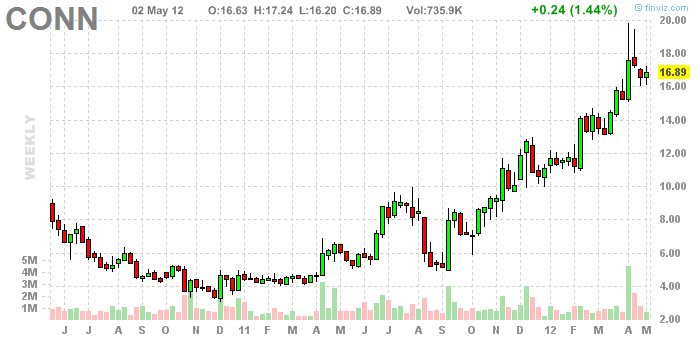
But as quickly as the lights go out, the plug is pulled, the speakers are blown, and the latest Top Dog is at best humbled or worse, liquidated, investors - ever hopeful (or merely gluttons for punishment) - try their luck anew. This time, it's Texas-based Conn's, a former favourite of the IBD crowd when they pumped it up to absurd heights back in the mid-noughties, before souring and returning it's share price to panhandles altitude.
Analysts (the few who cover it) are again optimistic, despite their poor 2011, and leverage which is double that of former heavyweight champion, Best Buy, along with an ev/sales 5x that of BBY, and an ev/ebitda more than 3x BBY's - both on historic and forward-looking measures. Historical margins are inferior in every way, though, they are forecast to sparkle in the coming year. What CONN's does have going for it is a short interest nearly double that of highly-shorted BBY. Perhaps it is the the fact that Texas is NOT the USA. Perhaps it is CONN's marginally-broader offering - a few lawnmowers and some furniture - that separate it. Maybe it's made the IBD TOP-50, again with its Donchian channel breakout and high momentum. Or perhaps it is the starry-eyed belief that like Tractor Supply, good 'ol boy Conn's may be on the cusp on succeeding nationally where the dull methodical no-nonsense midwestern Best Buy could not. I really do not know.
What I do know is that, outside the hasidic bucket shops in Manhattan where it seems to be as much a way of life as a business, electronics retailing well-and-truly sucks. And investors should be ever-wary of paying up, or being optimistic, or thinking that THIS time it's different. It's not. And it won't be. At 6x next year's forecast, with a reasonable balance sheet, huge scale, BBY might be cheap enough provided the macro status quo doesn't further deteriorate. I am not long, and am unlikely to be so, but there are no shortage of bottom-fishers that may think otherwise. As for Conn's, god bless them and their investors. They will need all the help they can get in order to fulfill expectations.
The history of American retail is littered with the carcasses of electronics retailers. Crazy Eddie, The Brick, Musicland, Sam Goody, Radio Shack, Circuit City, and most recently, the humbled Best Buy. And if the aforementioned challenges are in and of themselves not sufficient to deter retail entrepreneurs and their investors, then just add the challenge of web retail, where prices are lower, sales taxes non-existent, fulfillment rapid, and the comparative technical information, more informed. Strangely, somehow, a few Europeans have managed to prosper in their restricted markets (e.g.
But as quickly as
Analysts (the few who cover it) are again optimistic, despite their poor 2011, and leverage which is double that of former heavyweight champion, Best Buy, along with an ev/sales 5x that of BBY, and an ev/ebitda more than 3x BBY's - both on historic and forward-looking measures. Historical margins are inferior in every way, though, they are forecast to sparkle in the coming year. What CONN's does have going for it is a short interest nearly double that of highly-shorted BBY. Perhaps it is the the fact that Texas is NOT the USA. Perhaps it is CONN's marginally-broader offering - a few lawnmowers and some furniture - that separate it. Maybe it's made the IBD TOP-50, again with its Donchian channel breakout and high momentum. Or perhaps it is the starry-eyed belief that like Tractor Supply, good 'ol boy Conn's may be on the cusp on succeeding nationally where the dull methodical no-nonsense midwestern Best Buy could not. I really do not know.
What I do know is that, outside the hasidic bucket shops in Manhattan where it seems to be as much a way of life as a business, electronics retailing well-and-truly sucks. And investors should be ever-wary of paying up, or being optimistic, or thinking that THIS time it's different. It's not. And it won't be. At 6x next year's forecast, with a reasonable balance sheet, huge scale, BBY might be cheap enough provided the macro status quo doesn't further deteriorate. I am not long, and am unlikely to be so, but there are no shortage of bottom-fishers that may think otherwise. As for Conn's, god bless them and their investors. They will need all the help they can get in order to fulfill expectations.
Tuesday, April 24, 2012
Protecting the Imaginary Spoils
While listening to a programme on corruption, my 12-year old daughter was incensed. "Thats's awful!" she chimed, to which I sighed and nodded my agreement, while navigating the slip road. She has inherited my current-event-junkie gene, and so I posed the following question: "What percentage of the population, given the chance to be corrupt, or steal or embezzle, would do so, were the opportunity presented and the probabilty of punishment low?"
"Ummm ten percent....", she suggested. "Really??? Hmmm", I replied. "No umm errr ninety percent!!", she tried alternatively at the other end of the spectrum. "That high??", I inquired. "No wait, FORTY PERCENT!!", she cried, this time more confidently. "Ohh no, I know, "Seventy percenty....yes... it's seventy percent". She really didn't really didn't have a clue, though nor did I. In all likelihood, however, the question was slightly unfair, and required a qualified answer, for the percentages almost certainly differ depending upon the country, whether one is Kyoto or Petropavlovsk, Des Moines or Mumbai, Helsinki or Beirut. And it probably is impacted by whether one is in a rural and urban location. Research has also shown that the people in power are primed to feel more entitled to such spoils, hence are both more likely to capitalize on the opportunity and feel less remorse.
And so listening to the BBC the other day, I chanced upon a programme focused upon Nigeria and corruption. Interviewed, amongst many others, was an "honest" minister who admitted with some apologies that most ministers and officials left government vastly wealthier than before they took their posts, adding that such an outcome was unlikely given their official remuneration. The interviewer sternly inquired why the people don't revolt demand justice, and vote them out, pointing out that few if any have ever been brought to justice for their misdeeds and avarice. The minister chuckled, before proceeding with his answer. Paraphrasing, he said that no one wants to shut it down because everyone thinks and hopes that one day, they THEY TOO might find in themselves in the position to make a big score, and no one wants to potentially shoot themselves in the foot and shut it down, thereby denying themselves an oppportunity which they see as their right, no matter the societal consequences and petty injustices such existing corruption perpetuates. Wow!!!! And the interviewer proceeded to ask the very question to the man in the street who with gusto and honesty, frankly and jovially confirmed the thesis.
Interestingly, this aspiration and ability to project themselves into a position of power and privilege is the same reason that lower-income voters in the US problemmatically eschew higher marginal rates and enforceable estate taxes on the wealthy. I find this parallel attitude interesting if for no other reason than corruption is in general culturally-specific, whilst the attitude towards power/wealth aspiration and therefore the prtoection of its privileges, somewhat more universal.
"Ummm ten percent....", she suggested. "Really??? Hmmm", I replied. "No umm errr ninety percent!!", she tried alternatively at the other end of the spectrum. "That high??", I inquired. "No wait, FORTY PERCENT!!", she cried, this time more confidently. "Ohh no, I know, "Seventy percenty....yes... it's seventy percent". She really didn't really didn't have a clue, though nor did I. In all likelihood, however, the question was slightly unfair, and required a qualified answer, for the percentages almost certainly differ depending upon the country, whether one is Kyoto or Petropavlovsk, Des Moines or Mumbai, Helsinki or Beirut. And it probably is impacted by whether one is in a rural and urban location. Research has also shown that the people in power are primed to feel more entitled to such spoils, hence are both more likely to capitalize on the opportunity and feel less remorse.
And so listening to the BBC the other day, I chanced upon a programme focused upon Nigeria and corruption. Interviewed, amongst many others, was an "honest" minister who admitted with some apologies that most ministers and officials left government vastly wealthier than before they took their posts, adding that such an outcome was unlikely given their official remuneration. The interviewer sternly inquired why the people don't revolt demand justice, and vote them out, pointing out that few if any have ever been brought to justice for their misdeeds and avarice. The minister chuckled, before proceeding with his answer. Paraphrasing, he said that no one wants to shut it down because everyone thinks and hopes that one day, they THEY TOO might find in themselves in the position to make a big score, and no one wants to potentially shoot themselves in the foot and shut it down, thereby denying themselves an oppportunity which they see as their right, no matter the societal consequences and petty injustices such existing corruption perpetuates. Wow!!!! And the interviewer proceeded to ask the very question to the man in the street who with gusto and honesty, frankly and jovially confirmed the thesis.
Interestingly, this aspiration and ability to project themselves into a position of power and privilege is the same reason that lower-income voters in the US problemmatically eschew higher marginal rates and enforceable estate taxes on the wealthy. I find this parallel attitude interesting if for no other reason than corruption is in general culturally-specific, whilst the attitude towards power/wealth aspiration and therefore the prtoection of its privileges, somewhat more universal.
Monday, March 26, 2012
Hanging Around For Justice
In Japan, generally speaking ,it is 'shame' which keeps people on the straight and narrow. In Douala (Cameroun), it is apparently something else altogether per this article. And THAT was a purse!! Kleptocrats and cronies in the West take (and China) note....
Tuesday, March 13, 2012
Farewell Dynegy
So farewell
then Dynegy,
highly leveraged
wholesale supplier
of electricity.
One can endlessly generate
apt puns:
"Ohm my God, DYN has a reVolting balance sheet!"
"Lenders finally switched-off the credit to DYN
"DYN 'Lights out' really hertz equity holders..."
"Creditors pulled the plug on DYN..."
"Investors shocked by short-circuit in DYN"
"Bankruptcy will be transforming for DYN"
etc. etc. etc.
But my catchphrase -
for you (& replicants) shall be:
"The light that shines
twice as bright
burns for half
as long".
(with apologies to Private Eye & EJ Thribb)
then Dynegy,
highly leveraged
wholesale supplier
of electricity.
One can endlessly generate
apt puns:
"Ohm my God, DYN has a reVolting balance sheet!"
"Lenders finally switched-off the credit to DYN
"DYN 'Lights out' really hertz equity holders..."
"Creditors pulled the plug on DYN..."
"Investors shocked by short-circuit in DYN"
"Bankruptcy will be transforming for DYN"
etc. etc. etc.
But my catchphrase -
for you (& replicants) shall be:
"The light that shines
twice as bright
burns for half
as long".
For once you
aspired to
be more like
ENRON.
Now,
your wish
has finally
been granted.
(with apologies to Private Eye & EJ Thribb)
Monday, March 12, 2012
Another One Bites The Dust (Updated)
Things, people, ideas believed to have integrity now seemingly compromised...(the updated and expanded version)
The "risk-free" rate
LIBOR as a Benchmark
Public Sector Pensions
HFT as a Beneficial Provider of liquidity
Diversifying properties of Hedge Fund's
Einstein's Theory of Special Relativity
Celtic Rangers
Macroeconomic Forecasts
John Paulson
FRB Open Market Operations
Standardized Educational Testing
Swiss National Bank
A Relaxing Cruise
WTI as Oil Benchmark
Olympus Corp.
TEPCO
Payment Protection Insurance
DSK
HM Revenue & Customs
Sony Playstation Network
Google
Privacy
Social Mobility
Actuarial Return Assumptions for Pension Funds
Marmite
Ryan Giggs
Acupuncture
USA Govt AAA
France AAA
Voicemail
Boob Jobs
Snooker
David Einhorn
Nuclear Power
Deepwater Drilling
Tiger Woods
Professional Cricket
Sumo
Professional Cycling
High-Frequency Trading
Professional Baseball
FIFA
Professional Tennis
Municipal Bond Underwriting
The Catholic Church
Track & Field Athletics
NCAA Sports
US Congress
UK Parliament
Analyst Research
Credit Ratings
Banks
Newtonian Physics
The Stock Market
The Food Pyramid
Incentive Stock Options
Reinsurance Brokerage
Lou Dobbs
The Mortgage-Backed Securities Market
Hedge Funds
Social Security
Government Balance Sheets
Tooth Fairy
Errr ummm Professional Wrestling is starting to look good by comparison - at least it makes no pretensions to be anything other than it is. What's left?
Friday, March 09, 2012
Get Shorty 3
Irony amuses me. Maybe not as much as tannic satire, or creatively-apt word-smithing, but as a close of cousin of hypocrisy, it stands apart from mere smile-inducing happenstance or serendipity. Most of my efforts are admittedly sophmoric and rather feeble. And even if they weren't wooden imitations, they certainly couldn't compare to the surreality of people's own flaws and foibles.
For example, Rand and Hayek were, unbeknownst to most of their disciples, rather contented beneficiaries of Medicare. Or that the wholesome-imaged founder/CEO of Wholefoods, John Mackey was caught with his trousers around his ankles, perennially-posting potshots against competitor Wild Oats under a pseudonym on Yahoo! message boards. Or how, according to former IMF Economist Per Kurowski, the very Basel II risk-weightings meant to limit the risk of banks actually turbocharged the feedback loop encouraging banks to gorge themselves on now-risky Euro-Area sovereign debt. Or that Daily Mail journalists were phone-hacked by their fleet-street rivals at Murdoch's NOTW. All amusing in their way.
But what separates the merely humorous from the absolutely riotous is when irony glaringly overlaps with hypocrisy (as highlighted by The StreetWise Professor who knows more than a thing or two about market manipulation). Such was the case when this lawsuit was filed in December by a West Coast Private Equity Firm alleging conspiracy, fraud and market manipulation by a cabal of larger-than-life characters involving several grifters, felons, a haplesss Forbes blogger, Bulgaria, and centrally and most amusingly ZeroHedge, that popular blog well-known for conjuring and lambasting ummm ... errrr ..... yes, fraud, conspiracy and market manipulation. You couldn't make it up if you'd wanted to. It's a long but illuminating accusatory read, but rewarding for those who persevere. And it serves yet again to highlight the omnipresence of conflicted interests that should cause all readers to carefully consider carefully their sources, and critically examine such sources' underlying motivations.
The Elmore Leonard version ("Get Shorty III"? or "Getting Shorty Again") loosely-based on the same will no doubt be out soon.
For example, Rand and Hayek were, unbeknownst to most of their disciples, rather contented beneficiaries of Medicare. Or that the wholesome-imaged founder/CEO of Wholefoods, John Mackey was caught with his trousers around his ankles, perennially-posting potshots against competitor Wild Oats under a pseudonym on Yahoo! message boards. Or how, according to former IMF Economist Per Kurowski, the very Basel II risk-weightings meant to limit the risk of banks actually turbocharged the feedback loop encouraging banks to gorge themselves on now-risky Euro-Area sovereign debt. Or that Daily Mail journalists were phone-hacked by their fleet-street rivals at Murdoch's NOTW. All amusing in their way.
But what separates the merely humorous from the absolutely riotous is when irony glaringly overlaps with hypocrisy (as highlighted by The StreetWise Professor who knows more than a thing or two about market manipulation). Such was the case when this lawsuit was filed in December by a West Coast Private Equity Firm alleging conspiracy, fraud and market manipulation by a cabal of larger-than-life characters involving several grifters, felons, a haplesss Forbes blogger, Bulgaria, and centrally and most amusingly ZeroHedge, that popular blog well-known for conjuring and lambasting ummm ... errrr ..... yes, fraud, conspiracy and market manipulation. You couldn't make it up if you'd wanted to. It's a long but illuminating accusatory read, but rewarding for those who persevere. And it serves yet again to highlight the omnipresence of conflicted interests that should cause all readers to carefully consider carefully their sources, and critically examine such sources' underlying motivations.
The Elmore Leonard version ("Get Shorty III"? or "Getting Shorty Again") loosely-based on the same will no doubt be out soon.
Tuesday, March 06, 2012
SPORTS LATEST: (In Extra Time) US Federal Rangers 0 - Stanford Rovers 0
Reuters reports in late breaking news that neither side has been able to hit the back of the net during regulation time. The referee ordered players back onto the pitch to continue their battle in extra-time. The Feds most potent weapon failed to convert numerous opportunities after being continually dogged by Stanford defenders. Stanford played most of second half short-handed as player-manager Alan Stanford was taken injured and declared unfit to play as a result of apparent abuse whilst in the locker room. He did, however, manage a high-five to his trainer following the whistle at regulation time. Given what's at stake in the match a draw would be a massive victory for Stanford, and most embarrassing for Rangers, given their numerical and home-pitch advantage.
Monday, March 05, 2012
Does Your Financial Guru or Doomster Resemble A Cult?
Does your financial Guru or Doomster resemble a cult? To satisfy your curiosity, it might be worth taking simple test that will give you an idea whether what you thought was innocent objective altruistic financial advice and unbiased analysis is actually something more nefarious that wants to control your mind, your trades, and empty your bank account.
1. Does your Guru always make out like he's right?
2. Does you Guru paint a picture that the other [non-disciples] are always wrong?
3. Is there any exit from the Guru's philosophy without following the philosophy?
4. Does the Guru's group use its own "Cult-speak"?
5. Does "group-think" dominate, suppressing dissent and enforcing conformity of thinking?
6. Is Guru's advice irrational at times, contradicting previous or other tenets of Guru advice?
7. Does Guru's philosophy suppress disbelief?
8. Does Guru's philosophy denigrate competing ideas, schools of thought, and other Guru's?
9. Does Guru make personal attacks upon critics?
10. Does Guru believe non-followers need "fixing"?
11. Does Guru insist that his interpretation is the only correct way?
12. Does Guru and his disciples make you feel that by following you are "special"?
13. Is Guru's philosophy an unquestionable dogma, sacred science, or infallible ideology?
14. Does Guru's philosophy appeal to perceived unquestionable authorities ?
15. Does following Guru confer a feeling of "instant community"?
16. Is your Guru inconsistent and does he speak contradictory messages?
17. Does your Guru use personal testimonies of the success of earlier converts to validate advice?
18. Is your Guru self-absorbed?
19. Are there potential dual purposes, hidden agendas, ulterior motives, in Guru's advice?
20. Does your Guru readily admit when he is wrong?
21. Does your Guru undertake deceptive recruiting and/or aggressive promotion?
22. Does your Guru's ideas implant phobias and self-doubt into your psyche?
23. Is Guru and his disciples money grubbing?
24. Are you pressured to change your beliefs and adopt the Guru's beliefs?
25. Does your Guru hold ideology and dogma higher than experience, probability and logic?
26. Does your Guru ascribe unexplained or contrary events to mystical manipulation?
27. Does your Guru demand your faith, trust (and money?)
28. Does your Guru use thought-stopping language and thought-terminating cliches and slogans?
29. Does Guru use affiliate front groups, hidden promoters, or disguised propagandists?
30. Does your Guru imply his belief equals truth?
31. Does your Guru make use of double-binds?
32. Is your Guru held accountable for his performance?
33. Is your Guru a charismatic leader?
34. Does your Guru prevent you from trusting you're own mind?
35. Does your Guru claim to have the panacea for market problems or all market conditions?
36. Does your Guru see he world through permanently tinted lenses?
37. Does your Guru make you think you can't make it without his advice?
38. Does your Guru use unchallengeable sources of information?
39. Does your Guru inflate his experience or make bombastic grandiose claims about performance?
40. Does your Guru employ black and white thinking?
Score Key:
Add up your "yes" answers and compare to the table below.
1 to 8 Probably Safe and reasonably selfless like Gandhi
9 to 17 Heard of one Werner Erhard & EST? Self-improvement with a dark twist.
18 to 26 Think of L. Ron & Scientology - Weird and NSFW.
27 to 35 Jonestown...plausible fringe idea gone horribly horribly wrong. Watch what you drink...
36 to 40 Put on your trainers & trackies and prepare for a Slim Pickens ride on Hale-Bopp
1. Does your Guru always make out like he's right?
2. Does you Guru paint a picture that the other [non-disciples] are always wrong?
3. Is there any exit from the Guru's philosophy without following the philosophy?
4. Does the Guru's group use its own "Cult-speak"?
5. Does "group-think" dominate, suppressing dissent and enforcing conformity of thinking?
6. Is Guru's advice irrational at times, contradicting previous or other tenets of Guru advice?
7. Does Guru's philosophy suppress disbelief?
8. Does Guru's philosophy denigrate competing ideas, schools of thought, and other Guru's?
9. Does Guru make personal attacks upon critics?
10. Does Guru believe non-followers need "fixing"?
11. Does Guru insist that his interpretation is the only correct way?
12. Does Guru and his disciples make you feel that by following you are "special"?
13. Is Guru's philosophy an unquestionable dogma, sacred science, or infallible ideology?
14. Does Guru's philosophy appeal to perceived unquestionable authorities ?
15. Does following Guru confer a feeling of "instant community"?
16. Is your Guru inconsistent and does he speak contradictory messages?
17. Does your Guru use personal testimonies of the success of earlier converts to validate advice?
18. Is your Guru self-absorbed?
19. Are there potential dual purposes, hidden agendas, ulterior motives, in Guru's advice?
20. Does your Guru readily admit when he is wrong?
21. Does your Guru undertake deceptive recruiting and/or aggressive promotion?
22. Does your Guru's ideas implant phobias and self-doubt into your psyche?
23. Is Guru and his disciples money grubbing?
24. Are you pressured to change your beliefs and adopt the Guru's beliefs?
25. Does your Guru hold ideology and dogma higher than experience, probability and logic?
26. Does your Guru ascribe unexplained or contrary events to mystical manipulation?
27. Does your Guru demand your faith, trust (and money?)
28. Does your Guru use thought-stopping language and thought-terminating cliches and slogans?
29. Does Guru use affiliate front groups, hidden promoters, or disguised propagandists?
30. Does your Guru imply his belief equals truth?
31. Does your Guru make use of double-binds?
32. Is your Guru held accountable for his performance?
33. Is your Guru a charismatic leader?
34. Does your Guru prevent you from trusting you're own mind?
35. Does your Guru claim to have the panacea for market problems or all market conditions?
36. Does your Guru see he world through permanently tinted lenses?
37. Does your Guru make you think you can't make it without his advice?
38. Does your Guru use unchallengeable sources of information?
39. Does your Guru inflate his experience or make bombastic grandiose claims about performance?
40. Does your Guru employ black and white thinking?
Score Key:
Add up your "yes" answers and compare to the table below.
1 to 8 Probably Safe and reasonably selfless like Gandhi
9 to 17 Heard of one Werner Erhard & EST? Self-improvement with a dark twist.
18 to 26 Think of L. Ron & Scientology - Weird and NSFW.
27 to 35 Jonestown...plausible fringe idea gone horribly horribly wrong. Watch what you drink...
36 to 40 Put on your trainers & trackies and prepare for a Slim Pickens ride on Hale-Bopp
Friday, March 02, 2012
Contrapreneurship For the Lazy Ex-Financier
Making money the old-old fashioned way (manufacturing or providing a service to fulfill an under-fulfilled need) or even making money the old-fashioned way (honest-to-goodness lying, cheating, defrauding and/or insider-trading) has become either far too difficult in an era of heightened due-diligence, or is fast-becoming too legally precarious for most people (and many professional investment managers). But all is not lost. Some niches remain robust and ripe for the opportunist demagogue. Here's a shortlist of some easy and attractive money-spinners for anyone sufficiently lazy and light on conscience.....
1. Create a Financial Doomsday Website (with on-line retail affiliate)
HyperHyperHyperInflation.com, MyKaczynskiTrade.com, ShortingFinancials.eu UnderTheMattress.Com, BoomersGloomers&Doomers.net, JustFedUp.com, MyBigFatOrlovianHedge.com, all have the right cache to attract sufficient sympathetic eyeballs to get some sort of business rolling. The beauty of this is that you can sell all manner of related merchandise to your loyal following of paranoiacs – things such as Miracle-Fibre Dirt-repelling T-Shirts (with your logo) since in the feared dystopian future there will be no electricity to run your washing machine, and your gold or oil will clearly be too precious to trade for something as frivolous as new clothes. There are many teats to milk with this too. You can also sell off-the-grid technology, water-purification technology, surveillance and defense equipment, seeds and agricultural implements, remote seaside cottages with fishing rights in black-fly infested Labrador, as well as offering time-shares in your Swiss-bomb shelter (complete with bullion storage and assaying services).
2. Create a “Talk-My-Trading-Book” InfomercialAdvertorialSocialMediaWebChannelSite
We've come a long way since Wholefoods CEO John Mackey was busted dissing WildOats on Yahoo a message board. Propaganda and disinformation are far more professional now, whether it is through commissioning of bespoke reserach reports or, in the macro world, through creating websites(s) with the right advertorial view. Conjure a good name. TheMacroChannel, SmartestTrades.Com, Best Informed Investor, Real Macro Research, AlphaSeeker, Divergent Perspectives, Deep Market Insider, Daily Dose of Macro, Base-Nine Scenarios or anything like that will do fine so long as it sounds professional. Get a front man and a web-designer. Pepper it with cross-links. Then use it a platform for talking your book. Be certain NOT to disclose your conflicts of interest, or if you must do, then bury them somewhere obscure in the smallest fine print possible. Be outrageous and provocative. Do NOT be held back by your lack of education or your degree from an on-line university. Do NOT be held hostage by the truth. Exaggeration and mis-information are your friends providing they are wrapped in plausible garb, and presented by a white-toothed, well-groomed spokespeople with conviction (and a book-deal). Whatever you do, DO NOT give attention to competing theses or points of view unless they are soundbytes by Al Sharpton, or someone from Brussels who looks shifty “and don't speak good English”.
3. Create Yet ANOTHER Online FX Bucket Shop
It is a fact that most retail spec FX traders are losers. I do not mean that in the pejorative by implying they are losers as in worthless human beings, rather just that, statistically, they are overwhelmingly long and wrong or short and caught-out, which when leveraged 100-to-1 is a ticket-to-paradise for whoever sees the flow and holds the account. Indeed, considering the average gross casino take in Vegas or AC is less than 5% across all games, systematically taking the opposite side against your retail FX Customers probably yields an edge considerably larger without the overhead and headaches. All you need is a fiduciary-sounding name containing “FX”, preferable a three-letter meaningless acronym, a colourful GUI, and some adverts featuring formula-one race cars (sorry NASCAR fans – wrong demographic) a few bikini-clad models, and you're off to the races (no pun intended).
4. Create a Stock-Market Trading System & Newsletter With a Cool Sounding Name
Since most people have more difficulty, and know less about, choosing stocks than they do about choosing a bottle of wine (something that sufficiently mystifies most ordinary people into a state of ordering by colour or choosing the prettiest label), ANYONE who sounds authoritative, boasts of preposterously monstrous returns and statistically Madoff-like Win-Loss ratios will find a ready-made clientele desperately in need of help, to churn-and-burn. In areas of such confusion and innocence, people (especially trusting Midwesterners) NEED to be told what to do, and when to do it. It doesn't matter that the Pinata Method or the Fortune-Cookie Method would do equally-as-well, if not better. Some pointers are in order for the newbie contrapreneurial tipster: (1) Make it momentum-based. It just sounds better. Reversion, contrarian, or counter-trend sounds like an incurable disease or that you're a communist trouble maker; (2) Emphasise Trend-Following. Ameica is a don't rock-the-boat culture from its immigrant roots (despite current political polarisation). People have a natural tendency to want to fit-in and they want to be part of the trend. And, since most people possess sheep-like tendencies, they want to follow, and do not understand the power of contrarian thinking. (3) Choose Small-Cap, Low-Liquidity Near-Dead Stocks . And that's it. Now all you need is a website, purchase some banner ads on a relevant high-traffic site. Oh, and one more thing. If you really want to clean up, make sure you can borrow the stock, and do so BEFORE selling it to yourself from different accounts at different brokers. Then, sell your longs slowly to the pigeons as they come in to buy your recommendations, and buy in your shorts as they sell dispiritedly sell their longs. And to think some suckers actually WORK for a living...
5. Promote and Trade PennyStocks
There are sufficient number of people in the world who sadly equate the raw price of the stock with its implied value, the same way they are drawn to 99-Cent Shops. If cheaper is better when buying flatware, why not stocks? Why would one buy just 1 share of Berkshire Hathaway (symbol=BRK-A $11,910.00) when one can buy 1,000,000 shares of Acme Superconducting Solar & Oil Exploration Research (Symbol=ASSOL) at $0.0119 cents???!? Dearie me. While this may be an intellectual affront to some of you ex-fixed-income guys, it is precisely these qualities that you will value and a cherish in a customer as a newly-minted penny-stock promoter. If you have a guilty conscience. Look at the bright side: you are redistributing the wealth from those that obviously have no ability to do so, to those that have only less of an ability, but will spend it on all manner of wonderful things with beneficial trickle-down effects such as Bentley's, Beach and Ski homes, and for the truly talented promoter, a shiny used Gulfstream...at least until the Feds catch up with you, if they can.
6. Write a Cantankerous Financial Best-Seller
This has been popular a popular way to raise your profile, and there are no shortage of topics or plausibly-culpable villains that will provide colourful and readily-marketable material. The Fed, Bankers, Congressmen, Lobbysists, Economists, Madoff, Detroit, Paulson, ex-Presidents, China, Japan, Insider Traders, Research Analysts, The Rating Agencies, Landlords, The Mafia, Immigrants, Rich People, McDonalds, The Plunge Protection Team, Real Estate Agents, Hedge Funds, Arabs, Jews, Oil Companies, Drugmakers, The Weather, Robert Mugabe, Sunspots, The Kennedy Dynasty, Saddam Hussein, and best and most stealthily of all, my fav, the Canadians, all make for excellent scapegoats for people to read about, rage and avoid introspection. NB: Avoid dissing Ronald Reagan (no matter how culpable you think he is) if you want to move the merchandise. NB2: Avoid blaming the readers themselves. HL Mencken made the mistake of rubbing his readers' noses in it, and he was completely and wholly despised thereafter since no one want to be told “I told you so”. So if you want to write (and sell copies) of another or a sequel, heed this important advice.
7. Author An Aspirational “How-To” Financial Book
There are many verticals in this already crowded but always buoyant market. And it is not very difficult- just look at Suze Ormond – so long as one slaps a suitably optimistic and aspirational title on the jacket. Some suggestions:
“10-Step Plan To Successful Insider Trading ”,
“Using Friends & Family to Build Your Own Expert Network”,
“Investing for the Very Very Long Long Long Run”,
“How to Get Truly Rich Without Luck, Brains or Money”
“Gold Coins and Precious Metals Investing for Dummies”,
“Chant Your Way To Financial Freedom: The Best Mantras and Affirmations To Help You Realize The Rewards You Deserve”,
“Rich Dad, Richer Dad, Richest Dad – Lessons From My Millionaire Father A Trustafarian”
“The How-To Book of Writing Successful How-To Books”,
“Pessimism is for Losers: Riding the Next SuperCycle to Dow 100,000 1,000,000”,
“Winner's Guide To Day-trading: Surfing the Momentum Wave”.
“From Tenement to Bel-Air in Twelve Months: How I Made Money in Real Estate (And YOU Can Too!)”
“Channeling Graham & Dodd – Investment Tips From Beyond The Grave”.
(NB to Publishers – These have all been copyrighted!!)
8. Give “5-Minute Abs” "How-To" Trading Seminars
“Give a man a fish, he'll eat for a day...teach a man to fish and you'll feed him for a lifetime”. Fishing is hard work of course, and ignoring the fallacy of composition with this parable, there appears to be no shortage of people who want to become self-sufficient the 5-Minute Abs Way, by attending your “Trading For Winners” Seminars or Seminar-Lite (sm) that you will give at cheesy airport hotel conference rooms all around the country. You can teach them about “CANSLIM”, golden crosses, gaps, volume surges, can't lose set-ups, Donchian channel break-outs, FX Carry, and perennially shorting the Euro and USD, so they can “earn BIG returns” and “make millions in up and down markets” in order to fulfill your their dreams. And for the true sheep, you can offer them your daily premium alert service where (for a not ungodly sum) you TELL them what to do – at least until they piss away all of their stake.
9. Become a Rage-a-holic Presenter on Fox News –
There are few things more objectionable in the realm of non-violent crime than cynically preying upon the financially-ignorant for parochial gain. But toying with the real emotions of frustration and bewilderment that an increasing percentage of the American population feel in the face of globalization, increasing inequality, and falling real incomes, for financial gain and media market share, must certainly be one of them. But if you have little shame and even less scruples, then becoming a rage-a-holic media personality is a viable option. You'll probably have to start local, on radio, and work the graveyard shift. You'll need to hone an outrageous and angry persona , perfect the art of distorting facts, practice using innuendo, smear and ad-hominems against opponents and mis-characterization of their opposing arguments to discredit them in the minds of your listeners. It is arguably more difficult than selling Pennystocks, but for the truly misanthropic, far more rewarding.

Wednesday, February 29, 2012
[Almost] Unvarnished Truth
My first radio was a black, sixties, Japanese made transistor brick of no import, given to me by my grandfather when I was no more than six years old. At eight, I received a modern ball-shaped plastic one whose precise, late 60's psychedelic colour now-escapes me, with two dials (for eyes) and a lucite window dial (the nose) for the frequency. Both were 9v powered and limited to AM or FM. At ten, I withdrew my accumulated savings and bought a cool-looking Sears ten band receiver (with all the shortwave spectrum) that called out to me from its display shelf every time I passed enroute to the hardware department with my father. I strung an "X" of wires from the corners of my room in a crude attempt to mimic a di-pole antenna. And with that, the world entered my bedroom through this box, and I was never the same.
Although day-time transmissions can be received on the higher frequencies, it was after dusk that the world seemed to truly come alive. "Lights-out" was never bedtime for me. It was only the beginning of my nightly travels. The BBC World Service was my first and daily fare, but "Tom Meier" of Radio Nederland, was my favorite, mostly for reasons of its strong signal relayed through their station in Bonaire, Netherlands Antilles. Radio Moscow punched through every band, and occupied what seemed to be the entire 41meter frequencies with their 200kw transmitter, holding up their end of the propaganda wars then raging. So strong and prevalent were they, they trampled and bled into more diminutively-powered neighboring stations that had the misfortune of living adjacent to them. Radio Kiev, sharing facilities and transmitters, was almost indistinguishable in brashness (unless one wishes to learn Ukrainian over the airwaves). Radio Habana Cuba, Peking Radio, Radio Sofia, Vatican Radio, and half-hour english-language broadcasts from every capital in Europe never failed to intrigue and fascinate as I sought to determine their location in my World Atlas.
By eleven, I had reached the limitations of this box, whose low sensitivity and poor filters prevented me from visiting more exotic lands, and caused the unstable signal to drift and waver. I watched the newspaper classifieds daily for used army surplus gear receivers (or transceivers) made by military suppliers Hammarlund or Hallicrafters, bedazzled as I was by their dimensions, knobs and toggles and super-sensitive tuning wheels. I finally found one and my mother hesitantly drove the two hours to exchange my $35 for a grey metal behemoth filled with glowing-orange tubes, weighing at least twenty kilos, that looked as if it belonged on the bridge of a WWII aircraft carrier, or in the control-room of a nuclear power station.I pestered my mother for a trip to the nearest Radio Shack to buy big spools of copper wire, and insulators. Upon returning home, I shimmied up the trees in the backyard and created a large array - a 75m by 75m di-pole, complete with a ground, and ran it to control box that I built which allowed me to create single directional poles, as well as attenuate their lengths. Now, inserting it into the antenna receptacle of the receiver, I was able to visit almost every nation of the world from my bedroom. I would send them letters attesting to my reception on the east coast of America. In exchange, they would send a post card of verification (a "QSL") - typically with a lovely photo or image from their capital or something iconic from the country, in addition to a schedule, magazines, pennants, and tourist info to entice the potential traveller. And for the ones with ulterior political motives, they sent reams of propaganda (The Ba'ath Party Manifesto, History of Socialism in Albania, The Christian Word Afrikaans Life, and dozens of LPs from Springbok Radio that were intolerably boring but which looked great on my bookshelf). Some were after my soul, which I would gladly rent for a large pretty colour-postcard of Ecaudor's majestic snow-capped Mount Cotopaxi, whereas others were as eager for international contact from their remote studios in Kabul or Irian Jaya, as I was. For at eleven, the many politics were dwarfed by the novelty value of correspondence from around the world. I might go to bed with ABC Brisbane's morning show, dial down to the multitude of local small-power stations in rural Venezuela or Colombia, before drop in to Tashkent and Yerevan. I'd set my alarm to rise at 3am to catch the afternoon news on Radio New Zealand, before drifting back to sleep under the magical spell of Radio Cairo's non-stop show-casing of Umm Kulthum. I started receiving more mail than my parents. All my money was spent on postage, and I fretted when Mr Smiley (real name, no fooling!), our local postman was late for his route.
Within two years, lightning had not yet taken out my installation, and solid state technology was advancing rapidly. The tubes and heat generated by the Hallicrafters (not to mention the space it took up on my desk) were becoming a liability and I upgraded to a best-in-class Japanese-made Yaesu FRG-1-0-something-or-other. I initiated the formation of a regional club of similarly socially-awkward radio geeks, and began publishing a specialty shortwave radio publication, gathering several hundred of members from the area, organizing in-depth, surveys of frequencies, equipment reviews, and tips, as well as occasional get-togethers. This was quite an undertaking since it was all done before word-processing and home computers, requiring final drafts all typed on an IBM Executive (without an eraser-key relying wholly upon good typing and bottles of "Liquid Paper"), before the monthly two dozen pages were arranged, reduced and printed on my father's IBM Copier, to make a neat package. Dues just about covered postage, but it was enjoyable and engaging nonetheless.
As a result of my virtual travels, I matured and rapidly developed intellectually. Political sensitivities arose early as result of the many hours of listening. My bullshit detectors were raised to hypersensitive levels, as I mastered the art of distilling fact from fiction or opinion. The sheer hyperbole of Radio Tirana's or Radio Pyongyang's english service was comical, even to a twelve-year-old. It was possible to listen to both All India Radio and Radio Pakistan's versions of the Indo-Pakistani war, before being mediated by the BBC for the central case, or the Voice of Israel's version of the Yom Kippur war relative to that of Radio Moscow. It became obvious that, by comparison to the BBC World Service, The Voice of America was almost as tainted as Radio Moscow, fighting as they were for minds on the front line of the cold war. Though despite all these defects, the variety of programs from talk radio, classical music, interviews with artists and writers in their respective countries provided enlightenment unavailable in American television or radio media, let alone my middle-school in an anodyne middle-class suburb. World capitals, major cities their industries and life, were memorized as were world leaders, forms of government and regional and historical travails. Geography and history became my favorite subjects, though my writing skills were honed as well.
But it was the BBC (and to a lesser extent CBC and CBC Northern Service) which provided the daily stability - the continuous unexaggerated voice to navigate the extremes of bullshit, propaganda, and outright lies. They were the gold standard, and I became addicted, and remain so to this day. As I went to university and travelled abroad, I brought a SONY ICF-5100 and now, still possess an even a smaller version, that has allowed me have the BEEB with me, wherever and whenever, which was particularly important when travelling back to the USA where intelligent international news was and remains well-nigh impossible to find without a broadband connection.
Of course the internet has changed everything. Short-waves while still important to outlying areas and less-developed nations, are almost wholly irrelevant where connectivity is ubiquitous and live stream from all over the world are the norm. Yet, the BBC, more than any other news, information, or media organization has continued to make itself relevant in walking the line of [almost] unvarnished truth in an increasingly tainted world of slant and disinformation, airing diverse views and opinions, producing unfathomable quantities of fascinating content that would otherwise be nearly-impossible hear, as well as developing methods of audience participation on many contentious issues. Some may take exception and find fault in the BBC World Service and they are not perfect, but, to me, they are valued beyond measure. And to this end, I wish them and all associated, a very very happy happy 80th anniversary. You impacted my life, and changed MY world for the better, and I will always be extremely grateful.
Tuesday, February 28, 2012
Doubting Your Doubter or There Is Always A Bull Market Somewhere
One of the first "Old Saws" I learned in my market apprenticeship several decades ago was the adage: "There is always a bull market somewhere". Despite plummeting prices of Greek and Portuguese sovereign debt, the flat-lined bid-side for McMansions in Vegas, Phoenix and non-prime Fla, or real wages for unskilled labour in much of America, the advent of internet coupled with good web-design, and a Silly-Putty-like stretching of the truth, has enabled a definitive bull market in the power of self-invention and consequential rise of the self-proclaimed-though-untrained-expert.
Nowhere is this more apparent than the sphere of macroeconomics and financial advice, where by sheer force of will, clever obfuscation and exaggeration, or the adoption of an impressive-sounding title, one can instantly step-up onto their virtual soapbox and turn plausible-sounding kernels of truth into dangerous demagoguery. Charlatans abound, creating the financial equivalent of doomsday cults built upon membrane-thin educations, and even finer and more dubious layers of "experience", though never for wont of hyperbole or adjectives. Such suspicion and derision directed towards the aspirational self-invented commentator is NOT meant to idolize bona-fide, (i.e. more educated and certificated) economists. They too have been known to get it wrong, missing the obvious, as well as being guilty of putting conclusions before objective observation and research. Rather, it is meant to serve as a warning for those relying upon authoritative but tainted 7-Minute Ab equivalent of macro-like advice.
So, you might ask, what's wrong with the power of self-invention and positive thinking (or in case of the doomsday web-ring, negative thinking)? Can you not be what you aspire to be by sheer power of a desire to be so? Despite the hijacking of Nichiren-Shoshu, I think not. I do not see how one can place value (other than psychic confirmation of prior bias) on "research" or observations of those whose point of departure is an already-formed conclusion, and who then work backwards, witnessing each and every event through a unitary (often distorted) lens. Oh, they will inevitably be "right" about some things. And their distillation too, will on occasion, hit close to the target, just as the broken clock will be right once in the day. But how can a perma-view maintaining a narrow static unitary macroeconomic view of the world have value in respect to markets whose relative values fluctuate largely and significantly?
Bear Stearns lost a 2002 lawsuit involving former Fed Gov and their FX strategist Wayne Angell over advice to a rich and silly Canadian FX Spec named Count Henryk Kwiatowski. Bear's Angell gave advice to the Count who subsequently lost hundreds of millions punting FX. It's a funny docket and should be read in its entirety by everyone with a sense of humour. The Count was obviously sore after taking such a beating while following the advice of Mr Angell and wanted his money back. Bear tried to argue (unsuccessfully) that they, and Angell, were not responsible since he was in fact "an entertainer", and therefore whose advice shouldn't be relied upon. I'd long thought this an amusing, and somewhat accurate line of defense. However, they were found culpable since the court believed there are certain fiduciary responsibilities incumbent upon firms to their clients. As I said, I think their defense WAS apt, up to a point. Angell, despite his FRB pedigree WAS an entertainer. And I put to you, so too are the great majority of newly-minted self-invented macro-strategist-commentators and members of the doomster-ring. They do NOT have your interests in mind. They have NO fiduciary responsibility, toward you or anyone. And though credentials guarantee neither accuracy, nor impartiality, such charlatans frequently offer little to none of consequence. They are cynically, like Glenn Beck, simple entertainers, parochially-self-interested, scraping a living by media appearances, online advertising, premium newsletters, referral payments for click-throughs, and in some instances, talking their, and their friends books and positions. And if one accuses this pot of calling the kettle black, let it be said here and now that this blog, too, is entertainment, albeit less-tainted and conflicted due to its entirely non-commercial nature. I also, hope it sets itself apart by occasionally eliciting a few chuckles, rather than unending tears.
So be wary. And in the event you have doubts about doubting your favourite doubter, just consider that your "trusted source of economic analysis" for interpreting the latest US unemployment numbers, Spanish trade figures, or Euro-area CDS-spreads may have just been interviewed on Coast-to-Coast AM, sandwiched in between George Noori's talk with "Crypto-Hunter John Rhodes's Tales of Underground Reptilian Bases"; Greg Braden's exposition about the end of the Mayan 5,125 year cycle which is now meant to be impacting us all; Nostradamus' forecast of the Obama Presidency; and a report on ET Intrusions into America's most secret nuclear weapons sites. Next time, don't forget to have the popcorn ready before opening your RSS reader...
Nowhere is this more apparent than the sphere of macroeconomics and financial advice, where by sheer force of will, clever obfuscation and exaggeration, or the adoption of an impressive-sounding title, one can instantly step-up onto their virtual soapbox and turn plausible-sounding kernels of truth into dangerous demagoguery. Charlatans abound, creating the financial equivalent of doomsday cults built upon membrane-thin educations, and even finer and more dubious layers of "experience", though never for wont of hyperbole or adjectives. Such suspicion and derision directed towards the aspirational self-invented commentator is NOT meant to idolize bona-fide, (i.e. more educated and certificated) economists. They too have been known to get it wrong, missing the obvious, as well as being guilty of putting conclusions before objective observation and research. Rather, it is meant to serve as a warning for those relying upon authoritative but tainted 7-Minute Ab equivalent of macro-like advice.
So, you might ask, what's wrong with the power of self-invention and positive thinking (or in case of the doomsday web-ring, negative thinking)? Can you not be what you aspire to be by sheer power of a desire to be so? Despite the hijacking of Nichiren-Shoshu, I think not. I do not see how one can place value (other than psychic confirmation of prior bias) on "research" or observations of those whose point of departure is an already-formed conclusion, and who then work backwards, witnessing each and every event through a unitary (often distorted) lens. Oh, they will inevitably be "right" about some things. And their distillation too, will on occasion, hit close to the target, just as the broken clock will be right once in the day. But how can a perma-view maintaining a narrow static unitary macroeconomic view of the world have value in respect to markets whose relative values fluctuate largely and significantly?
Bear Stearns lost a 2002 lawsuit involving former Fed Gov and their FX strategist Wayne Angell over advice to a rich and silly Canadian FX Spec named Count Henryk Kwiatowski. Bear's Angell gave advice to the Count who subsequently lost hundreds of millions punting FX. It's a funny docket and should be read in its entirety by everyone with a sense of humour. The Count was obviously sore after taking such a beating while following the advice of Mr Angell and wanted his money back. Bear tried to argue (unsuccessfully) that they, and Angell, were not responsible since he was in fact "an entertainer", and therefore whose advice shouldn't be relied upon. I'd long thought this an amusing, and somewhat accurate line of defense. However, they were found culpable since the court believed there are certain fiduciary responsibilities incumbent upon firms to their clients. As I said, I think their defense WAS apt, up to a point. Angell, despite his FRB pedigree WAS an entertainer. And I put to you, so too are the great majority of newly-minted self-invented macro-strategist-commentators and members of the doomster-ring. They do NOT have your interests in mind. They have NO fiduciary responsibility, toward you or anyone. And though credentials guarantee neither accuracy, nor impartiality, such charlatans frequently offer little to none of consequence. They are cynically, like Glenn Beck, simple entertainers, parochially-self-interested, scraping a living by media appearances, online advertising, premium newsletters, referral payments for click-throughs, and in some instances, talking their, and their friends books and positions. And if one accuses this pot of calling the kettle black, let it be said here and now that this blog, too, is entertainment, albeit less-tainted and conflicted due to its entirely non-commercial nature. I also, hope it sets itself apart by occasionally eliciting a few chuckles, rather than unending tears.
So be wary. And in the event you have doubts about doubting your favourite doubter, just consider that your "trusted source of economic analysis" for interpreting the latest US unemployment numbers, Spanish trade figures, or Euro-area CDS-spreads may have just been interviewed on Coast-to-Coast AM, sandwiched in between George Noori's talk with "Crypto-Hunter John Rhodes's Tales of Underground Reptilian Bases"; Greg Braden's exposition about the end of the Mayan 5,125 year cycle which is now meant to be impacting us all; Nostradamus' forecast of the Obama Presidency; and a report on ET Intrusions into America's most secret nuclear weapons sites. Next time, don't forget to have the popcorn ready before opening your RSS reader...
Subscribe to:
Comments (Atom)