Tuesday, September 29, 2009

Every Day Has It's Dog

While many stocks have doubled or tripled over the past five or six months, venerable Ginza retailer, Matsuya, has been more than cut-in-half during the last three. The charts herein minimize the need for words about the pain inflicted upon large and concentrated (not to mention potentially leveraged) shareholders.

"Why has this happened", one might ask, at a time when re-risking, carry-trades, fast-narrowing risks-premia are more than de rigeur? Some might point to a recent poor earnings announcement. But this has been a prevailing fact of Matsuya life for more than two decades for this time-honoured family and passive shareholders. In fact, one might argue that for the controlling family, it is more a way of life than an economic pursuit. No. the more probable answer is classical Entropy as described in December 2007 post entitled Matsuya (8237) - Good Luck ! ( You'll Need It....). Therein, I described the folly of SFP Value Realization's accumulation of Matsuya shares (at least from SFP investors point of view) at higher and higher prices, and, suggested that eventually, the supremacy of the Second Law of Murphy will rule, in which not only will anything that might go wrong, will, but these things will inevitably be caused by unforeseen Shit Happening. And so it has come to pass.

We will eventually know the precise reasons as returns are revealed, and filings are made public. In the meantime we might, on the basis of historical experience, intelligently speculate as to the cause. Occam would suggest that Mr Baran's SFP Value Realization has been liquidating. Volume averages are somewhat symmetrical to the original accumulations, and the price impacts similarly devastating, even before the earnings disappointment. For outside of index investors, there are no players excepting SFP. Redemption requests, performance-related issues, release of funds from gates, all might have caused vicious unwind into a veritable vacuum.

There is however, a second possibility. This might be termed the "low hanging fruit" thesis. Armed with the knowledge of the paucity of inflows, a venturesome plunger might posit SFP was in little position to buy more to maintain absolute (or even relative) prices from index flows. Although there is no non-callable stock to borrow, one might be able to source sizable chunks of callable stock, to push the proverbial boulder down the hill. Commencing such an operation would likely trigger a red-alert at SFP's Prime Broker, and cause grave damage to prevailing daily P&Ls and thus NAVs,, thus raising the alarm with investors in sufficient time to submit that September 30th redemption notice, an outcome which would force liquidation into the hands of the plunger who (having big balls and a strong constitution) would undoubtedly continue to hit the bids in front of their increasingly desperate sales, a script (from the Concentrated Long's point of view) that would resemble anything Hitchcock might have conjured at the peak of his abilities.

Yes, maybe it was earnings related. But the comparison with other retailers remains stark. Fortunately perhaps, for SFP, few care about about such market games. Matsuya, it appear, will not be be committing Seppuku anytime soon in order to placate the whims of foreign carpetbaggers. For the purposes of this post, I am agnostic. But for investors, who've paid "2 & 20", on the upside, and who will not nor cannot claw it back, the outcome is sobering, for even if they had the good fortune to have money with the plunger, they will be haircut there, too, and still need then to exit their now-oversized short position...

Wednesday, September 23, 2009

Burning Down The House

I am, in a strange sort of way, sorry to see the "recession" leave so quickly (if it indeed is leaving us). Not that I find subdued traffic, diminished restaurant queues, and elastic pricing unpleasant, of course, but I do not wish more suffering upon fellow citizens than necessary. And I understand that large complex processes (such as humanity's combined economic activity) are difficult to attenuate in the best of times, and that in the heat of the moment, faced with what was a quite real threat of systemic collapse from loss of confidence, the cost vs. benefit of letting the house fire burn itself down vs. the quite heightened risk of the fire spreading IMHO justified action. We can quibble about the details, for I am no apologist for four-letter financial program acronyms that give away our collective money without extracting an appropriate slice of flesh on our collective behalf. However, I just have a gnawing feeling that the "recession" (as perhaps did each post-1981 recession) left much of its work unfinished. Leveraged spec still rules, and what wasn't killed one might argue, is perhaps even stronger. Despite falls in counsumer credit, overall credit growth (according to David Pearson) remains positive as Feds have picked up the slack (for now). Little in the way of debt-to-equity conversion has been been realized. Aggregate energy use remains profligate (and likely unsustainable) contributing to the still-sorry state of America's current account, which is bloodier-red than Omaha Beach in 1944. Expectations of what IS, what should be sustainably normal remains elevated; real estate agents (and stock brokers) are as ubiquitous as ever, and the People still have no clue that they ARE The State. Employing the house-fire analogy again, it's as if the flames were nipping at the home of the despised and uncivic-minded neighbors, whose children were the neighborhood bullies, who neglected their property, free-rode upon others' initiatives, and whom most would have been happy to see depart - even under such beastly incendiary circumstances. But now, with the fire extinguished, the smoke has cleared and the damage is such they will be staying, so long as their Prop-Cat insurer stays afloat and makes good their claim). Perhaps they will be slightly chastened. Perhaps they now will tend to essential electrical repairs, remove the rusting hulks from the yard, and their children might no longer smoke in bed. And so this recession leaves the proverbial house uncleaned, excess capacity unremoved, less-than-competitive enterprises continuing to pursue less-than-successful practices, corporate rent-seeking run amok, specs (even those who flamed-out spectacularly) unchastened, and hubris emblematic (ironically through the good graces of the very public saviours now-scorned by those emboldened [again]). Though I do not deny that I possess a curmudgeonly streak, this feeling is not mean-spirited, but just Calvinistic. As such, perhaps we should endeavor to collectively expend an appropriate effort upon BOTH the qualitative nature of growth, and the quality of down-cycle, each unnatural and akin to using one's weak, opposite, hand. It isn;t pleasant, but it is decidedly useful in the longer run.

Wednesday, September 16, 2009

Apple - I Love You...I Hate You!!

"How do I love thee? - Let me count the ways..." Thy ways in CY2009 alone include: iMac G5 24", iPhone 3GS 16gb, iPhone 3GS 32gb, iTouch 16gb, iTouch 32gb, and a MacBook Pro 13" 250gb. I won't tell you the damage, but you can do the math. This is in addition to our existing iMacs, and iPods of virtually all vintage since inception. And I consider myself a Luddite (of sorts)! My ardour was enhanced with the discovery that I can tether my iPhones to any machine (via bluetooth no less!) to share its 3G connection to the web, which wihile not helping me conjure posts during the past month, did enable the family to overcome the abominable work (or lack thereof) of the terrassier on our external connections to the world.

But no relationship is perfect (at least in my experiences). And so I discovered when, upon arrival, I plugged in my c2004 iMac G5 20" PowerPC, depressed the on-button, which was immediately followed by a thunderous BANG! as if rapper Dolla was capped in my new home office. This was followed by the pungence of melting electronics or burnishing solder, an undesirable aroma in the vicinity of any computer - especially one's own. WTFFFF??!?!? Pirsig would term this a "gumption trap", and it took some deep breaths to keep my demeanor centered upon puzzlement rather than its more visceral outlet: rage.

Back into its box. Into the car. And a same-day drop-off (it weas Friday) to the regional authorized Apple Service center where my machine had received a scheduled appointment, Monday at 200pm, which was a welcome change from the flunky banana republicanism prevailing in my old locale. At precisely 2:05pm on Monday, iPhone rings, and service center confirms it's the Power Supply ("alimentation" en francais) ...yes, please order one...Wed?...yes that's fine....Merci, Au revoir. Wow, these guys have their act together. Wed arrives. Service center phones. Ummm Houston we've a problem. Power supply installed but it won't boot? The logic board is fried too?? About Euro700 for new power supply, logic board, and labour? Thanks, leave it for now.

But it was what the technician said next that fascinated me. He said my machine strangely had a 110v-only power supply inside. I said that was impossible - everyone knows everything Apple is dual-voltage. He confirmed yes, everything Apple is dual voltage, however the fact remained my iMac G5 was sporting a 110v-only power supply. No wonder it got smoked when 220v of juice coursed into it. But how did it get in there?? Then I vaguely recalled the repair of a known-fault involving random-shutdowns we'd experienced in 2007. After many calls to the Apple helpline, and numerous futile attempted fixes, I reckoned it was hardware. Ah yesss....the local authorized Apple service center had (in typical banana republic fashion taking one month) replaced the power supply with a non-standard replacement. The buggers!!

I phoned Apple, and after three attempts with underlings and a month's worth of mobile credit, finally tracked down a Senior Customer service rep. I pointed out that Apple had responsibility since their authorized service center replaced my power supply with a non-OEM non-standard part. I said I would like some justice, and someone is culpable, and it's not me. What I got was that " service centers are independent". "We don't know why they put in a 110v only power supply". "You have to take it up directly with the service center". "How can we even know the logic board was fried as a result of the power supply explosion?!? Infuriating first line of defense stuff more suited to an HMO or health insurer trying to deny a claim. I said I would pursue directly with the service center, but in any event Apple should take this seriously since their authorized service center is probably arbing them by collecting high rates for reimbursement of warranty repairs and using shitty low-rent 110-only replacements.

I phoned the offending service center and asked the secretary to email me the service report which she promptly did. Excellent! No mention of 110-only. I got past the gatekeeper and phoned the CEO, apologizing in advance for bothering him with such petty matters. Explained my case: machine in for repair -> diagnosis=power supply ->power supply replaced -> non-standard part -> plug into 220v -> BANG! He commiserates, says he will investigate. Says it will be interesting to see whether Apple themselves dispatched the part. A week passes. It seems, he says, we followed normal protocol. We entered the serial number into Apple's system per protocol; it recommended the precise replacement part, and dispatched it to us. No unauthorized parts. All parts to Apple spec. "Sorry we can't help you...but we did everything correctly".

Back to Apple Customer Service. Email them the copy of the service report and the explanation of offending service center and further details demanding an explanation. Few days later I receive a telephone call from Mr Apple. They have investigated my case #567893456443/XF2. Yes, Apple dispatched the offending part. Yes, the part was a 110v-only power supply. But, Apple, he says also followed standard operating procedures and dispatched the offending part because the machine was operating in the North American region in a 110v environment. This is their standard protocol. Sorry, you are fucked, and if you wish to pursue this you'll have to take it up with "Legal".

I listen to his explanation. I am shocked that I am shocked, but shocked I am. My serenity and placidness dissipate. I tell him I understand that they followed their standard operating procedure. German officers used the same lame defense at Nuremburg and it didn't fly. Their SOP I tell him is flawed - well-and-truly-fucked. You recommended, and shipped a replacement part with one that was NOT an OEM part, and not only was it no an OEM part, but it substantively changed the critical functionality of the machine WITHOUT INFORMING THE CUSTOMER or creating an avenue that would in some way allow the customer to know or discover the functionality has critically changed. No red-sticker on the rear of the machine suggesting "Warning 110v-Only". No blurb to the repair center asking them (as Apple's agents) to inform the customer. In fact, the repair center was unlikely to have even known the part was a deviant from the OEM power-supply. What sayeth you Mr Apple....??

More back and forth and chipping away at their position. "The procedure is NOT flawed". "IF you were going abroad with the machine, you should have told them the service center that you had special considerations". I replied, IF this were the issue, then why does Apple, as a global enterprise in a globalized world, use duall-voltage power supplies as their OEM spec? Wy not use 110-only as an OEM part?" More silence. More Customer Service waffling in return, the kind that is learned after many hours of intensive training to teach empathy followed by denial tactics. But I could see I was making progress in my case. He was hesitating longer in his counterarguments. His tone was softening. He could see the absurdity of his claims that the procedure was not flawed, despite repeating it. Personally, he was already on my side, though seemingly prevented from relenting and shipping me my power supply and logic board out of SOP. I continued to chip away, and managed to get so far as him admitting he can do nothing, and that if I wanted justice, I would need to prove my resolve by putting in writing to and sending to Customer Service Central in Cupertino.

There is no shortage of love-hate with Apple. Their products are lovely in almost all respects. But their customer service, stranglehold on iPhone Apps and music via iTunes, gouging on replacement parts (bought a brick or MacBook battery recently!) are maddening at the best of times. Yes, my pursuit of justice is probably less-than economic for me. But they have truly pissed-off a good customer, and I will see this one through, out of principal. So wish me luck as we see whether my pen and the compelling logic of my claim is mightier than their errrr ummm customer service brick-wall...

Sunday, September 13, 2009

Special Survey Runes

Perhaps my friends at my favorite broadsheet, The Financial Times, can tell me what it means when their "Survey on Japanese Banking and Finance" (in last Monday's UK edition) was but four pages in length, containing not a useful column inch of copy nor a noteworthy advertisement (one week later I reckon I recall Nomura might have had ponied up. Oh how we [FT &I) must both pine for the days when such an insert was almost equal in length to the news or markets sections themselves!! Yet another telltale...?!?? Surely I wasn't the only one to notice?

Condos-'R'-Us

So farewell
then
Corus,
Brickwell Community
and
Venture Banks.

Numbers
ninety, ninety-one
and ninety-two
to be euthanized
in 2009.

Venture, you were
aptly-named.
though
Brickwell,
less-so,
(unless one
was thinking of
shareholder
values).

Corus
(short for Condos 'R' Us)
(and who will not be missed)
simultaneously violated
every golden rule
of prudent
banking.

But..."Don't Panic!
Your savings are insured..."
will be The FDICs
(and new managements')
catch-phrase.

Unless,
of course,
you had A LOT
of savings
there.

The media
forlornly said
you were "victims",
but
I think
you were
The Perps.

(with usual apologies to EJ Thribb & PrivateEye)

Saturday, September 05, 2009

Your Lucky Day in Hell...

Long absence indeed. An inward looking interlude. Completing profoundly personal chores. Like listening to The Eels. Some will know why [I am listening to this music], for they [The Eels] are by no means adorning the walls of bedrooms around the world. Wry. Sketpical. Musically quirky. Too-cerebral. I am attracted. There are too many tunes that I like, but you can start with: I Like Birds, Mr E's Beautiful Blues, and for your pleasure, Your Lucky Day in Hell. We'll be back shortly with our regularly unscheduled drivel and thanks to all who've inquired and/or pined for Cassandra. And no, rest assured, I am not Tyler Durden.....

Monday, July 20, 2009

Is Something Wrong with Certain Kinds of Trading?

Beautiful as France is, it's ski resorts are filled with pesky, queue-barging coquins with all their attendant bad manners, trampling upon one's skiis, and mayhem creation. It cannot help royally tick one off after civic-mindedly and patiently waiting in a queue and/or letting others take their deserved turn. As disturbing is to meander down to the hotel swimming pool after breakfast only to find that a contingent of Germans have staked out all of the pool chairs with their towels, never mind that they are off sightseeing on the tour bus, or being buffed and pedicured in the spa. Not dissimilar are the feats of the notorious Frigate Birds who routinely make their diets eponymously stealing the fish caught by pelicans, boobies or other more industrious birds.

What is their common thread? For one, they are reasonable analogies for a flavour of low-latency, high-frequency, order-sniffing, front-running strategies that parasitically intermediate real buyers and sellers, but only after excising a requisite toll that CUNY's Donefer (thanks to TD at Zerohedge for posting the presentation bullet points) estimates to be in the range of USD$15 to 25 billion. Of course not all short-term traders are predatory. and not all predatory traders are short term. However, given the estimated sized of frigatted profits, responsible civic-minded investors should at the very least ask some questions about its legality. desirability, as well as the enforceability of restrictions (not necessarily in that order) and the philosophically slippery slope and unforeseen externalities any restrictions might ultimately yield.

But before I have my say, allow me first to express my admiration at the undertaking. I admire it's cleverness, its technical feats, it's use of probability and game theory, and it's predation upon what is essentially others' doltishness, not having yet come to terms with technology or conceived of others' misuse . Having said, that, this still doesn't mean we - the royal "we" - should admire it or even encourage it, but we can still admit it IS clever - in the same way that the locals in Hong Kong would watch the Barings booth, and sell futures whenever the Barings phone rang on the floor, having learned that most of their index arb was long stock and short futures and that a knee-jerk sale was a reasonable bet for a scalp, or like the clever URL-nappers who registered and held hostage names like HOTELLS.COM and HOTELSS.COM and all other poorly spelled permutations, re-directing mis-hits to other places until the purveyors grudgingly bought back the misspelled real estate. Saints or sinners - what sayeth you? Or perhaps you nihilistically matters not in the least.

But really, how should we feel about it?? That USD$15 to 25 billion is coming from somewhere - probably your mutual fund, your defined-benefit pension fund, and possibly your own pocket via your P.A. While it's true that no one dies as a result of the clever gamester-ing, almost everyone is hurt, albeit small. Is this sufficient violation of the public interest to warrant action? Let's examine the boundaries: At one end, "front-running" of the contrapreneurial sort (i.e. on 100% information) is decidedly illegal in most civilized markets. At the other end, speculative buying on reasoned information or no information (like that peddled by CNBC) is wholly acceptable and encouraged. But predatory, parasitic order-sniffing strategies lay somewhere in-between though closer to Darth Vader than Alec Guinness, for one might aptly describe it as front-running on 75% probable information where said information is cleverly inferred from quasi-public, though admittedly obscure and difficult to tease-out information. This is not an easy case to find fault or guilt, even for the likes of Solomon. Call it legal-to-the-letter, but with substantive externalities negative to the public's interest.

But perhaps there are some redeeming qualities to the undertaking of parasitic trading based upon hidden order-revelation and algorithm-spoofing that shakes the electronic tree yielding the sought-after fruit? Perhaps they add liquidity - qualitiatively or quantitiatively? Errrr, methinks not. Their pings, probes, posts and cancels, add nothing to market quality or integrity. Their "firm" 100-share bid or offer is a quintessential poison chalice. You taste it at your peril and ultimately with regret.

One must look outside the marketplace for their "positives". They do spawn technological advances, and neaten the parks and libraries in Stonybrook, LI while increasing the municipal coffers in Chicago. It might be thought to generate tax revenue, though if its a zero-sum game, there is no net gain systemically. It has a Randian free-to-pursue cleverness-rewarded element, but even here, the conentious-philosopheresse (with lower-case "p") might begrudgingly yield on logical grounds of harming the public interest.

Might the main exchange itself have something civically useful to say about this? Sadly, the civic incentives of the exchange were jettisoned long ago, and are now somewhat shortsightedly intent upon solely maximizing turnover and volume, on behalf of its shareholders rather than pandering to the interests of such pedestrian constituents as the listed companies and their investors - irrespective of their primacy to game itself. Sympathy for the buccaneers runs deep, however - perhaps by tradition for specialists were themselves monopolists who systematically abused privileged information -however inimical this was to the community at large.

In the realm of The Trade , it's hard enough for bona-fide buyers and sellers (with horizons of longer than intra-day) to locate each other and maximize achieved results, or minimize slippage, without service providers themselves and all the minions privileged to transaction information front-running (whether large or small) without a dedicated army of thieves kitted-out with the highest-tech gear, and the shortest and quickest lines to the exchange tripping you up, knee-capping you, picking your pockets, at any and every opportunity. In this sense, they are not merely annoying gnats to be waved aside, nor even pesky mosquitoes, but nasty flesh-tearing financial midges or black-flies inflicting real damage. "Ouuch....f*&k that hurt!!"

Which begs the question: in the absence of pecuniary restrictions (message fees, fees for cancels? Tobin taxes? etc) or other yet-to-be-conceived outright heavy-handed rule-making, how can normal participants fight back, and snooker them in return. Hidden cameras watch the croupiers and box-men, keeping them honest. Surveillance exists on the few remaining pits, ostensibly though ineffectually to try to catch the covert shin-kicks, ear-pulls and information abuse that was rife anywhere rules or privileged information could possibly be capitalized into a dollars. But employ a series of probing orders, or a cute predictive algorithm upon a numerical sequence that does nearly the same thing (albeit with an element of risk and uncertainty) with the same intention, and Presto! one is sanitized and legitimate and courted by the very exchange whose constituents one preys upon. Hmmmm. Something doesn't seem quite right. They serve no purpose, even if purposefulness is over-rated.

Still, the uproar outside rantings of ZeroHedge is decidedly muted. Exchanges make money. Brokers make money. Libertarians dislike any regulation or restriction. Perhaps regulation is simply not possible and pecuniary control is not desirable. But there remain weapons at the disposal of both perturbed traders, and the daring and the bold. Guerilla tactics. In simpler times, when Atari elicited a "wow" instead of a "huh?", this might have been achieved by leaving sizable but plausible limit, stop or MOC orders, then pulling them to see who and how much was leaning on them. Now more cunning is required. Torquemada-like fear and surprise. Spoof them back. Double-spoof. Triple spoof. In size. BOOOO!! Randomize. Maybe relax or eliminate all restrictions upon transaction etiquette, thereby allowing trade with oneself to paint the tape as required shake the parasites, perhaps leveling the playing field. Or merely to make it more like quick-sand. Declare all-out war so anything goes. Let - no, encourage the 'bots to fight and predate each other. "Greetings, Mr Anderson". Is this real or are we in the Matrix??! Hunt the hunter. "Kill the bear" as Anthony Hopkins rallied in The Edge. "What one man can do - another man can do!!" Heck, it's not about investing anymore (if ever it was) - its about winning the game, and as this time of The Quickening approaches, an algorithmic battle to the death, an epic battle cannot be far behind, leaving in its wake, RAIDs, bandwidth, over-educated Russians with no scrupples, recursive bloodshed and, then yes, SkyNet...

And all the while, the thoughtful genuine investors, will watch with morbid fascination while exiting such venues and making greater use of alternative auctions that somehow keep out the riff-raff, reveal less and more optimally perform the true role of the exchange - to raise capital for growing enterprises, to match true buyers and sellers in the secondary markets.

Wednesday, July 08, 2009

Farewell JWM

So farewell
then
(yet again)
John W. Meriwether.

Old saws
abound
to describe
your fickle luck
and less-than
illustrustriousness.

Such as
"Fortune favors
the bold
"
errr not
always.

"Thrice lucky"
perhaps?,
ummm.
not quite.

"The cream
rises to
the top
?".
Evidently
not.

"There's a
sucker born
every day
...",
ah, yes, that
will be your
catchphrase.


(with usual apologies to EJ Thribb and PrivateEye)

Tuesday, June 23, 2009

Anything But A Financier

Attention all media personnel:

Please cease referring to Alan Stanford as "a Financier". If your prose is feeling naked and you are looking for an appropriate job description might I suggest "Ponzista", "Contrapreneur", "Confidence Man", "Trickster", "Financial Huckster" "Snake-Oil Salesman", or "Pathological Liar", Barricuda, Bilker, Bunco, Cheater, Clip Artist, Crook, Deceiver, Fleecer, Flimflammer, Fraudster, Hoser, Hustler, Mountebank, Scam Artist, Scammer, Shark, Sharpie, Smoothie, Swindler, or Antiguan Anti-Christ. Should you feel these tags a tad premature (editorially-speaking), do not hesitate to preface it with "alledged", or for those willing to go out (but not too for out) on a limb, "likely".

Thank you,

"Cassandra"

Sunday, June 21, 2009

The Reith Lectures: 2009

BBC's Reith Lectures are always both thought-provoking and illuminating. This year Harvard's Michael Sandel examined morality in a variety of venues - first markets, then politics, and, the third coming up, in science with respect to genetics. The first two of Dr Sandel's talks are well worth one's attention, as I am certain the final two will as well.

Needless to say, I am a big fan of the both the format and purpose. They are, at once dense yet approachable - attributes that in an ever-increasing world of complexity is useful for non-specialists to fathom the nuances of the deliberated subject. The BBC describes their history and purpose as follows:
The Reith Lectures were inaugurated in 1948 by the BBC to mark the historic contribution made to public service broadcasting by Sir John (later Lord) Reith, the corporation's first director-general.

John Reith maintained that broadcasting should be a public service which enriches the intellectual and cultural life of the nation. It is in this spirit that the BBC each year invites a leading figure to deliver a series of lectures on radio. The aim is to advance public understanding and debate about significant issues of contemporary interest.

The very first Reith lecturer was the philosopher, Bertrand Russell who spoke on "Authority and the Individual". Among his successors were Arnold Toynbee (The World and the West, 1952), Robert Oppenheimer (Science and the Common Understanding, 1953) and J.K. Galbraith (The New Industrial State, 1966). More recently, the Reith lectures have been delivered by the Chief Rabbi, Dr Jonathan Sacks (The Persistence of Faith, 1990) and Dr Steve Jones (The Language of the Genes, 1991).

While some will argue that the internet and huge range of similar content now-available has made this redundant, but I'd argue that the exponential the Public Interest is still-served by the mediation and editorial policy of a trusted source. Yes one can still argue about who best serves this role, but I am pleased to benefit from the Beeb's filtering on our behalf. Hope you enjoy them...

Tuesday, June 16, 2009

Moving Blues

My family and I are moving. Across an ocean. Large upheavals for the entire lot of us. Leaving friends and an indolent but simply honest way of life will be challenging for children and parents alike. But this is no time for regret as the die has proverbially been cast. As a result, I've had little time to write - much to my chagrin - hence the spartan posting of late, as the practical details associated with sifting and sorting more than a decade-and-a-half of accumulated shite and entrenched life that seemingly must (and now as I edit this, has) found its way into boxes and crates before floating across the azure, and hopefully placid (lest the container slip off), sea.

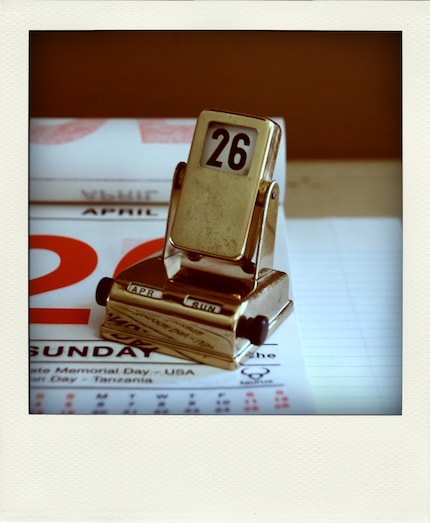
Down-sizing is a time-consuming though cathartic exercise. One gets lost in the endless photos, letters to or from friends, loved-ones now passed and old flames, pondering the whereabouts of old acquaintances whose address on a scrap of paper or business card has been used as a bookmark in a half-finished novel, or in ruminations upon mementos such the unusual brass desk calendar (something like this) with a fine 70-year old patina that turns to flip the two-sided cards within in order to change the prevailing day, (twice at the end of the month if it's a short one) ... one of the few tangible relics I possess from my grandfather, that made the cut on all prior moves, and will, again, this time. As I packed, I wondered of the origins and stories of these oddities and curios - the seemingly endless accumulated junk like the pair of E&Y mini-binoculars handed out at some function or another, never used, having consumed resources, the energy of asian labour, shippers diesel, the forwarders trans-shipments, multiple deliveries and manifests that brought it hither only to land (with one of it's siblings, no less) in a drawer, still-protected by its hermetical seal. Multiplied by five people, and untold drawers and shelves, now binomially at the crossroads between the increasingly pregnant rubbish bag, and membership in the growing tower of #42, #52, and #62 cartons, the exercise is arduous. Will the stuffed animals ever be re-cuddled, the re-match of "Clue", ever re-played, or the old cards and letters ever be re-read?!? Yet a few days later, with the boxes gone, I cannot tell you what became of most of them, such was the frenzy and blizzard of the removal. Now, I am profoundly unsettled. Not because of the impending move, but because I am not proud of the hoard. In fact, just the opposite. I am at once shocked and horrified by the obscenity of clothes, linen, PVC, toys, games, DVDs, CDs stuffed animals and all type of shiny, glazed colourful bric-a-brac that we human magpies collect (or, at least my family unit has collected). And yet, prior to this, I thought (or romantically imagined) we were parsimonious - at least compared to our peers. "Quality, not quantity". "No No No, you CANNOT have that - it's a waste...". The unending pleas to grandparents NOT to buy more junk. "Need little, want less", the wise catchphrase, over at Jesse's Cafe I hold out as a core value to demonstrate good non-acquisitive non-materialistic values. And yet, before me are boxes with too-many-multiples and sets of errrr ummm well, nearly everything, evidence I've failed in my attempts. Despite continual shedding of excess to friends, acquaintances, and the needy, the substantial purge of what will shortly be incinerated, and the sale of all the pedestrian furniture, devices that will not operate on 220v, what remains seems inconceivably vast, I feel empty, and ill as a result. I wish for that feeling when I first discovered DT Suzuki, identified with anicca and annata, and swore a now-broken oath that I'd never find myself where I presently am.

Analysing how this happened without my noticing, I begin to suspect that there is something allegorical in my predicament, both with respect to The Credit Bubble in general, and the erosion of America's fiscal position, and household balance sheets in particular. For just as I never set out with a plan to mindlessly consume and acquire, so too did America not consciously embark upon a credit-induced death-wish, nor the State and Her households conspire to burden themselves with untenably servicable quantities of debt. Incrementalism was the path. Manana, manana, manana was the mantra of denial that insured the difficult choice, the painful option, the road less travelled, was rarely contemplated let alone set out upon. Just as one doesn't become hugely obese by the pull of a rip-cord, the extension and multiplication of credit is not instanteously conjured. It is a slow-motion result cumulating from innumerable small decisions, each not life-threatening and reversible in themselves, but when conjoined, and embedded in feedback-loops, result in veritable disaster, be it fiscally, in one's waistline, or, in the accumulation of stuff. One's child desire's a brightly coloured plastic widget-thinger. One is tired, so one relents, makes the bargain with the devil and buys it - a respite from incessant demands, a bribe to keep the polity content. But intuitively, from wisdom and experience one knows it will rarely be played with thereafter, as are the multitudes of birthday presents, holiday gifts from family close and far. One knows the moment of weakness, far from currying favor or satiating demand, will only amplify it. One knows intuitively it's wrong and wasteful. But few are strong enough. Few people in the heat of that decisive moment - be it a mindless "toy" or an omnibus appropriations bill take into account cost vs. benefit analyses or an assessment of negative externalities. A plant, a book, a poem, a perennial bulb, a sketch, a charitable donation, all devalued in favor of PVC plastic bakelite injection molded synthetic rayon nylon stuff with imagination engagement values measured in the minutes or hours, but environmental half-lives measured in the centuries. Or deficit-spent consumption at the expense of investment. It is the same. How did we get here? Haven't more people noticed?

Does this stuff have value to anyone else? Would it find a market in its hovel of origin, outside of the salvage value from the materials from which is was constructed? Were they thinking of the gullible buyers, as I wonder about who made it? Decorative votive holders? Harvest motif napkin rings? Endless junk and clutter, some once useful, others never approached any reasonable utility. There is no secondary market value for most of it. Even the local charity ceased to accept clothes excepting those of a suitable pedigree. Beggars, it would seem, can, and are, choosy.

Now, I have shed [much of] my excess, filled my boxes, and sent them on their way in the container. Now, I am living in a minimalist purgatory for a couple of months until my [remaining] belongings arrive at their destination. I miss none of it. I feel liberated. If the container fell off of the ship, was waylaid by Somali pirates, or jack-knifed on the A7 enroute to delivery, I would shed no tears. I have my family, my health, a piano, some books, a trusty bicycle (which I've yet to figure out how to bring to its new home), and my running shoes. But this is potentially where the allegory stops. The last twelve months of de-leveraging at first glance, appeared to provide some strong introspective incentives. The upper boundary of aggregate credit appeared to have been reached, and the consequence of the mass-realization of this fact, combined with the cascading impact upon asset prices of system-wide reactions was too much to countenance. While I've satirically and bitterly mocked how we got there, as we were getting there, I do believe in the predicament at the moment, that stabilization of the patient was necessary. Just seven months ago, we had innumerable 'Ghost of Xmas Past' moments. "Never again" , "How could we have been so foolish?" "XYZ is the new normal", etc. Now, with asset prices on the mend, and feedback loop, well, feeding back in the prevailing direction, there is the belief that the worst is passed. Recovery is purportedly here (at least if viewed through the eyes of risk premia). Jimmy Stewart is already forgotten, as are the sleepless nights of what systemic obliteration might have meant. The promises of change and pleas of obedience to the deity of choice have been transgressed. Or at least so say the price action of the commodity complex and diversified inflation hedges.

This may true. But the crucial question, put most simply is: Has the denoument of the crisis passed, or is this merely the eye of the storm?? I am but an economist with a very small "e", however, as I wrote in favored post "If You Can't Tell Who The Sucker Is...", the question of what is likely to appear to be normal in hindsight is not (if this is The Big One as I believe it is) what is popularly perceived. "Peak Credit" has come and gone, and with it, the Era of Stupid Loans passed - for this generation anyway. In hindsight, we will wonder NOT why credit was crunched, but how the hallucinogenic wheat fungus that caused those with capital to, along with pixie dust conjured from it, to give it away to anyone and everyone who wanted it with such reckless abandon. So IF the era of Stupid Loans is finished, there will be no recovery. There will be precious little inflation, and it is likely deflation will persist.

I want to be bullish. I want asset prices to already be south of some long-term equilibrium, and be ready to rise. It would be less painful for The People. But with employment shocks still to ripple through the chain of dependencies, household balance sheets compromised, continued real-estate indigestion, our position between a fiscal rock & a hard place, and continued financial sector deleveraging, we collectively are the place that I've just been. We collectively are just beginning to sift through our shit - mentally sizing up what's important, what to take and what to leave. We are just beginning to realize that tough choices lie ahead - in all facets of life. We are just beginning to understand that these choices do not include 5-litre Cadillacs, absurdly over-applianced kitchens, or $5 iced-frappucino lattes. But, on the bight side - you won't miss most of it as much as you ex-ante believe you might...

Monday, June 15, 2009

Don't Break the Law When You're Breaking The Law

When I was in Aspen in April, Patrolman Joe sirened me to a stop as I came over the Bridge into town. "What's the rush Sir? - Is someone ill??" "Do you realize you were doing 37 in a 25 zone?" "Ummm ummm no sir, I KNOW it's a 25 in town and I crawl safely like everyone else there. I thought I'd slowed down. I didn't realize the zone began at the bridge... I have no excuse, as I was clearly guilty".

"License and registration Sir..." he demanded politely. "Are you going to be arrested?!? my son called from the back seat. My daughter had her head in her hands embarrassed by her groveling parent. My spouse gloating with "I told you so looks and tongue clicks". He ran my license. Didn't catch my outstanding offense from 1987 for non-payment of a non-applicable fine that I'd neglected to clean up. Back he came. "Now, IF I were going to give you a ticket it would be $140 and three points. Of course, you're not from here so I am sure you don't care about the points. All the same, it would be expensive. But, I can see you're well-intentioned, so I'm just going to give you a warning...Please drive safely in our town!

Two months later, they pulled over another hedgie (report here). Perhaps the arresting Officer was invested in the driver's Fund since since the offending Driver of the Green Land Rover was clearly not as lucky as your's truly. I still remember the sagely advice of a local villain where I grew up (obviously unheeded by the driver below): "Don't Break the Law When You're Breaking The Law..."

(hat-tip CB!!)

Wednesday, May 27, 2009

So Farewell Then...

So farewell
then
Pequot Capital
Management
Hedge
Fund.

You told
investors
you
channel-checked
more accurately
than
anyone...

...counted cars
in a
fab's lot
at 9pm
to stay ahead
of the
herd.

And you didn't
dispel flattering
rumours
your Wharton interns
were dumpster-diving.
on your
behalf.

But it seems
your research
edge was
less-than
salubriously
on the edge.

Quite aptly,
'Pequot'
translates as:
"Men of
the Swamp"

Perhaps there
is more
justice in
the second liquidation
of the Pequot
than in
the first.

(With apologies to PrivateEye and EJ Thribb and posthumous ackowledgement to Greg Newton)

Tuesday, May 26, 2009

Trojan Horse Becomes Trojan Rabbit

Porsche's perfect Trojan Horse corner and attempted takeover of VW is, according to Bloomberg (and others), rapidly in danger of becoming a less-perfectly concocted "Trojan Rabbit". Had Mr Wedeking perhaps spoken with the Hunt Brothers, they would have learned that getting the price up is only half of it (and the easy half). Cashing out in full, and banking the plunder, as the Hunt's would have told them, is a bit more tricky.

I must admit that I am actually a bit sad to see it come unravelled (not having had a short in VW) since there was brilliance in shafting may of the self-professed smartest guys in the world (?!?!?) by suckering them in with a trail of seemingly free bank notes, before giving them the P&L wedgie of their lives and hanging them-up in public view by their short and curlies. But it appears that The Street may have the last laugh.

Tuesday, May 19, 2009

Perfect Revelation

In my post, The Perfection of Quantitative Easing, I ruminated upon the linguistic perfection of the phrase, wondering aloud who might have conjured such a wonder. The answer has revealed itself in this kind note below that was too illuminating to leave buried in the comments section of the post...

Richard Werner said...
I believe I am the originator of the phrase 'Quantitative easing'. The original Japanese expression is 'ryoteki kinyu kanwa' or 'ryoteki kanwa' for short. Both are, literally translated, 'quantitative easing'. Thank you Cassandra for your most wonderful description of the English translation.

I used the expression prominently in my articles in the Japanese press in 1995, 1996, 1997, 1998 (Nikkei, Japanese Economist, Toyo Keizai, Japanese Newsweek, etc.) to suggest the necessary and sufficient policy response to end the recession (I had predicted the Japanese banking collapse in 1991; in print see Discussion Paper 129, Oxford Institute of Economics and Statistics). I had already argued then that interest rate reductions, even to zero, won't help. What was needed was to stimulate the economy through the quantity, not the price of money - correctly done. I wanted to avoid expressions such as the figurative 'printing money' and the common 'expanding the money supply', not only because they would unnecessarily alarm Japanese lay readers, but also because these are traditional monetarist prescriptions, which I argued would not work (as the monetarists argued for an expansion of bank reserves). At the time I was chief economist at Jardine Fleming Securities (Asia) Ltd. and Assistant Professor at Tokyo's Sophia University and known as the BoJ's fiercest critic. The Bank of Japan adopted my expression in 2001 as its official policy. The BoJ used exactly my Japanese phrase, and in its English-language press statement literally translated it.

However, and this is a predictable irony of central bank behaviour, they used it is a cover, because they did not adopt true quantitative easing, and instead implemented simple monetarist expansion of bank reserves. As I had predicted, this could not work. Next year Japan will basically be in its 20th year of recession. One further comment: In my English-language articles and interviews that I gave I used the expressions 'credit expansion', 'liquidity expansion' or 'credit creation' (the latter being the most accurate description) instead of 'ryoteki kanwa', as the audience in the financial markets would then understand me more or less correctly. Anyway, shame I'm not getting license fees each time a central bank talks about 'QE'.
Professor Richard A. Werner, D.Phil. (Oxon), Chair in International Banking, Director of the Center for Banking, Finance and Sustainable Development, School of Management, University of Southampton. werner@soton.ac.uk
9:00 AM, May 14, 2009

Monday, May 18, 2009

Time of Your Life

It's a contemplative self-proclaimed "No-Finance Monday". As such, I will encourage you to enjoy one of my fav's with me. It's quite an archetypical theme, so I would be surprised if it doesn't touch most people, at even just a little.

Monday, May 11, 2009

Financial Psalm 16

Financial Psalm 16

16:1 Preserve me, Gold, for in you do I take refuge.

16:2 My portfolio, you have saveth, and it sayeth: “You are my Saviour.

Apart from you, I have no good thing.”

16:3 As for the silver and oil which is in the earth,

they are also excellent ones in whom is my delight.

16:4 Their sorrows shall be multiplied who diversifyeth into other assets.

Their offerings of bonds I will not accept,

nor hold such paper on my lists.

16:5 Gold well-assayed is my preference and made-eth my cup. 

You made my lot secure.

16:6 Your prices have risen making pleasant our faces.

Yes, our offspring will have a good inheritance.

16:6.1 Beware the false prophet, paper gold, promising false profits.

16:7 Blessed be Chris Wood, who resembleth Jesus, and has given me wise counsel.

My heart instructs me to stay long during the right seasons.

16:8 I have set Gold always before other assets. Because It is is heavy in my right hand, and shall not be moved from its Swiss vault without  countersigned instructions.

16:9 Therefore my heart is glad, and my relative purchasing power rejoices.

My portfolio shall also dwelleth in safety so long as Bernanke ruleth.

16:10 For you, Gold will not leaveth my portfolio in Zimbabwe, or Weimar

neither will you allow my portfolio to become holey due to political corruption, or crony capitalism.

16:11 You, Gold, will show me the path of wealth preservation during times of inflationary woe and political uncertainty.

In your presence, I feel the joy of your security.

So that my hand can exchangeth you for pleasures forevermore.


(with apologies to Private Eye)


Reg FD: I am not a goldbug and still believe it has one more big puke before the rocket-ride (not the "gee, I printed a price and stayed there for 5 mins puke)

Wednesday, May 06, 2009

The People of Great Britain are Better Off Today...

The People (and Government) of Great Britain have, for the last century-and-a-half been notoriously tolerant. From Karl Marx to the Mad North London Mullah with a prosthetic hook, Abu Hamza, from Glenn Hoddle to Simon Cowell, they let a whole lot pass upon their shores that other people simply wouldn't countenance, (and if they did, certainly would not do so for as long). And true to my political orientation, I think Britain, and the British people are not the worse-off for their open-mindedness and forbearance. So I am reasonably certain that, if I were consistent, I rightly should feel Britain has suffered some meaningful loss over Home Secretary Smith's slapping an entry ban on Michael Wiener, a.k.a. Michael Savage.


Yet, I don't. Paradoxically, despite my predisposition towards free speech, and general tolerance of most weird, eccentric, iconoclastic, ludicrous, subversive, even lunatic ideas, I am quite confident that Britain is better without the inciting bigotry and facist, racist, homophobic, hyperbolic rantings of Mr Savage-Wiener. Mrs.Smith's solution was simple and clinical. Probably not optimal, but effective. And so in one small way, (FTSE short-squeeze andincreasing risk appetites asides) the people of Great Britain are better off today than they were but a few days ago, save the elimination of Mr Savage-Wiener 's entertainment-value of which they will now be deprived.

Sunday, May 03, 2009

Financial Gitmo

I am a survivor of the Japanese bear market. Twelve (or twenty - depending on your school of thought) long years of it. Call it "Financial Gitmo". The lessons of this incarceration were varied, and the experience invaluable - indelibly etched upon my brain for ease of retrieval when required in the future. Like now. One such lesson was that once the initial violent trauma of the market waterboarding dissipated, the mind-fucking treachery and psychologically-painful water-torture begins. Not unliike being forced to watch the same lame episode of "Kudlow & Cramer" or being subjected to a Mossad interrogation (at least according to recountings of the tens of thousands of Palestinians so graphically subjected).

Deeply oversold markets can rally for all manner of reasons: simple sellers' fatigue; government intervention, whether directly in markets (PKO anyone?) or indirectly through moral suasion, jawboning, or policy response, inciting the feedback loop to short-covering, which, causing higher prices fuels positive momentum and the optimism that the worst is maybe, possibly, hopefully over. The Strategist weatherwanes (like Abbey Cohen or Alex Kimmont) chortle which way the wind is blowing rather than where it will blow tomorrow. Professionals get squeezed-in to further penalize their (and their customer's) less than prescient capitulation at or near the prior lows. These episodes typically last longer than most bears can tolerate, both in time, though more acutely in P&L. They decry the move and point to fundamentals (and they are of course right, though it matters not). They conjure conspiracy and highlight manipulation (and may be right) but it gets no traction for the bullish side has more constituents than the bears. Their confidence wanes with their P&L, each higher intermediate-term low pushing them one step to closer to covering. The trend-followers have long-since bailed - even the longer-term programmes are turning bullish. Markets do, after-all, lead, don't they? Finally, like the interrogated, the short is broken and confession to anything and everything is achieved. And like a false confession, this capitulation is a hollow victory for the bulls and the market, since it is likely to be an intermediate-term top - NOT an early whistle-stop along the New Prosperity Line, particularly where The De-leveraging is The Big One.

So hearing Mobius, Cohen, and other pundits speak of bull-markets and greenshoots is predictable. But I reckon that Mssrs Schilling,and Roubini, will in time - once again - more likely be correct insofar as I believe continued recession and mild deflation will predominate longer than optimists (and inflationists)- and in particularly longs, can bear once the shorts have sufficiently covered and the intermediate term optimism rolls over with the continued bleak news flow. Then, the trend-followers will mechanically bail, and reverse positions, prescient programmes and specs, too, will re-establish their shorts, until finally the squeezed-in will, once again get squeezed-out, and those amongst us with weak constitutions will be forced to hide the pills and sharp objects to avoid .... tragedy.